
Creative Biolabs is offering the most comprehensive services for antibody development projects. With strict regulation and effective execution, we are dedicated to providing the most valuable solutions to complete your projects.
HighlightsCreative Biolabs is offering the most comprehensive services for antibody development projects. With strict regulation and effective execution, we are dedicated to providing the most valuable solutions to complete your projects.
HighlightsCreative Biolabs has established a broad range of platforms for developing novel antibodies or equivalents. These cutting-edge technologies enable our scientists to meet your demands from different aspects and tailor the most appropriate solution that contributes to the success of your projects.
HighlightsWith deep understanding in antibody-related realms and extensive project experience, Creative Biolabs offers a variety of references to help you learn more about our capacities and achievements, including infographic, flyer, case study, peer-reviewed publications, and all kinds of knowledge that can assist your projects. You are also welcome to contact us directly for more specific solutions.
HighlightsGet a real taste of Creative Biolabs, one of the most professional custom service providers in the world. We are committed to providing highly customized comprehensive solutions with the best quality to advance your projects.
Highlights Loading...
All listed services and products are For Research Use Only. Do Not use in any diagnostic or therapeutic applications.
Natriuretic peptide receptor 1 (NPR1, also named NPR-A) is a single-pass transmembrane guanylyl cyclase receptor encoded by NPR1 gene, highly expressed in cardiac myocytes, vascular smooth muscle and renal tubular epithelial cells, functioning as the primary high-affinity receptor for atrial natriuretic peptide (ANP) and B-type natriuretic peptide (BNP) secreted by cardiomyocytes in response to cardiac stretch and volume overload. The large extracellular ligand-binding domain selectively binds mature ANP/BNP peptide hormones, while the cytoplasmic region contains a kinase-homology regulatory domain and a C-terminal catalytic guanylyl cyclase domain that generates second messenger cGMP upon ligand-induced receptor homodimerization. Under physiological hemodynamic steady state, NPR1 activation triggers cGMP-dependent signaling cascades driving systemic vasodilation, renal sodium and water excretion, and suppression of cardiomyocyte hypertrophic transcriptional programs to lower blood pressure and reduce cardiac wall mechanical stress. Upon chronic hemodynamic overload, NPR1 membrane expression and catalytic activity are downregulated, blunting endogenous natriuretic protective signaling and exacerbating hypertensive cardiac hypertrophy and heart failure progression. Distinct from low-affinity NPR2/GC-B and clearance receptor NPR3, NPR1 uniquely couples natriuretic peptide ligand binding to intrinsic guanylyl cyclase cGMP production, representing the sole functional signaling receptor mediating systemic cardiovascular volume unloading with no redundant paralog able to compensate its hemoprotective activity. Loss-of-function NPR1 variants reduce circulating ANP/BNP responsiveness, elevate resting blood pressure and accelerate pathological cardiac remodeling, while sustained NPR1 activation mitigates pressure overload-induced myocardial hypertrophy, establishing NPR1 as a core research target for natriuretic receptor biology and cardiovascular therapeutic screening.
NPR1 executes core cardiovascular protective signaling function via ligand-triggered homodimerization at cell surface membranes: ANP or BNP binding to extracellular domains induces conformational rearrangement that releases autoinhibitory constraints within the cytoplasmic kinase homology region, enabling the C-terminal guanylyl cyclase domain to catalyze GTP conversion into cGMP second messengers. Intracellular cGMP activates downstream protein kinase G effectors that modulate ion channel activity, cytoskeletal contractility and nuclear hypertrophic transcription factor localization across cardiac, vascular and renal tissues. Conserved extracellular cysteine disulfide bonds stabilize the ligand binding pocket to maintain high ANP/BNP affinity under variable extracellular ionic conditions. NPR1-dependent cGMP signaling sustains balanced systemic hemodynamic homeostasis, covering controlled peripheral vasodilation and renal natriuresis to counteract volume overload and hypertensive cardiac damage. NPR1 participates in a broad spectrum of cardiovascular physiological processes including resting blood pressure maintenance, post-stress cardiac remodeling suppression and renal fluid-electrolyte balance regulation. Downregulated NPR1 signaling removes endogenous natriuretic protection and accelerates pathological myocardial hypertrophy and heart failure progression. Therefore, NPR1 represents a pivotal research target for transmembrane guanylyl cyclase receptor study and cardioprotective vasodilator compound discovery.
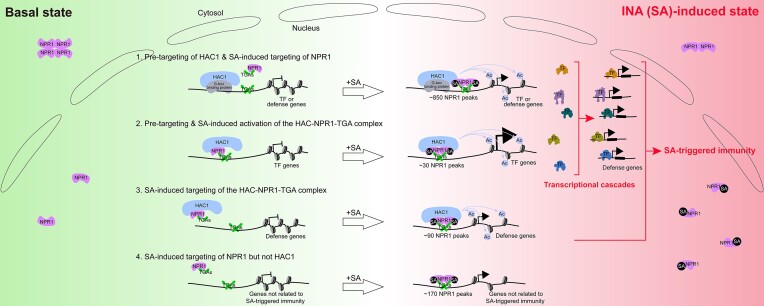 Fig. 1 Four distinct NPR1 recruitment patterns drive layered transcriptional cascades to activate salicylic acid‑dependent plant immune defense responses.1
The biological functions of NPR1 are focused on natriuretic peptide ligand recognition, intrinsic cGMP second messenger synthesis and hemodynamic stress protection:
Creative Biolabs offers high-quality NPR1 proteins through optimized expression systems, including full-length transmembrane receptor and isolated extracellular ligand-binding / cytoplasmic cyclase domain variants. These products retain native conformational characteristics and ANP/BNP binding guanylyl cyclase catalytic biological activity, suitable for natriuretic receptor-ligand interaction assays and cardioprotective cardiovascular compound screening. All NPR1 proteins undergo strict quality control to ensure consistent performance and reliable application across diverse research platforms.
Not finding the membrane protein product you need? Contact us to start your one-stop custom service!
Creative Biolabs provides custom-engineered NPR1 stable cell lines, including wild-type and cyclase-dead mutant control models. These cell lines are optimized for ANP/BNP cGMP signaling profiling and cardiac hypertrophic remodeling functional analysis. Each cell line undergoes stringent validation to ensure stable expression profiles and consistent functional performance in diverse experimental contexts.
Not finding the stable cell line product you need? Contact us to start your one-stop custom service!
High-specificity recombinant antibodies targeting NPR1 are developed via advanced antibody engineering technologies, with no cross-reactivity with NPR2 and NPR3 natriuretic receptor paralogs. These antibodies are validated for cardiac myocyte and vascular smooth muscle membrane localization detection and hypertensive cardiac tissue expression profiling, and can be combined with ANP/BNP detection reagents to quantify complete hormone-receptor signaling complexes in cardiovascular research models.
Not finding the recombinant antibody product you need? Contact us to start your one-stop custom service!
Beyond catalog products, Creative Biolabs offers specialized custom services for NPR1 research:
NPR1/NPR-A is a transmembrane guanylyl cyclase receptor that binds ANP/BNP to produce cGMP, driving vasodilation, natriuresis and suppression of pathological cardiac hypertrophy.
NPR1 mediates the body's primary endogenous anti-hypertensive and cardioprotective pathway, serving as a key target for heart failure and hypertension therapeutic development.
No, all NPR1 products and services are strictly for research use only, not intended for clinical diagnosis or treatment.
Offerings include full-length NPR1 membrane receptor proteins, isoform-specific detection antibodies and custom stable cell lines for cardiovascular natriuretic signaling research.
NPR1 proteins are validated via ANP ligand binding and ligand-stimulated cGMP guanylyl cyclase catalytic functional testing.








