
Creative Biolabs is offering the most comprehensive services for antibody development projects. With strict regulation and effective execution, we are dedicated to providing the most valuable solutions to complete your projects.
HighlightsCreative Biolabs is offering the most comprehensive services for antibody development projects. With strict regulation and effective execution, we are dedicated to providing the most valuable solutions to complete your projects.
HighlightsCreative Biolabs has established a broad range of platforms for developing novel antibodies or equivalents. These cutting-edge technologies enable our scientists to meet your demands from different aspects and tailor the most appropriate solution that contributes to the success of your projects.
HighlightsWith deep understanding in antibody-related realms and extensive project experience, Creative Biolabs offers a variety of references to help you learn more about our capacities and achievements, including infographic, flyer, case study, peer-reviewed publications, and all kinds of knowledge that can assist your projects. You are also welcome to contact us directly for more specific solutions.
HighlightsGet a real taste of Creative Biolabs, one of the most professional custom service providers in the world. We are committed to providing highly customized comprehensive solutions with the best quality to advance your projects.
Highlights Loading...
All listed services and products are For Research Use Only. Do Not use in any diagnostic or therapeutic applications.
Neuropilin-1 (NRP1), encoded by the NRP1 gene located on chromosome 10p11.22, is a 130-140 kDa type I transmembrane glycoprotein that belongs to the neuropilin family. The extracellular region of NRP1 is composed of five distinct subdomains: two N-terminal CUB domains (a1 and a2), two coagulation factor V/VIII homology domains (b1 and b2), and a MAM (meprin, A5 antigen, receptor tyrosine phosphatase μ) domain (c domain). The a1/a2 CUB domains mediate binding to class 3 semaphorins such as SEMA3A, while the b1 domain contains the primary binding site for VEGF-A and other C-end Rule (CendR) ligands; the MAM domain is important for receptor homodimerization and heterodimerization with plexin family members. NRP1 has a relatively short cytoplasmic domain of approximately 40 amino acids that contains an intrinsically disordered region (IDR); recent studies have shown that this IDR interacts with multiple binding partners including GIPC-1 and SNX-5, and that phosphorylation within this region modulates these interactions. NRP1 is expressed in multiple tissues including the developing heart, vasculature, lung, kidney, placenta, and epidermis, and is found on endothelial cells, neurons, immune cells, and tumor cells.
NRP1 functions as a non-catalytic transmembrane co-receptor that binds structurally diverse ligands and modulates signaling through multiple pathways. NRP1 serves as a co-receptor for vascular endothelial growth factor receptor 2 (VEGFR2), enhancing the binding of the VEGF165 isoform of VEGFA to VEGFR2 and promoting VEGF165-mediated chemotaxis. Through this mechanism, NRP1 plays a critical role in steering VEGFA-induced endothelial cell responses toward angiogenesis. NRP1 also binds class 3 semaphorins—most notably SEMA3A—which are regulators of neuronal guidance. Semaphorin signaling through NRP1 requires complex formation with plexin family members, mediating chemorepulsive axon guidance and contributing to vascular patterning. Beyond its well-established roles in vascular development and axon guidance, NRP1 has been identified as an immunoregulatory receptor that enhances the suppressive function of regulatory T cells (Tregs). NRP1 expression on T cells has been shown to confer enhanced immunosuppressive activity, and NRP1 has also been reported to interact with TGF-β signaling pathways. These properties make NRP1 an important research target for studies of angiogenesis, axon guidance, immune regulation, and the molecular mechanisms underlying receptor co-receptor signaling networks.
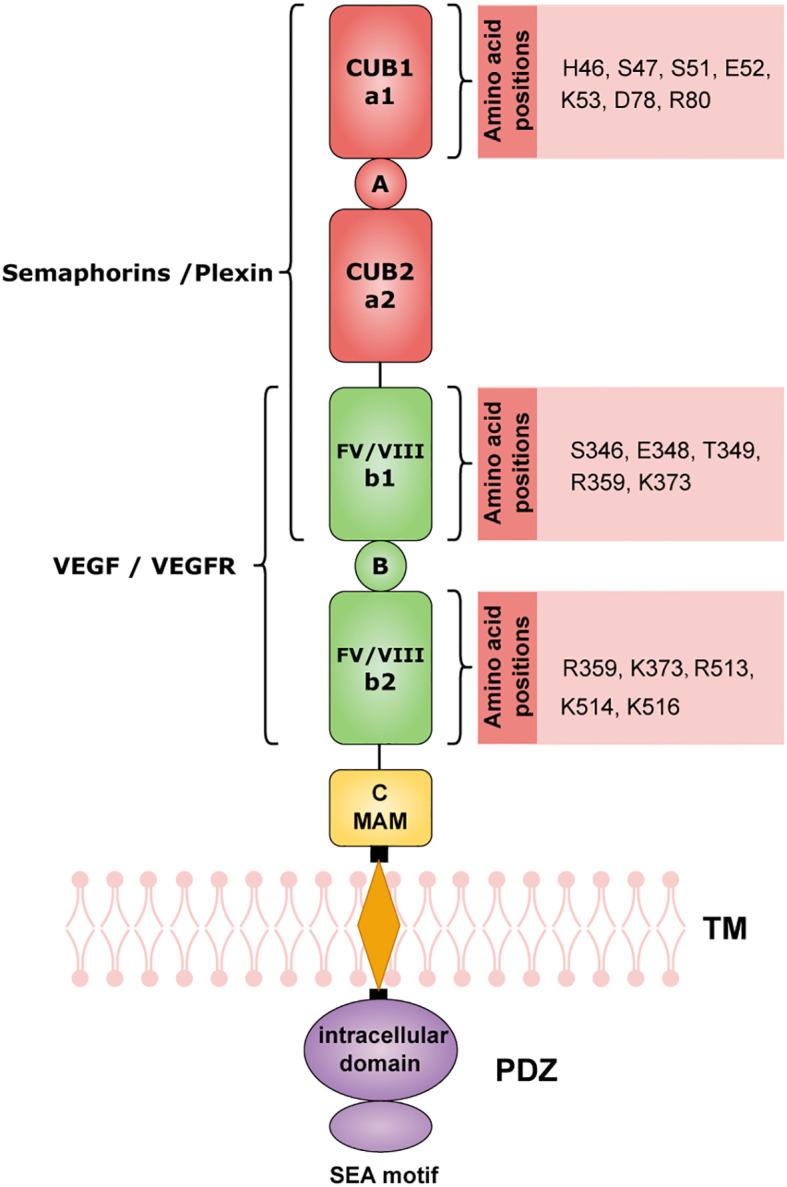 Fig. 1 The core structure of NRP1.1
NRP1, encoded by the NRP1 gene, functions as a multifunctional transmembrane co-receptor that binds diverse ligands and modulates signaling through multiple pathways:
Creative Biolabs offers high-quality NRP1 membrane protein products produced using optimized expression systems. These include full-length type I transmembrane protein that retains the native membrane-spanning domain and cytoplasmic intrinsically disordered region, as well as isolated extracellular domain variants containing the CUB domains, coagulation factor homology domains, and MAM domain. The extracellular domains mediate ligand binding to VEGF and semaphorin family members as well as receptor complex formation, making these proteins suitable for studies of ligand-receptor interactions, co-receptor signaling, and protein complex assembly. All NRP1 proteins undergo strict quality control to support consistent performance across applicable research platforms.
Not finding the protein product you need? Contact us to start your one-stop custom service!
Creative Biolabs provides custom-engineered NRP1 stable cell lines, including overexpression and knockdown models. These cell lines are optimized for studies of VEGF signaling, semaphorin-mediated axon guidance, immune cell regulation, and receptor co-receptor complex formation. Each cell line undergoes stringent validation to ensure stable expression profiles and consistent functional performance in diverse experimental contexts.
Not finding the stable cell line product you need? Contact us to start your one-stop custom service!
High-specificity recombinant antibodies targeting NRP1 are developed using antibody engineering technologies for research applications involving NRP1 expression and localization. These antibodies can be used in studies of NRP1 distribution in endothelial cells, neurons, and immune cell populations, and may also support characterization of NRP1-containing receptor complexes in combination with appropriate detection reagents.
Not finding the recombinant antibody product you need? Contact us to start your one-stop custom service!
Beyond catalog products, Creative Biolabs offers specialized custom services for NRP1 research:








