Creative Biolabs is offering the most comprehensive services for antibody development projects. With strict regulation and effective execution, we are dedicated to providing the most valuable solutions to complete your projects.
HighlightsCreative Biolabs is offering the most comprehensive services for antibody development projects. With strict regulation and effective execution, we are dedicated to providing the most valuable solutions to complete your projects.
HighlightsCreative Biolabs has established a broad range of platforms for developing novel antibodies or equivalents. These cutting-edge technologies enable our scientists to meet your demands from different aspects and tailor the most appropriate solution that contributes to the success of your projects.
HighlightsWith deep understanding in antibody-related realms and extensive project experience, Creative Biolabs offers a variety of references to help you learn more about our capacities and achievements, including infographic, flyer, case study, peer-reviewed publications, and all kinds of knowledge that can assist your projects. You are also welcome to contact us directly for more specific solutions.
HighlightsGet a real taste of Creative Biolabs, one of the most professional custom service providers in the world. We are committed to providing highly customized comprehensive solutions with the best quality to advance your projects.
Highlights Loading...
All listed services and products are For Research Use Only. Do Not use in any diagnostic or therapeutic applications.
Neurotrophic receptor tyrosine kinase 1 (NTRK1) which is also referred to as tropomyosin receptor kinase A (TrkA), is approximately 140 kDa member of the family of trkreceptor Tyr kinasesthat are characterized by their abilityto bind with and activate different forms. It has an LRR motif in the extracellular region and is flanked by two clusters of cysteines, followed by two tandem immunoglobulin-like domains (IgC1 and IgC2) that together provide a high-affinity binding interface for nerve growth factor (NGF). The ATP-binding pocket and catalytic residues necessary for autophosphorylation and propagation of downstream signaling reside within the intracellular kinase domain. NTRK1 is mainly limited to neuronal tissues under physiological conditions, where it mediates the survival, differentiation and axonal growth of NGF-dependent sensory and sympathetic neurons. Ligand binding induces receptor homodimerization, trans-autophosphorylation of key tyrosine residues as well recruiting adapter proteins including Shc Grb2 and PLCγ. These interactions trigger the canonical RAS/MAPK, PI3K/AKT, and PLCγ-mediated PKC signaling cascades that together control neuronal differentiation/development (neurogenesis), synaptic plasticity leading to cognitive functions related to training paradigms such as memory retention or conditioned responses after reward-based learning in mice under behavior analyses testing for retaliation/counter-defense mechanisms producing nociception. The precision of this signaling axis is critical for normal peripheral nervous system development and homeostasis.
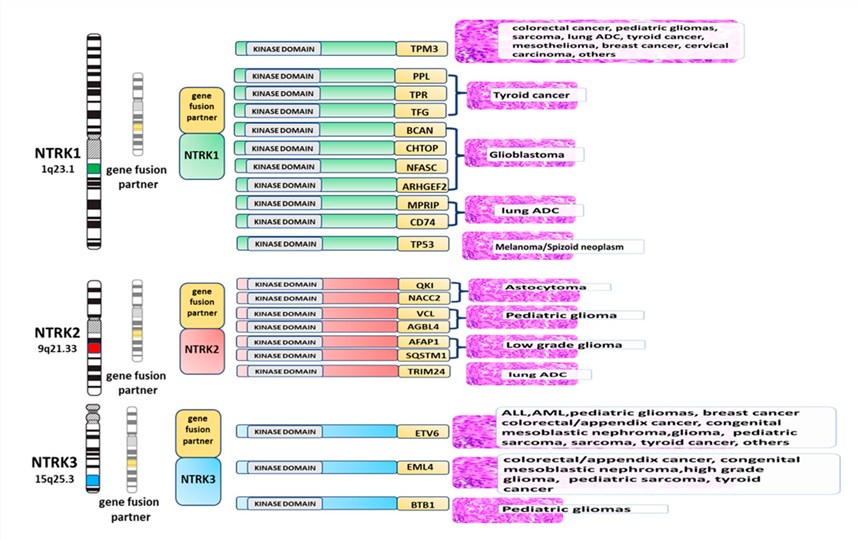 Fig.1 NTRK gene fusions in cancers.1
The biological relevance of NTRK1 encompasses development, neurobiology and malignancy:
Advance your neurobiology and disease-related research with our recombinant NTRK1 membrane protein products. The multi-domain extracellular architecture, transmembrane topology, and kinase-dependent conformational dynamics of NTRK1 present distinct considerations for protein production and experimental design. We provide wild-type and engineered NTRK1 research constructs suitable for a range of applications, including structural studies, NGF-binding research, antibody development and characterization, and investigation of receptor kinase function and inhibition. Available species, fusion constructs, sequence variants, expression formats, and functional characteristics should be determined according to the corresponding product information and supporting data.
Not finding the membrane protein product you need? Contact us to start your one-stop custom service!
Reproducible and reliable cellular models are essential to dissect NTRK1-driven biology and assess drug candidates. Stable cell lines expressing either wild-type or oncogenic alleles of human, mouse and rat NTRK1 (available from our B2B Biorepository) with concomitant modulation of endogenous expression for loss-of-function experiments. These platforms maximise throughput for TRK inhibitor screening, downstream phosphorylation assays, neurite outgrowth quantification and fusion protein internalisation studies to provide the key experimental reproducibility necessary in multi-step projects.
Not finding the stable cell line product you need? Contact us to start your one-stop custom service!
We have developed a high-affinity recombinant antibody portfolio targeting NTRK1 that is optimized for challenging research applications. These antibodies engineered in accordance with use of advanced recombinant technologies provide greater specificity, sensitivity and consistency from batch to batch than polyclonal (traditional) antibodies. Validated for use in WB, ELISA, FCM, IF/ICC/IHC/IP Our NTRK1 recombinant antibodies can detect & quantify your target proteins in neuronal lysis buffers as well as human tumor biopsy and transfected membranes.
Not finding the recombinant antibody product you need? Contact us to start your one-stop custom service!
In addition to products in our catalog, we also provide tailored custom services for membrane protein and antibody discovery and development:
Yes, we reported stable lines expressing both full-length NTRK1 and SHC1 from distinct loci constitutively. Batches are accompanied by characterization of NGF-stimulated neurite outgrowth and downstream ERK phosphorylation that allows ongoing mechanistic investigations without the need to repeat transient transfection.
Yes, the protein is prepared in a defined buffer free of amines and endotoxin that maintains physiological pH leading to conservation of its native immunoglobulin-like fold.
No all NTRK1 products & services are for Research use only, and are not intended for clinical diagnosis, prevention, treatment, or cure of any disease.
Absolutely. Cells engineered by our team typically include tetracycline-inducible systems, along with lines co-expressing NTRK1 and TPM3 or LMNA combinations or truncated reporter constructs to facilitate a thorough pathway analysis. We look forward to having a more detailed conversation about the expression architecture and phenotypic criteria you are looking for.