
Creative Biolabs is offering the most comprehensive services for antibody development projects. With strict regulation and effective execution, we are dedicated to providing the most valuable solutions to complete your projects.
HighlightsCreative Biolabs is offering the most comprehensive services for antibody development projects. With strict regulation and effective execution, we are dedicated to providing the most valuable solutions to complete your projects.
HighlightsCreative Biolabs has established a broad range of platforms for developing novel antibodies or equivalents. These cutting-edge technologies enable our scientists to meet your demands from different aspects and tailor the most appropriate solution that contributes to the success of your projects.
HighlightsWith deep understanding in antibody-related realms and extensive project experience, Creative Biolabs offers a variety of references to help you learn more about our capacities and achievements, including infographic, flyer, case study, peer-reviewed publications, and all kinds of knowledge that can assist your projects. You are also welcome to contact us directly for more specific solutions.
HighlightsGet a real taste of Creative Biolabs, one of the most professional custom service providers in the world. We are committed to providing highly customized comprehensive solutions with the best quality to advance your projects.
Highlights Loading...
All listed services and products are For Research Use Only. Do Not use in any diagnostic or therapeutic applications.
Otoferlin (OTOF) is a large multi-C2 domain transmembrane synaptic protein encoded by the OTOF gene, selectively expressed in cochlear inner hair cell ribbon synapses and peripheral vestibular sensory neurons, with six conserved calcium-binding C2 structural modules distributed along its cytoplasmic segment. Distinct from canonical synaptotagmin calcium sensors found in general central neurons, OTOF is the exclusive primary calcium transducer specialized for auditory ribbon synapse signal transmission and lacks functionally redundant homologous substitutes within the inner ear sensory network. In the normal physiological hearing process, acoustic stimulation leads to depolarization of hair cell membrane, and then induces calcium influx; At this time, OTOF protein can accurately identify and bind calcium ions, start the anchoring, docking and glutamate transmitter release process of synaptic vesicles in an orderly manner, and stably convert mechanical acoustic signals into afferent nerve signals and transmit them to spiral ganglion neurons, so as to complete the normal transmission of auditory signals. Mutation of hereditary OTOF function loss will seriously destroy the neurotransmitter release function of auditory hair cells and induce autosomal recessive hereditary auditory neuropathy pedigree disorder; However, the slight down-regulation of the gene expression level will also accelerate the age-related cochlear synaptic degeneration and cause vestibular balance dysfunction. Because other synaptophysin can't compensate OTOF's unique sensory-specific calcium sensing and vesicle regulation functions, this protein has become an irreplaceable core research target in the fields of synaptic physiological mechanism of inner ear, pathogenesis of hereditary deafness and screening of new ear protection drugs.
OTOF executes calcium-dependent synaptic vesicle priming and fusion function anchored to the presynaptic plasma membrane of auditory hair cells, relying on tandem C2 domains to coordinate intracellular calcium binding and vesicle membrane lipid interaction. Its calcium recognition pocket structural features are uniquely adapted to the high calcium microenvironment of ribbon synapses, distinguishing its functional mechanism from ordinary neuronal synaptotagmin family proteins. OTOF-mediated vesicle exocytosis bridges mechanical auditory vibration stimulation and downstream afferent nerve electrical signaling, balancing the sensitivity of sound signal transmission across low, medium and high frequency auditory ranges. OTOF participates in the formation and stable operation of cochlear ribbon synapses as well as vestibular afferent sensory signal transmission. Defective or absent OTOF expression completely blocks sound-evoked glutamate secretion and abolishes normal auditory signal conduction. Therefore, OTOF represents a pivotal research target for auditory neuroscience and hereditary hearing loss therapeutic exploration.
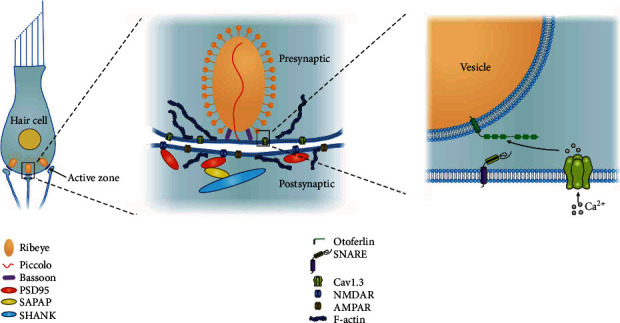 Fig. 1 Hierarchical schematic of cochlear inner hair cell ribbon synapse highlighting Otoferlin as the calcium sensor mediating synaptic vesicle exocytosis.1
The biological functions of OTOF are focused on calcium-dependent synaptic vesicle docking and glutamate exocytosis:
Creative Biolabs offers high-quality OTOF proteins through optimized eukaryotic expression systems, including full-length transmembrane protein and isolated C2 domain variants. These products retain native calcium-binding and vesicle-interacting activity, suitable for hair cell synapse interaction assays and hearing disorder compound screening. All OTOF proteins undergo strict quality control to ensure consistent performance and reliable application across diverse research platforms.
Not finding the membrane protein product you need? Contact us to start your one-stop custom service!
Creative Biolabs provides custom-engineered OTOF stable cell lines, including overexpression and blank control models. These cell lines are optimized for hair cell synaptic protein profiling and calcium-triggered vesicle functional analysis. Each cell line undergoes stringent validation to ensure stable expression profiles and consistent functional performance in diverse experimental contexts.
Not finding the stable cell line product you need? Contact us to start your one-stop custom service!
High-specificity recombinant antibodies targeting OTOF are developed via advanced antibody engineering technologies, with no cross-reactivity with synaptotagmin family proteins. These antibodies are validated for cochlear hair cell presynaptic localization detection and inner ear tissue profiling, and can be combined with synaptic vesicle markers to analyze ribbon synapse complexes in sensory cell models.
Not finding the recombinant antibody product you need? Contact us to start your one-stop custom service!
Beyond catalog products, Creative Biolabs offers specialized custom services for OTOF research:
OTOF is a multi-C2 calcium sensor localized at hair cell ribbon synapses, which mediates calcium-dependent synaptic vesicle fusion and auditory neurotransmitter release.
Pathogenic OTOF mutations are the leading genetic cause of congenital auditory neuropathy, critical for deafness mechanism and gene therapy research.
No, all OTOF products and services are strictly for research use only, not intended for clinical diagnosis or treatment.
Offerings include full-length OTOF proteins, isoform-specific detection antibodies and custom stable cell lines for inner ear synaptic research.
OTOF proteins are validated via calcium and synaptic vesicle co-binding functional testing.








