
Creative Biolabs is offering the most comprehensive services for antibody development projects. With strict regulation and effective execution, we are dedicated to providing the most valuable solutions to complete your projects.
HighlightsCreative Biolabs is offering the most comprehensive services for antibody development projects. With strict regulation and effective execution, we are dedicated to providing the most valuable solutions to complete your projects.
HighlightsCreative Biolabs has established a broad range of platforms for developing novel antibodies or equivalents. These cutting-edge technologies enable our scientists to meet your demands from different aspects and tailor the most appropriate solution that contributes to the success of your projects.
HighlightsWith deep understanding in antibody-related realms and extensive project experience, Creative Biolabs offers a variety of references to help you learn more about our capacities and achievements, including infographic, flyer, case study, peer-reviewed publications, and all kinds of knowledge that can assist your projects. You are also welcome to contact us directly for more specific solutions.
HighlightsGet a real taste of Creative Biolabs, one of the most professional custom service providers in the world. We are committed to providing highly customized comprehensive solutions with the best quality to advance your projects.
Highlights Loading...
All listed services and products are For Research Use Only. Do Not use in any diagnostic or therapeutic applications.
Phosphoprotein membrane anchor with glycosphingolipid microdomains 1 (PAG1), encoded by the PAG1 gene on chromosome 8q21.13 and also known as Csk-binding protein (Cbp), is a type III transmembrane adaptor protein localized to glycosphingolipid-enriched membrane microdomains (GEMs), also known as lipid rafts. The PAG1 gene spans approximately 144 kb and contains 19 exons, encoding a 432-amino-acid protein. Structurally, PAG1 comprises a short 16-amino-acid extracellular domain, a 20-amino-acid transmembrane domain, a putative palmitoylation site, and an unusually long 397-amino-acid cytoplasmic tail containing 9 potential tyrosine phosphorylation sites, multiple casein kinase II and protein kinase C phosphorylation sites, and 2 proline-rich sequences that may bind to SH3 domains. Of the 10 tyrosines in PAG1, 6 are associated with ITAM-like motifs. The 70 kDa PAG1 protein shifts to an approximately 85 kDa phosphoprotein after cell stimulation. PAG1 is expressed nearly ubiquitously, with highest levels in the immune system, lung, heart, and placenta, and is detected in peripheral blood lymphocytes and monocytes. At the subcellular level, PAG1 is predominantly localized to the plasma membrane, with nearly all of the protein present in GEMs.
PAG1 functions as a negative regulator of Src family kinase (SFK) signaling through its ability to recruit the C-terminal Src kinase (Csk) to lipid rafts. PAG1 binds CSK through its Tyr317 residue, independently of FYN, and this interaction increases the signaling threshold required for initiating an immune response, helping to maintain lymphocytes in a resting state. Following T-cell activation, PAG1 is dephosphorylated and its association with CSK markedly decreases. Through this mechanism, PAG1 negatively regulates T-cell antigen receptor (TCR)-mediated signaling in T-cells and FCER1 (high-affinity immunoglobulin epsilon receptor)-mediated signaling in mast cells. PAG1 is also involved in the spatial regulation of c-Src kinase: sequestration of activated c-Src into lipid rafts via PAG1 efficiently suppresses c-Src-induced cell transformation in Csk-deficient cells. Studies have further shown that PAG1 modulates SFK activity in brain maturation and that it functions as a tumor suppressor in neuroblastoma by inhibiting c-Src and downstream effector pathways. Additionally, an allergy risk allele on chromosome 8q21 increases PAG1 transcription by activating a poised enhancer located 732 kb from the gene promoter, linking PAG1 to immune regulation. These properties make PAG1 an important research target for studies of lipid raft signaling, Src family kinase regulation, immune cell activation thresholds, and transmembrane adaptor protein biology.
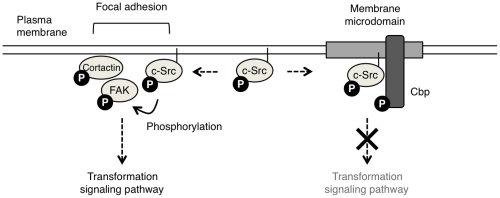 Fig. 1 Proposed hypothesis for the spatial control of c-Src phosphorylation.1
PAG1, encoded by the PAG1 gene, functions as a lipid raft-anchored transmembrane adaptor protein that negatively regulates Src family kinase signaling:
Creative Biolabs offers high-quality PAG1 membrane protein products produced using optimized expression systems. These include full-length type III transmembrane protein that retains the native short extracellular domain, transmembrane helix, and extended cytoplasmic tail, as well as isolated cytoplasmic domain variants containing the tyrosine phosphorylation sites and proline-rich sequences. The cytoplasmic domain mediates CSK recruitment and SH2 domain binding, making these proteins suitable for studies of lipid raft signaling, Csk recruitment, and transmembrane adaptor protein interaction characterization. All PAG1 proteins undergo strict quality control to support consistent performance across applicable research platforms.
Not finding the protein product you need? Contact us to start your one-stop custom service!
Creative Biolabs provides custom-engineered PAG1 stable cell lines, including overexpression and knockdown models. These cell lines are optimized for studies of lipid raft signaling, Csk recruitment, Src family kinase regulation, and immune cell activation thresholds. Each cell line undergoes stringent validation to ensure stable expression profiles and consistent functional performance in diverse experimental contexts.
Not finding the stable cell line product you need? Contact us to start your one-stop custom service!
High-specificity recombinant antibodies targeting PAG1 are developed using antibody engineering techniques for research applications involving PAG1 expression and localization. These antibodies can be used in studies of PAG1 distribution in lipid raft fractions and immune cell populations and may also support characterization of PAG1-containing signaling complexes in combination with appropriate detection reagents.
Not finding the recombinant antibody product you need? Contact us to start your one-stop custom service!
Beyond catalog products, Creative Biolabs offers specialized custom services for PAG1 research:
PAG1 is a type III transmembrane adaptor protein localized to lipid rafts that recruits Csk to the plasma membrane, negatively regulating Src family kinase signaling and maintaining lymphocytes in a resting state.
PAG1 is a key negative regulator of Src family kinase signaling and immune cell activation. It functions as a tumor suppressor in neuroblastoma and is associated with allergy risk, making it important for studies of lipid raft signaling, immune regulation, and transmembrane adaptor protein biology.
No, all PAG1 products and services are strictly for research use only, not intended for clinical diagnosis or treatment.
Offerings include full-length PAG1 membrane proteins, cytoplasmic domain variants, specific detection antibodies, and custom stable cell lines for lipid raft signaling and immune regulation research.
PAG1 proteins are validated via Csk binding assays, protein-protein interaction assays, and relevant functional characterization in applicable research platforms.









