Creative Biolabs is offering the most comprehensive services for antibody development projects. With strict regulation and effective execution, we are dedicated to providing the most valuable solutions to complete your projects.
HighlightsCreative Biolabs is offering the most comprehensive services for antibody development projects. With strict regulation and effective execution, we are dedicated to providing the most valuable solutions to complete your projects.
HighlightsCreative Biolabs has established a broad range of platforms for developing novel antibodies or equivalents. These cutting-edge technologies enable our scientists to meet your demands from different aspects and tailor the most appropriate solution that contributes to the success of your projects.
HighlightsWith deep understanding in antibody-related realms and extensive project experience, Creative Biolabs offers a variety of references to help you learn more about our capacities and achievements, including infographic, flyer, case study, peer-reviewed publications, and all kinds of knowledge that can assist your projects. You are also welcome to contact us directly for more specific solutions.
HighlightsGet a real taste of Creative Biolabs, one of the most professional custom service providers in the world. We are committed to providing highly customized comprehensive solutions with the best quality to advance your projects.
Highlights Loading...
All listed services and products are For Research Use Only. Do Not use in any diagnostic or therapeutic applications.
Protocadherin related 15 (PCDH15) is a single pass transmembrane protocadherin encoded by PCDH15 gene. This protein localizes to specialized stereociliary membrane subdomains of sensory hair cells, where it contributes to tip-link formation and mechanotransduction. PCDH15 contains multiple extracellular cadherin like repeat modules, one transmembrane helix and a relatively long intracellular cytoplasmic segment. Extracellular cadherin like repeats project into the extracellular space and carry calcium coordination sites within each repeated unit. Multiple transcript isoforms exist which differ in cytoplasmic segment sequences, generated from alternative transcript processing. Newly synthesized PCDH15 polypeptide undergoes folding inside endoplasmic reticulum compartments before trafficking toward specific plasma membrane subdomains. Only properly folded molecules can accumulate at specialized stereociliary sites. Expression profile of PCDH15 shows high cell type selectivity and protein abundance matches formation requirements for specialized mechanosensory structures. Different isoforms exhibit distinct distribution patterns, adding further diversity to molecular interaction capacity in different cell contexts.
Extracellular cadherin like repeats of PCDH15 mediate calcium dependent intermolecular contacts with CDH23 across tip links connecting adjacent stereocilia. Calcium ion coordination stabilizes conformation of extracellular repeat modules and supports stable intermolecular engagement. Intracellular cytoplasmic isoform variable segments can recruit distinct sets of cytoplasmic adaptor molecules to assemble sub membrane molecular complexes. These assembled complexes contribute to coupling PCDH15 with the mechanotransduction apparatus and intracellular cytoskeleton elements. Other cadherin superfamily members cannot fully reproduce the specialized PCDH15-CDH23 interaction required for tip-link organization. Changes in PCDH15 surface abundance or isoform usage may alter tip-link organization and mechanotransduction-associated complexes. Sequence disruption within extracellular repeats impairs PCDH15-CDH23 intermolecular contact capacity, while alteration of cytoplasmic isoform specific sequences changes the spectrum of recruited intracellular binding partners. Varied isoform abundance may reshape the range of mechanotransduction- and cytoskeleton-associated binding partners available at stereociliary sites.
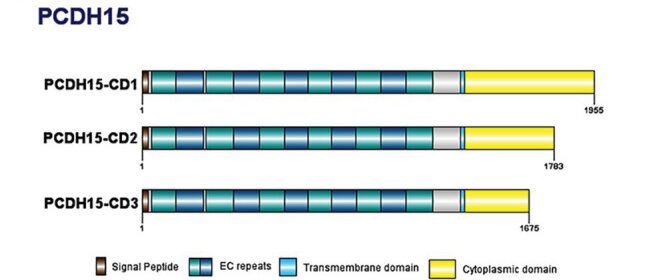 Fig. 1 Domain topology of major PCDH15 isoforms. Extracellular cadherin‑like repeats support calcium‑dependent intermolecular contacts; isoforms carry distinct cytoplasmic segments for differential adaptor‑protein recruitment.1
The biological functions of PCDH15 are focused on calcium dependent PCDH15-CDH23 tip link formation, isoform dependent cytoplasmic adaptor recruitment and mechanotransduction site molecular scaffolding:
Creative Biolabs offers purified PCDH15 membrane samples via standardized preparation workflows, including full length PCDH15 constructs and isolated extracellular structural variants. Isolated extracellular fragments may not support complete calcium dependent tip link interaction and isoform specific cytoplasmic complex recruitment related behaviours, while full length constructs may be suited for PCDH15-CDH23 tip link and mechanotransduction associated research. All samples receive routine quality screening, and functional relevant observation may only be carried out with full length samples under simulated membrane environments. All sample batches follow unified processing standards to maintain consistent structural features for comparative laboratory analysis across separate test groups.
Not finding the membrane protein product you need? Contact us to start your one-stop custom service!
Creative Biolabs provides adjustable PCDH15 expression cell models with varied expression levels, applicable to transmembrane protocadherin structural characteristic observation and tip link and mechanotransduction related research. Sample evaluation includes sustained target expression detection and preliminary intermolecular interaction associated observation, which can support comparative analysis of mechanotransduction associated behaviours under different expression statuses. These cell systems can be matched with diverse laboratory analysis schemes to observe changes of tip link associated intermolecular interaction under different target expression abundances.
Not finding the stable cell line product you need? Contact us to start your one-stop custom service!
Antibody reagents targeting PCDH15 are generated via mature protein preparation workflows, compatible with multiple routine laboratory detection methods for cellular localization profiling and molecular complex identification, to support systematic analysis of PCDH15 distribution and protocadherin associated molecular complexes across diverse laboratory research setups. The antibody series can cooperate with other common laboratory detection reagents to complete multi dimensional observation of target distribution inside tissue samples.
Not finding the recombinant antibody product you need? Contact us to start your one-stop custom service!
Beyond catalog products, Creative Biolabs offers specialized custom services for PCDH15 research:
PCDH15 may function as transmembrane protocadherin and participate in calcium dependent PCDH15-CDH23 tip link formation, mechanotransduction and isoform dependent intracellular adaptor complex assembly.
PCDH15 expression and isoform status may influence tip link organization and mechanotransduction associated complexes, supporting mechanosensory signal transduction research.
No, all PCDH15 related products and services are strictly for research use only, not intended for clinical related operations. All material designs and functional tests are only optimized for basic laboratory research scenarios, without matching clinical application standards.
Offerings include full length PCDH15 membrane protein, target specific recombinant antibodies and adjustable expression cell research models, supporting tip link formation and mechanotransduction research.
Laboratory observation schemes may include protocadherin mediated calcium dependent intermolecular contact tests to analyse molecule associated behaviours under simulated cellular environments.