Creative Biolabs is offering the most comprehensive services for antibody development projects. With strict regulation and effective execution, we are dedicated to providing the most valuable solutions to complete your projects.
HighlightsCreative Biolabs is offering the most comprehensive services for antibody development projects. With strict regulation and effective execution, we are dedicated to providing the most valuable solutions to complete your projects.
HighlightsCreative Biolabs has established a broad range of platforms for developing novel antibodies or equivalents. These cutting-edge technologies enable our scientists to meet your demands from different aspects and tailor the most appropriate solution that contributes to the success of your projects.
HighlightsWith deep understanding in antibody-related realms and extensive project experience, Creative Biolabs offers a variety of references to help you learn more about our capacities and achievements, including infographic, flyer, case study, peer-reviewed publications, and all kinds of knowledge that can assist your projects. You are also welcome to contact us directly for more specific solutions.
HighlightsGet a real taste of Creative Biolabs, one of the most professional custom service providers in the world. We are committed to providing highly customized comprehensive solutions with the best quality to advance your projects.
Highlights Loading...
All listed services and products are For Research Use Only. Do Not use in any diagnostic or therapeutic applications.
Phosphatidylinositol glycan anchor biosynthesis class L (PIGL) is an endoplasmic reticulum luminal metallophosphodiesterase encoded by the PIGL gene, belonging to the GPI biosynthetic enzyme family and serving as the core mediator of early glycolipid precursor trimming during cellular glypiation. PIGL carries conserved metal-binding catalytic domains and is widely and constitutively expressed in nearly all nucleated cell types that synthesize GPI-linked surface antigens, acting as an indispensable checkpoint enzyme that modifies immature GPI intermediates before covalent protein attachment. PIGL-dependent dephosphorylation represents an irreversible mandatory step in the glypiation cascade, without which no GPI anchor can be assembled and transported to plasma membranes for glycoprotein display.
PIGL exerts its full catalytic function through metal ion-dependent phosphodiester hydrolysis targeting ethanolamine phosphate residues on nascent GPI glycolipid scaffolds, a specific biochemical reaction that reshapes lipid conformation to permit recognition by downstream transamidase complexes. Unlike other sequential GPI biosynthetic enzymes that act at later reaction stages, PIGL-mediated trimming cannot be compensated by any other cellular hydrolase; incomplete removal of phosphate moieties disrupts substrate binding between glycolipids and precursor polypeptides, uncoupling ER lipid biosynthesis from the formation of functional cell surface glycoproteins. This dual regulatory mechanism balances overall cellular glypiation efficiency under normal physiological conditions, while loss-of-function PIGL mutations fully block GPI biogenesis and eliminate all membrane-anchored immune markers. PIGL participates in diverse biological events including embryonic differentiation signaling, hematopoietic antigen expression and inherited glypiation disorders. Defective PIGL catalytic activity leads to multi-system developmental abnormalities and impaired immune cell function, making PIGL a pivotal research target for glycobiology and GPI biosynthesis mechanistic study.
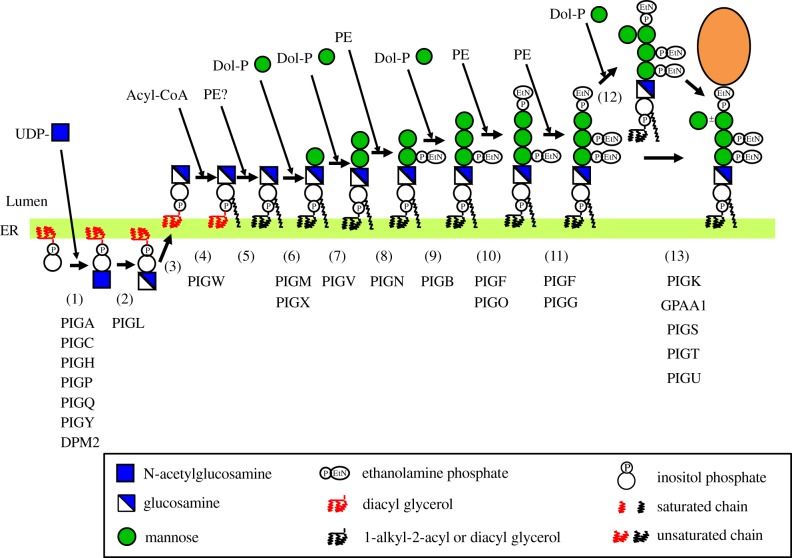 Fig. 1 Stepwise ER biosynthetic pathway of mammalian GPI anchors; PIGL catalyzes the mandatory second deacetylation step to convert GlcNAc-PI to GlcN-PI, which is a prerequisite for all subsequent glycan modification and protein transamidation reactions.1
The biological functions of PIGL are focused on metal-dependent phosphodiesterase catalysis and immature glycolipid structural remodeling:
Creative Biolabs offers high-quality PIGL proteins through optimized heterologous expression systems, including full-length wild-type enzyme and catalytic domain truncated variants with customized metal-binding pocket structural characteristics. These products retain native metallophosphodiesterase catalytic activity and specific GPI glycolipid substrate recognition capacity, suitable for GPI biosynthetic pathway research, enzyme-substrate interaction detection and glypiation regulatory small molecule screening workflows. All PIGL batches undergo strict quality control to ensure consistent performance and reliable application across diverse glycobiology research platforms.
Not finding the membrane protein product you need? Contact us to start your one-stop custom service!
Creative Biolabs provides custom-engineered PIGL stable cell lines, including overexpressing and knockdown research models. These cell lines are optimized for investigating GPI precursor maturation mechanisms and glypiation pathway regulatory small molecule potency testing. Each cell line undergoes stringent validation to ensure stable target expression profiles and consistent catalytic functional performance in diverse experimental contexts.
Not finding the stable cell line product you need? Contact us to start your one-stop custom service!
High-specificity recombinant antibodies targeting PIGL are developed via advanced antibody engineering technologies, with no cross-reactivity with other ER glycan-processing enzymes. These antibodies are validated for multiple applications, including endoplasmic reticulum immunofluorescence localization detection, Western blot expression quantification and co-immunoprecipitation analysis of GPI biosynthetic enzyme complexes, enabling precise characterization of PIGL expression levels and intracellular subcellular distribution under physiological and pathological conditions.
Not finding the recombinant antibody product you need? Contact us to start your one-stop custom service!
Beyond catalog products, Creative Biolabs offers specialized custom services for PIGL research:
PIGL is an ER-resident metallophosphodiesterase regulatory enzyme that hydrolyzes ethanolamine phosphate on immature GPI glycolipids, fine-tunes cellular glypiation maturation dynamics, and enables stable covalent anchoring of cell surface glycoproteins.
PIGL catalyzes an obligatory irreversible early step of GPI biosynthesis, and its loss-of-function mutations trigger multi-system congenital glypiation disorders. It is a critical core research target for glycobiology and glycan metabolic mechanism exploration.
No, all PIGL products and services are strictly for research use only, not intended for clinical diagnosis or treatment.
Offerings include full-length and truncated PIGL catalytic proteins, high-specificity recombinant antibodies, and custom stable glypiation reporter cell lines, supporting comprehensive GPI biosynthesis research projects.
PIGL proteins are validated by in vitro GPI precursor phosphodiester hydrolysis assays to retain native glypiation regulatory catalytic function.