
Creative Biolabs is offering the most comprehensive services for antibody development projects. With strict regulation and effective execution, we are dedicated to providing the most valuable solutions to complete your projects.
HighlightsCreative Biolabs is offering the most comprehensive services for antibody development projects. With strict regulation and effective execution, we are dedicated to providing the most valuable solutions to complete your projects.
HighlightsCreative Biolabs has established a broad range of platforms for developing novel antibodies or equivalents. These cutting-edge technologies enable our scientists to meet your demands from different aspects and tailor the most appropriate solution that contributes to the success of your projects.
HighlightsWith deep understanding in antibody-related realms and extensive project experience, Creative Biolabs offers a variety of references to help you learn more about our capacities and achievements, including infographic, flyer, case study, peer-reviewed publications, and all kinds of knowledge that can assist your projects. You are also welcome to contact us directly for more specific solutions.
HighlightsGet a real taste of Creative Biolabs, one of the most professional custom service providers in the world. We are committed to providing highly customized comprehensive solutions with the best quality to advance your projects.
Highlights Loading...
All listed services and products are For Research Use Only. Do Not use in any diagnostic or therapeutic applications.
PLD3 is a polypeptide belonging to the phospholipase D protein family encoded by the PLD3 gene. It is synthesized as a type II transmembrane protein and undergoes proteolytic processing during trafficking to the endolysosomal system, generating a soluble catalytic form in the lysosomal lumen. PLD3 has established 5′-to-3′ exonuclease activity toward single-stranded DNA and RNA under acidic conditions. Conserved HKD motifs contribute to its catalytic site. PLD3 can be detected across multiple tissue types and its abundance varies under distinct cellular contexts. Proper folding, proteolytic processing, lysosomal localization, and substrate availability influence its nucleic-acid degradation activity (Reference 2).
PLD3-mediated nucleic-acid degradation contributes to lysosomal substrate processing. Variation in PLD3 expression level alters the pool of enzyme available in this compartment. Residue alteration within the catalytic site can impair exonuclease activity, while changes affecting processing or localization can alter access to nucleic-acid substrates. PLD3 should not be assumed to reproduce the classical phosphatidylcholine-hydrolyzing activity of PLD1 or PLD2. Separately, direct biochemical and cellular evidence has demonstrated PLD3-dependent synthesis of S,S-bis(monoacylglycero)phosphate (S,S-BMP), a lysosomal phospholipid; this is a distinct lipid-related activity, not evidence that all PLD-family members share the same substrate reaction (Reference 3).
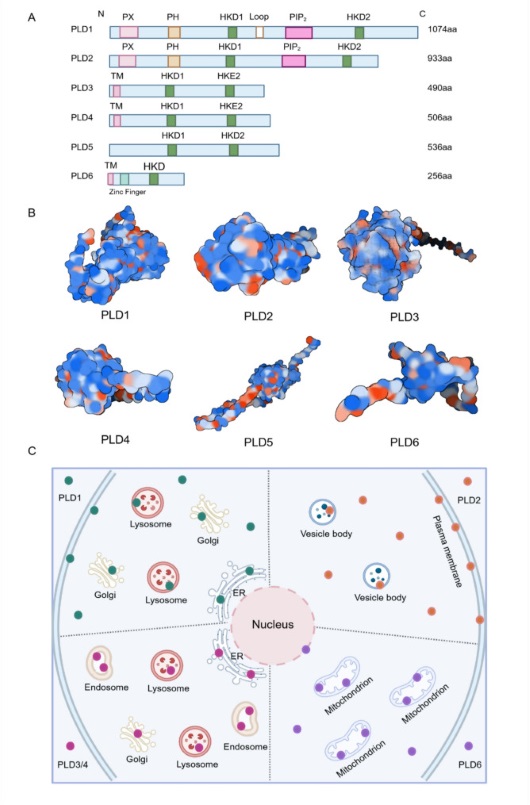 Fig. 1 Overview of domain architecture, 3D structures and subcellular localization of PLD family. PLD3 is a type II transmembrane protein with N terminal transmembrane helix and luminal conserved HKD motifs, localizing to ER, Golgi, endosome and lysosome membranes.1
The established exonuclease functions of PLD3 are focused on nucleic-acid substrate processing within lysosomes:
Creative Biolabs offers purified PLD3 protein samples via standardized preparation workflows, including full length PLD3 constructs and isolated individual domain variants. Full-length constructs may support processing and localization studies, whereas appropriately designed mature catalytic forms may support exonuclease and nucleic-acid degradation assays. All samples receive routine quality screening. Nuclease assays require suitable nucleic-acid substrates and acidic reaction conditions; activity must be established for the specific preparation rather than inferred from PLD-family membership. All sample batches follow unified processing standards to support comparative laboratory analysis across separate test groups. Suitability for a specific assay depends on construct design and experimental validation.
Not finding the potein product you need? Contact us to start your one-stop custom service!
Creative Biolabs provides adjustable PLD3 expression cell models with varied expression levels, applicable to lysosome associated protein characteristic observation and nucleic-acid degradation related research. Sample evaluation includes sustained target expression detection and preliminary intermolecular interaction associated observation, which can support comparative analysis of polypeptide associated behaviours under different expression statuses. These cell systems can be matched with diverse laboratory analysis schemes to observe changes of substrate engagement efficiency under different target expression abundances.
Not finding the stable cell line product you need? Contact us to start your one-stop custom service!
Antibody reagents targeting PLD3 are generated via mature protein preparation workflows, compatible with multiple routine laboratory detection methods for cellular localization profiling and molecular complex identification, to support systematic analysis of PLD3 distribution and endolysosomal molecular complexes across diverse laboratory research setups. The antibody series can cooperate with other common laboratory detection reagents to complete multi dimensional observation of target distribution inside tissue samples.
Not finding the recombinant antibody product you need? Contact us to start your one-stop custom service!
Beyond catalog products, Creative Biolabs offers specialized custom services for PLD3 research:
PLD3 has established lysosomal 5′-to-3′ exonuclease activity toward single-stranded DNA and RNA. Its processed luminal form is studied in nucleic-acid degradation, while separately demonstrated S,S-BMP synthesis should be distinguished from classical PLD1/PLD2 phospholipid hydrolysis.
PLD3 expression status may influence available polypeptide pool for nucleic-acid substrate processing, serving as a regulatory mediator of lysosomal nucleic-acid turnover.
No, all PLD3 related products and services are strictly for research use only, not intended for clinical related operations. All material designs and functional tests are only optimized for basic laboratory research scenarios, without matching clinical application standards.
Offerings include full length PLD3 protein, target specific recombinant antibodies and adjustable expression cell research models, supporting PLD3 exonuclease and lysosomal localization research.
These reagents are suited for research focused on PLD3 driven molecular events, including conserved scaffold function, nucleic-acid substrate binding and endolysosomal nucleic-acid processing related mechanistic studies under laboratory research only settings.









