
Creative Biolabs is offering the most comprehensive services for antibody development projects. With strict regulation and effective execution, we are dedicated to providing the most valuable solutions to complete your projects.
HighlightsCreative Biolabs is offering the most comprehensive services for antibody development projects. With strict regulation and effective execution, we are dedicated to providing the most valuable solutions to complete your projects.
HighlightsCreative Biolabs has established a broad range of platforms for developing novel antibodies or equivalents. These cutting-edge technologies enable our scientists to meet your demands from different aspects and tailor the most appropriate solution that contributes to the success of your projects.
HighlightsWith deep understanding in antibody-related realms and extensive project experience, Creative Biolabs offers a variety of references to help you learn more about our capacities and achievements, including infographic, flyer, case study, peer-reviewed publications, and all kinds of knowledge that can assist your projects. You are also welcome to contact us directly for more specific solutions.
HighlightsGet a real taste of Creative Biolabs, one of the most professional custom service providers in the world. We are committed to providing highly customized comprehensive solutions with the best quality to advance your projects.
Highlights Loading...
All listed services and products are For Research Use Only. Do Not use in any diagnostic or therapeutic applications.
Proteolipid protein 1 (PLP1; also known as lipophilin or myelin proteolipid protein) is the most abundant protein component of central nervous system (CNS) myelin, consisting in over 50% of total myelin protein. PLP1 consists of both N- and C-termini facing the cytoplasm, adopting a tetraspan topology of four transmembrane α-helices which designates it as a highly hydrophobic integral membrane protein. This arrangement establishes PLP1 as an architectural element of the compact myelin sheath, where it serves to mediate and stabilize interlayers lining the apposed extracellular membrane surfaces within a myelin lamella. Palmitoylation or palmitic acid modification of PLP1 occurs transitorily on six of its cysteine residues that serves as an autocatalytic post-translational modification to retain the protein within the lipid bilayer while supporting correct integration into other tightly packed compact myelin regions. Notably, PLP1 is close to 100% conserved in mammals, illustrating its cetal role among all vertebrate neurobiology. In the CNS, expression is largely limited to oligodendrocytes where DM20 is the primary isoform during early embryonic development and myelination. In addition to its structural function, PLP1 plays a role in integrin-mediated signaling, axonal support pathways and oligodendrocyte maturation programs. Mutations, duplications and deletions of the PLP1 gene on the X chromosome cause the severe hypomyelinating leukodystrophy Pelizaeus-Merzbacher disease (PMD) and milder allelic spastic paraplegia type 2 (SPG2), which makes PLP1 a major target for therapeutic development in inherited myelin disorders.
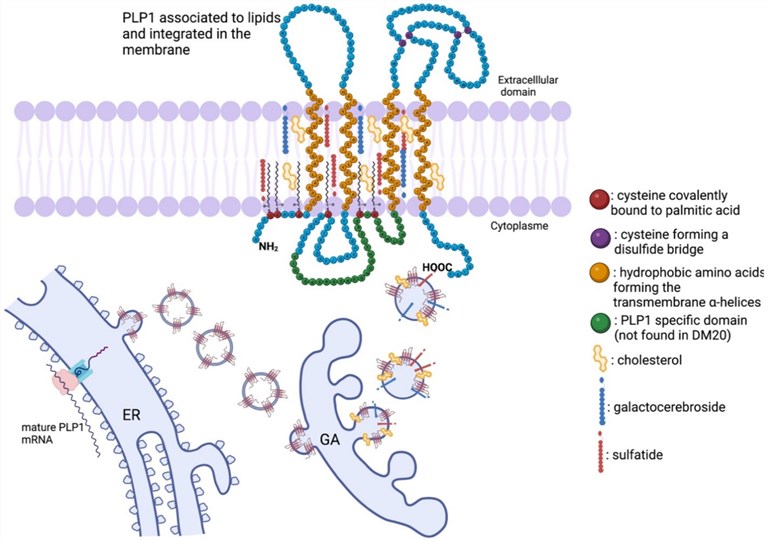 Fig. 1 The physiological state of PLP1 formation: from mRNA to a functional transmembrane protein.1
The role of PLP1 goes far beyond a passive structural scaffold as it also participates actively in various cellular processes involved in CNS homeostasis:
Creative Biolabs provides a range of high-quality PLP1 membrane protein products to support structural and functional research on this highly hydrophobic transmembrane protein. Using our membrane protein platform, we provide PLP1 constructs and preparations suitable for different experimental requirements. These products can support structural studies, antibody production and characterization, binding research, and investigations of PLP1 membrane localization, trafficking, and myelin-related biology. Available construct formats, expression systems, species, post-translational modification status, and functional characteristics should be determined according to the corresponding product information and supporting data.
Not finding the membrane protein product you need? Contact us to start your one-stop custom service!
PLP1 research requires the development of robust cellular models. Creative Biolabs's stable cell lines are the best for either a drug screening, ligand binding studies, ER stress response assays, myelin compaction modeling or high-throughput screening providing stable and reproducible platform to PLP1 biology and pharmacology. We guarantee highest level of expression and cellular integrity so as to supercharge your research pipeline. The available PLP1-overexpressing lines (for study of myelin protein trafficking and ER stress mechanisms) can be utilized for gain-of-function studies, whereas the PLP1-knockdown lines offer a tool to analyze loss-of-function investigations; expression was confirmed by flow cytometry, Western blotting, and functional membrane integration assays. In this work, we generated reporter cell lines underpinned by ER stress sensors to monitor cellular stress caused by mutant PLP1 as a means to provide tools for screening therapeutics in models of leukodystrophy.
Not finding the stable cell line product you need? Contact us to start your one-stop custom service!
Creative Biolabs has developed recombinant antibodies to PLP1 for a range of research applications. These antibodies are generated using recombinant technologies that support sequence-defined and consistent reagent production. Depending on the specific antibody and supporting datasheet, selected PLP1 recombinant antibodies may be suitable or available for applications such as Western Blotting (WB), ELISA, Flow Cytometry (FCM), Immunofluorescence (IF), Immunocytochemistry (ICC), Immunohistochemistry (IHC), and Immunoprecipitation (IP), supporting the detection and analysis of PLP1 in appropriate research samples such as cell lysates and research tissue sections. Isoform specificity, including the ability to distinguish PLP1 from DM20, as well as recognition of post-translationally modified forms, should be determined according to clone-specific validation data.
Not finding the recombinant antibody product you need? Contact us to start your one-stop custom service!
With years of experience and best-in-class platforms, we can support you with:
Yes, our custom protein engineering services also allows full-spectrum PMD-associated mutations and their combinations, including but not limited to duplication models and deletion constructs. We can produce these mutant proteins in diverse formats, allowing for structural studies, interaction mapping and target screenings.
No, all Creative Biolabs PLP1 products and services are strictly for research use only and are not intended for clinical diagnosis, prevention, treatment, or cure of any disease.
Yes, we have isoform-selective antibodies which target the unique peptide sequence within the cytoplasmic loop that is only present in PLP1 but not DM20. As a result, these clones provide robust, isoform-specific signal by western blot and immunofluorescence while being non-cross reactive with the DM20 counterpart enabling high-resolution deconvolution of developmental isoform switching in fixed cells or tissue sections without need for RNA extraction or sequencing.
We provide a full suite of products consisting of recombinant PLP1 membrane proteins in soluble (VLPs, detergent-solubilized, nanodisc-embedded), stable cell lines expressing wild-type and PMD-mutant PLP1 variants, high-affinity recombinant PLP1 antibodies with isoform specificity, and fully custom protein engineering & antibody discovery capabilities. These can include rodent and other mammalian species products for mouse, rat, etc.








