
Creative Biolabs is offering the most comprehensive services for antibody development projects. With strict regulation and effective execution, we are dedicated to providing the most valuable solutions to complete your projects.
HighlightsCreative Biolabs is offering the most comprehensive services for antibody development projects. With strict regulation and effective execution, we are dedicated to providing the most valuable solutions to complete your projects.
HighlightsCreative Biolabs has established a broad range of platforms for developing novel antibodies or equivalents. These cutting-edge technologies enable our scientists to meet your demands from different aspects and tailor the most appropriate solution that contributes to the success of your projects.
HighlightsWith deep understanding in antibody-related realms and extensive project experience, Creative Biolabs offers a variety of references to help you learn more about our capacities and achievements, including infographic, flyer, case study, peer-reviewed publications, and all kinds of knowledge that can assist your projects. You are also welcome to contact us directly for more specific solutions.
HighlightsGet a real taste of Creative Biolabs, one of the most professional custom service providers in the world. We are committed to providing highly customized comprehensive solutions with the best quality to advance your projects.
Highlights Loading...
All listed services and products are For Research Use Only. Do Not use in any diagnostic or therapeutic applications.
Phospholipid phosphatase 3 (PLPP3), also known as LPP3, PAP2b, or PPAP2B, is encoded by the PLPP3 gene on chromosome 1p32.2. The PLPP3 gene contains six exons and produces a membrane glycoprotein of the phosphatidic acid phosphatase (PAP) family. PLPP3 is a cell surface enzyme localized to the plasma membrane, where it dephosphorylates extracellular lipid phosphates including lysophosphatidic acid (LPA), sphingosine-1-phosphate (S1P), phosphatidic acid (PA), and ceramide-1-phosphate. The PLPP3 protein contains six transmembrane helices and an extracellular domain with two extracellular loops. Transmembrane helices 1–4 form a hydrophobic cleft that holds the lipid tails of the substrate, while the extracellular domain forms a positively charged pocket that accommodates the polar head group. PLPP3 exists as a tetrameric assembly, and the catalytic site is formed by three conserved phosphatase motifs (C1, C2, and C3), which include conserved catalytic histidine residues; Zn²⁺ binding is not established as a required catalytic cofactor and may instead inhibit activity. PLPP3 is broadly expressed, with high levels in thyroid, placenta, and other tissues.
PLPP3 functions as a lipid phosphate phosphatase that regulates the availability and signaling of bioactive lipid phosphates. By dephosphorylating extracellular LPA and S1P, PLPP3 terminates their receptor-mediated signaling, thereby modulating cell proliferation, migration, angiogenesis, inflammation, and immunity. Loss of Plpp3 expression in endothelial and hematopoietic cells enhances intimal hyperplasia and vascular inflammation, indicating that PLPP3 serves as a negative regulator of endothelial permeability and vascular inflammation. In the context of atherosclerosis, low PLPP3 expression in plaques increases the local accumulation of specific LPA species and is associated with more severe disease, supporting an atheroprotective role for the enzyme. Genome-wide association studies have identified PLPP3 loci that associate with coronary artery disease risk independently of traditional risk factors, linking this lipid phosphatase to cardiovascular disease susceptibility. In melanoma, structural mapping of somatic mutations combined with functional analysis has revealed that PLPP3 acts as a tumor suppressor.
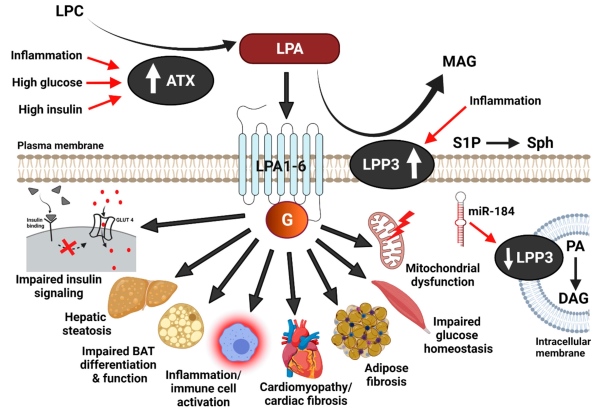 Fig. 1 Metabolic effects of the ATX-LPA-LPP3 axis.1
PLPP3, encoded by the PLPP3 gene, functions as a cell surface lipid phosphate phosphatase that regulates bioactive lipid signaling and vascular homeostasis:
Creative Biolabs offers high-quality PLPP3 membrane protein products produced using optimized expression systems. These include full-length multi-pass transmembrane protein that retains the native six-transmembrane helix architecture and extracellular catalytic domain, as well as isolated extracellular fragments for structural or binding research, where available. The extracellular domain contains the conserved catalytic site with three signature phosphatase motifs, with phosphatase activity studies requiring an intact, appropriately folded membrane-enzyme construct or a validated reconstitution system. All PLPP3 proteins undergo strict quality control to support consistent performance across applicable research platforms.
Not finding the protein product you need? Contact us to start your one-stop custom service!
Creative Biolabs provides custom-engineered PLPP3 stable cell lines, including overexpression and knockdown models. These cell lines are optimized for studies of lipid phosphate metabolism, LPA/S1P signaling, vascular inflammation, and PLPP3-associated cancer mechanisms. Each cell line undergoes stringent validation to ensure stable expression profiles and consistent functional performance in diverse experimental contexts.
Not finding the stable cell line product you need? Contact us to start your one-stop custom service!
High-specificity recombinant antibodies targeting PLPP3 are developed using antibody engineering techniques for research applications involving PLPP3 expression and localization. These antibodies can be used in studies of PLPP3 distribution in vascular tissues and other cell types and may also support characterization of PLPP3-containing membrane complexes in combination with appropriate detection reagents.
Not finding the recombinant antibody product you need? Contact us to start your one-stop custom service!
Beyond catalog products, Creative Biolabs offers specialized custom services for PLPP3 research:
PLPP3 is a cell surface lipid phosphate phosphatase that dephosphorylates extracellular LPA, S1P, PA, and ceramide-1-phosphate, terminating their signaling and regulating vascular homeostasis.
PLPP3 regulates bioactive lipid signaling linked to atherosclerosis and coronary artery disease, and acts as a tumor suppressor in melanoma. It is important for studies of lipid phosphate metabolism, vascular inflammation, and cancer biology.
No, all PLPP3 products and services are strictly for research use only, not intended for clinical diagnosis or treatment.
Offerings include full-length PLPP3 membrane proteins, extracellular domain variants, specific detection antibodies, and custom stable cell lines for lipid signaling and vascular biology research.
PLPP3 proteins may support research on lipid phosphate dephosphorylation and substrate binding, depending on protein format and experimental context.









