Creative Biolabs is offering the most comprehensive services for antibody development projects. With strict regulation and effective execution, we are dedicated to providing the most valuable solutions to complete your projects.
HighlightsCreative Biolabs is offering the most comprehensive services for antibody development projects. With strict regulation and effective execution, we are dedicated to providing the most valuable solutions to complete your projects.
HighlightsCreative Biolabs has established a broad range of platforms for developing novel antibodies or equivalents. These cutting-edge technologies enable our scientists to meet your demands from different aspects and tailor the most appropriate solution that contributes to the success of your projects.
HighlightsWith deep understanding in antibody-related realms and extensive project experience, Creative Biolabs offers a variety of references to help you learn more about our capacities and achievements, including infographic, flyer, case study, peer-reviewed publications, and all kinds of knowledge that can assist your projects. You are also welcome to contact us directly for more specific solutions.
HighlightsGet a real taste of Creative Biolabs, one of the most professional custom service providers in the world. We are committed to providing highly customized comprehensive solutions with the best quality to advance your projects.
Highlights Loading...
All listed services and products are For Research Use Only. Do Not use in any diagnostic or therapeutic applications.
Plasmalemma vesicle associated protein, commonly abbreviated as PLVAP, with another identifier PV-1, is a type II transmembrane glycoprotein with a molecular weight of approximately 50 kDa. This protein is not produced by any random cell in the body; it only appears in two specific types of vascular endothelial cells — fenestrated endothelial cells, and liver sinusoidal endothelial cells. It is the core structural component that forms diaphragms, which span over the openings of tiny channels such as caveolae and fenestrae on the cell surface, linking these open pores to form a structural barrier. It does not function as a single molecule: first, two identical PLVAP molecules assemble into a homodimer, and it can further bind more molecules of the same type to form more complex multimers, ultimately constructing a dynamically adjustable sieve that helps blood vessels control the passage of macromolecules, hormones, metabolites and other substances across the vascular wall. In a healthy physiological state, PLVAP is responsible for maintaining the selective permeability of blood vessels in three key locations — the ability to only allow eligible substances to pass through while blocking substances that should not leak out freely: first, the glomerulus in the kidney, second, the microvessels in endocrine organs, and third, the sinusoidal blood vessels in the bone marrow. All these sites rely on its sieve function to maintain normal operation. When specific diseases develop, its expression level changes significantly — the conditions mentioned in the original text include nephrotic syndrome, diabetic kidney disease, vascular lesions in solid tumors, and neuroinflammatory disorders. Once PLVAP expression malfunctions, the vascular barrier it originally constructs breaks down, proteins that should remain in the blood vessels leak out into the extravascular space, and tissue edema is triggered. It is precisely these unique properties of PLVAP that are closely related to vascular function that make it a highly promising target in fields including protein engineering, research and development of vascular-targeted therapeutic drugs, and vascular barrier repair research.
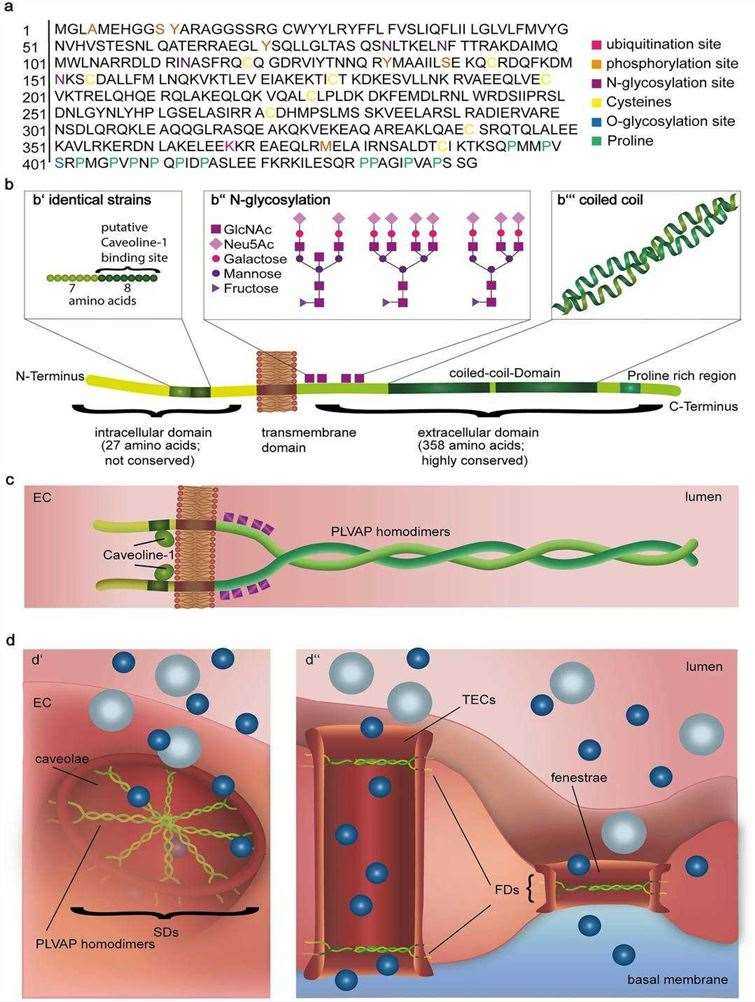 Fig.1 The molecular structure of PLVAP and its arrangement within diaphragms.1
The physiological processes that PLVAP participates in extend far beyond its structural role as an ordinary transmembrane protein:
We hold a proprietary collection of PLVAP proteins that is unique on the market, which includes both full-length intact PLVAP and mutant PLVAP, and can help you solve all difficulties encountered in studying the biochemical properties of this diaphragm-forming transmembrane protein. PLVAP itself is a transmembrane protein present on endothelial cells. It must polymerize into oligomers while maintaining the integrity of its extracellular domain; these two are the core of its ability to assemble diaphragms and exert barrier functions, and it cannot function properly without either. The expression system we use to produce these proteins integrates several cutting-edge technologies that can support the needs of the vast majority of experimental designs. Every batch of the prepared proteins has undergone comprehensive quality testing, so they can be directly used in your experiments immediately upon receipt, with reliable stability.
Not finding the membrane protein product you need? Contact us to start your one-stop custom service!
To advance PLVAP-related research, building a cell research platform that conforms to real physiological conditions is the most critical step — whether it is to clarify PLVAP-mediated vascular signaling pathways, or to promote the development of related therapeutic drugs, this researchCarrier that mirrors the real in vivo situation is indispensable. Through innovative methods supported by advanced systems, we provide the academic community with a set of PLVAP stable cell lines with stable performance and complete functions. In addition to wild-type PLVAP, our platform series also includes disease-related mutant variants, as well as negative controls for mechanistic research, to help you deeply explore the underlying logic of endothelial barrier function. All these research resources can be scaled up according to research needs; you can use them to study vascular biology, screen small-molecule regulators, or develop biological research tools targeting endothelial permeability, adapting to the research needs of different stages.
Not finding the stable cell line product you need? Contact us to start your one-stop custom service!
You can also use our other set of tools to customize your exclusive PLVAP research — we have a rich variety of high-affinity, sequence-defined monoclonal antibodies, specifically designed for the topological structure of this diaphragm-forming endothelial protein, perfectly fitting the spatial structure of PLVAP, with no risk of misrecognition. They have been validated and can be used for PLVAP Western Blotting, ligand-competitive direct ELISA, flow cytometry of fixed and permeabilized endothelial cell populations, as well as high-resolution immunofluorescence and confocal microscopy experiments for vascular junctions, covering all commonly used molecular and cell detection scenarios. The experimental data obtained with these tools can help you assess PLVAP expression in different endothelial cell populations, track the intracellular movement process of PLVAP, and assist in the development of antibodies for targeted research, paving the way for your follow-up research.
Not finding the recombinant antibody product you need? Contact us to start your one-stop custom service!
Beyond our catalog offerings, we provide comprehensive, end-to-end protein design and engineering services tailored specifically for challenging proteins:
No, all of the PLVAP products and services offered by Creative Biolabs are intended strictly for research use only, not for clinical diagnosis, prevention, treatment or cure of a disease.
Our products contain the necessary modifications for proper folding and diaphragm assembly to sustain endothelial barrier research.
No. All PLVAP-directed proteins, stable cell lines and antibody preparations are manufactured solely for preclinical research purposes. They are not validated for introduction into human subjects or for any procedure intended to modify disease states in living organisms. Investigators must ensure that every application remains within the scope of non-clinical exploratory studies, including in vitro characterization and ex vivo model development.
Our integrated platform encompasses three principal product classes: recombinant PLVAP proteins available in multiple biochemical presentations, stable expression cell lines with validated surface pools, and affinity-matured antibodies targeting distinct epitope regions across the polypeptide.