
Creative Biolabs is offering the most comprehensive services for antibody development projects. With strict regulation and effective execution, we are dedicated to providing the most valuable solutions to complete your projects.
HighlightsCreative Biolabs is offering the most comprehensive services for antibody development projects. With strict regulation and effective execution, we are dedicated to providing the most valuable solutions to complete your projects.
HighlightsCreative Biolabs has established a broad range of platforms for developing novel antibodies or equivalents. These cutting-edge technologies enable our scientists to meet your demands from different aspects and tailor the most appropriate solution that contributes to the success of your projects.
HighlightsWith deep understanding in antibody-related realms and extensive project experience, Creative Biolabs offers a variety of references to help you learn more about our capacities and achievements, including infographic, flyer, case study, peer-reviewed publications, and all kinds of knowledge that can assist your projects. You are also welcome to contact us directly for more specific solutions.
HighlightsGet a real taste of Creative Biolabs, one of the most professional custom service providers in the world. We are committed to providing highly customized comprehensive solutions with the best quality to advance your projects.
Highlights Loading...
All listed services and products are For Research Use Only. Do Not use in any diagnostic or therapeutic applications.
Protein O-mannose kinase (POMK), formerly known as SGK196, is a type II transmembrane protein localized to the endoplasmic reticulum (ER). POMK contains a short N-terminal cytoplasmic region, a single transmembrane helix, and a C-terminal kinase domain located in the ER lumen. Biochemical and structural studies have established POMK as a glycosylation-specific kinase. Using ATP as the phosphate donor, POMK phosphorylates the C6 hydroxyl group of the mannose residue in the core M3 O-mannosyl trisaccharide, GalNAc-β3-GlcNAc-β4-Man. This phosphorylation is required for subsequent modification of α-dystroglycan: FKTN and FKRP mediate ribitol-phosphate addition, RXYLT1 (formerly TMEM5) and B4GAT1 generate the glycan structure that primes downstream extension, and LARGE1 subsequently polymerizes matriglycan. Proper phosphorylation of core M3 is therefore important for efficient matriglycan formation and the extracellular matrix-binding function of α-dystroglycan.
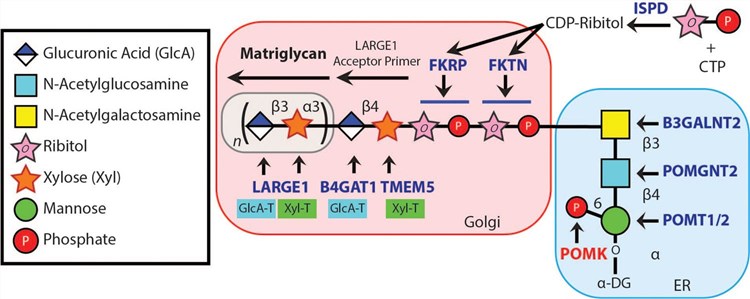 Fig.1 Synthesis of the α-DG Laminin-Binding Modification and Enzymes Involved.1
POMK engages several interrelated areas of glycobiology and neuromuscular pathology:
Explore our recombinant POMK protein products for glycobiology and muscular dystrophy-related research. As an ER-resident type II membrane protein with a luminal kinase domain, POMK presents specific considerations for construct design and protein production. Our portfolio may include full-length POMK and domain-specific or engineered research constructs according to product availability and experimental requirements. These proteins can support structural studies, investigation of POMK kinase mechanisms and substrate interactions, enzyme-related research, and antibody development and characterization. Available expression systems, construct designs, sequence variants, and functional characteristics should be determined according to the corresponding product information and supporting data.
Not finding the membrane protein product you need? Contact us to start your one-stop custom service!
These models are critical for the study of POMK dependent biology and therapeutic candidate evaluation. We deliver stable cell lines designed to either constitutively or inducibly express human, mouse and rat POMK as well as regulated endogenous expression of numbers of our top candidates for loss-of-function studies. These platforms are well-suited for high-throughput compound screening, α-DG glycosylation assays, laminin-binding rescue studies and kinase activity measurements to provide reliable and reproducible discoveries of POMK-mediated pathology or pharmacology.
Not finding the stable cell line product you need? Contact us to start your one-stop custom service!
We offer this wide range of high-affinity recombinant antibodies for POMK, developed to meet the strict requirements of numerous research fields. These highly specific and sensitive antibodies have been produced through the advanced recombinant technologies, which also provides significant batch-to-batch reproducibility over traditionally used polyclonal antibodies. POMK Recombinant Antibodies Validation Our POMK recombinant antibodies can be used for WB, ELISA, FCM and other applications using different sample types: ER membrane preparations; whole-cell lysates; tissue sections.
Not finding the recombinant antibody product you need? Contact us to start your one-stop custom service!
In addition to our product offering, we provide custom services for protein and antibody discovery and development:
POMK products and services are solely for research use only, not for clinical diagnosis or prevention treatment or cure of any disease.
We did generate stable lines co-expressing full length POMK as well as the mucin-like domain of dystroglycan from different loci. This allows the same batch to be released with validation documentation of O-mannose phosphorylation competence on a variety of dystroglycan-derived reporters, representing an uninterrupted glycosylation pathway without repeated transient transfection in one standardized cellular platform.
Yes, the immunogen correspond to a region that is very well conserved across mammalian species allowing detection in human, mouse and rat muscles and brain preparations without the need for additional species-specific reagents.
The catalog of POMK reagents contains mouse & rat. Additional orthologs or engineered mutants (eg, catalytically dead forms; trafficking mutants; patient-specific variants) can be custom produced upon request.








