
Creative Biolabs is offering the most comprehensive services for antibody development projects. With strict regulation and effective execution, we are dedicated to providing the most valuable solutions to complete your projects.
HighlightsCreative Biolabs is offering the most comprehensive services for antibody development projects. With strict regulation and effective execution, we are dedicated to providing the most valuable solutions to complete your projects.
HighlightsCreative Biolabs has established a broad range of platforms for developing novel antibodies or equivalents. These cutting-edge technologies enable our scientists to meet your demands from different aspects and tailor the most appropriate solution that contributes to the success of your projects.
HighlightsWith deep understanding in antibody-related realms and extensive project experience, Creative Biolabs offers a variety of references to help you learn more about our capacities and achievements, including infographic, flyer, case study, peer-reviewed publications, and all kinds of knowledge that can assist your projects. You are also welcome to contact us directly for more specific solutions.
HighlightsGet a real taste of Creative Biolabs, one of the most professional custom service providers in the world. We are committed to providing highly customized comprehensive solutions with the best quality to advance your projects.
Highlights Loading...
All listed services and products are For Research Use Only. Do Not use in any diagnostic or therapeutic applications.
Prostaglandin D2 synthase PTGDS is a rare small protein in the field of enzymology that holds two distinct roles. It not only functions to catalyze chemical reactions, but also undertakes the carrier function of transporting small molecules, packing these two completely different tasks into its compact protein structure. It can convert the ubiquitous prostaglandin endoperoxide intermediate in the body into prostaglandin D2 — a signaling molecule that has become an unavoidable core in sleep regulation research; nearly all studies related to sleep regulation are inevitably associated with it. Its own structure belongs to the lipocalin fold type, a class of protein architectures that has always had only one core strength: binding and transporting water-insoluble hydrophobic small molecules, and it almost never participates in work such as catalyzing chemical reactions. Its distribution in the human body perfectly covers all fluid regions that play key roles. Its production is particularly high in the brain: brain structures and cells including the meninges, choroid plexus, and glial cells can all synthesize it in large quantities, which naturally makes it one of the most abundant proteins in cerebrospinal fluid. Decades before people fully clarified its molecular identity and named it PTGDS, its presence had already been detected in cerebrospinal fluid, and it was given other old names at that time. Besides the brain, it can be found in the heart, in the retina, and in reproductive tissues. No matter where in the body it is, as long as there is a lipid signal that requires both a catalyst to synthesize it and an escort to help it traverse the aqueous extracellular environment, PTGDS is the one that appears there to take on this work.
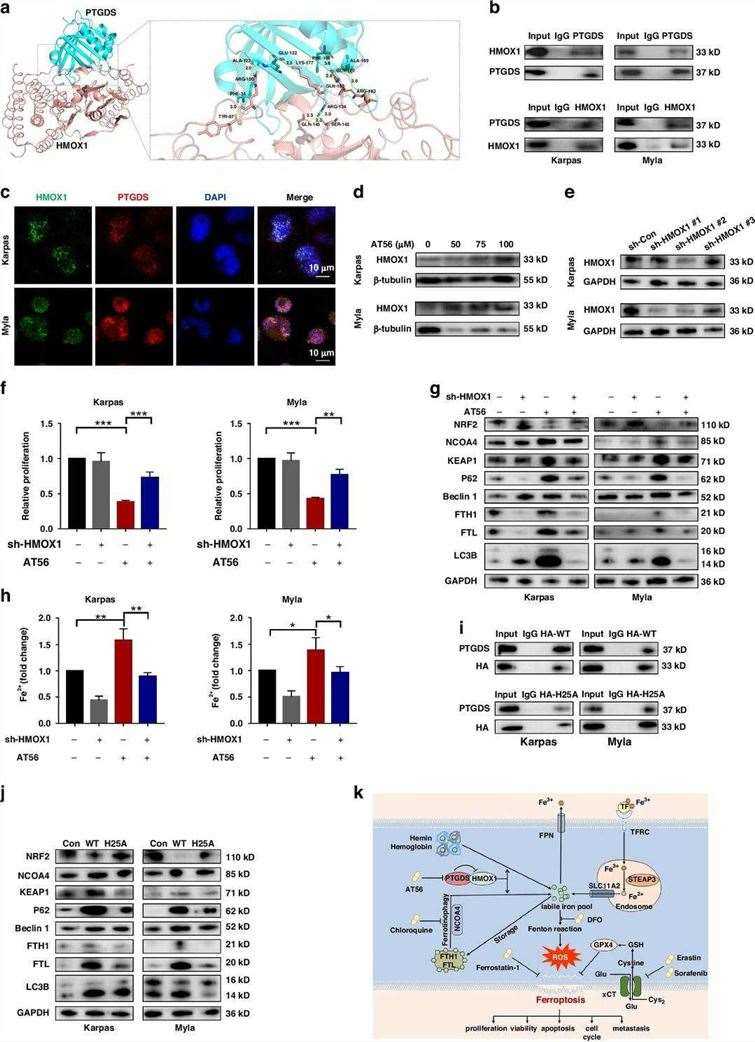 Fig.1 PTGDS interacted with HMOX1 to regulate iron metabolism and ferroptosis process in PTCL.1
A few research themes keep this enzyme in steady demand:
To stably produce PTGDS with normal function, the most critical task is to protect one of its key amino acids. The cysteine responsible for catalysis must remain in a reduced state throughout the entire process, from protein synthesis and purification to subsequent long-term storage. Once this state is compromised, the resulting protein, which appears structurally intact and identical to normal PTGDS, will completely lose its catalytic activity, turning into a useless empty shell. We have a specialized optimized protein expression system. The PTGDS produced using this system is full-length PTGDS with the complete native sequence. All products undergo a full set of rigorous testing before delivery. We use SDS-PAGE to verify protein purity and check for excess impurities; use analytical-grade size-exclusion chromatography to verify protein monodispersity and confirm that it does not aggregate into clumps that would affect use; and use light scattering analysis to confirm the protein's aggregation state, ensuring quality meets standards through multiple dimensions. If you have special requirements for your experimental protocol, such as a custom buffer system, a specific concentration format, or a formula adapted to a certain detection environment, you can submit your needs, and we will make adjustments fully in accordance with your requirements. Every protein preparation can be flexibly modified to match your experimental design and support your research.
Not finding the protein product you need? Contact us to start your one-stop custom service!
Cellular models for PTGDS work carry a secretion variable that must be understood before experiments begin: how much the line secretes, in which form, and with what redox protection. Wild-type overexpression lines supply defined secreted output; catalytic-residue variants let researchers separate synthesis activity from chaperone function; silenced lines remove the enzyme for loss-of-function studies. Each clone is characterized before release: expression output measured and calibrated, secretion documented, so the line's behavior is established before the first assay is run. If your program calls for a specific variant background, an unusual output tier, or a secretion format built around your assay design, the platform can be tailored to match; the cell line exists to serve the experiment it will run in.
Not finding the stable cell line product you need? Contact us to start your one-stop custom service!
Detection on PTGDS runs into two practical problems. The first is matrix complexity: the enzyme is abundant in cerebrospinal fluid and present in blood, and clones must perform in these protein-dense environments without losing specificity or sensitivity. The second is superfamily selectivity: the lipocalin fold is shared across a large family, and clones that fail to respect those relationships cross-react in ways that quietly corrupt quantitation. The recombinant panel here is screened for both matrix performance and genuine PTGDS discrimination, then validated across lysate quantitation, fluid-sample measurement, fixed-material staining, and imaging-based detection. Sequence-defined production keeps lot-to-lot behavior steady, and where a project needs a different conjugate, validation against a specific matrix, or an adjustment in clone format to fit a particular workflow, that can be arranged on request—the antibody panel flexes around the experimental design it serves.
Not finding the recombinant antibody product you need? Contact us to start your one-stop custom service!
Extending well beyond our standard catalog, we deliver fully customizable discovery and manufacturing solutions meticulously tailored to the sophisticated demands of PTGDS-targeted research and precompound development:
Yes. Custom formats and integrated multi-component engagements are routine, with unified quality frameworks keeping specifications aligned.
All PTGDS products and services are provided strictly for preclinical research. They are not designed, validated, or authorized for any use involving human subjects.
Catalog items work well for standard detection or activity workflows. Custom production makes sense when constructs, formats, or quality attributes step beyond routine specifications. A short consultation is usually enough to decide.
Yes. Custom formats and integrated multi-component engagements are routine, with unified quality frameworks keeping specifications aligned.









