Creative Biolabs is offering the most comprehensive services for antibody development projects. With strict regulation and effective execution, we are dedicated to providing the most valuable solutions to complete your projects.
HighlightsCreative Biolabs is offering the most comprehensive services for antibody development projects. With strict regulation and effective execution, we are dedicated to providing the most valuable solutions to complete your projects.
HighlightsCreative Biolabs has established a broad range of platforms for developing novel antibodies or equivalents. These cutting-edge technologies enable our scientists to meet your demands from different aspects and tailor the most appropriate solution that contributes to the success of your projects.
HighlightsWith deep understanding in antibody-related realms and extensive project experience, Creative Biolabs offers a variety of references to help you learn more about our capacities and achievements, including infographic, flyer, case study, peer-reviewed publications, and all kinds of knowledge that can assist your projects. You are also welcome to contact us directly for more specific solutions.
HighlightsGet a real taste of Creative Biolabs, one of the most professional custom service providers in the world. We are committed to providing highly customized comprehensive solutions with the best quality to advance your projects.
Highlights Loading...
All listed services and products are For Research Use Only. Do Not use in any diagnostic or therapeutic applications.
Protein tyrosine kinase 7 (PTK7) is a type I transmembrane receptor protein encoded by the PTK7 gene, featuring multiple extracellular immunoglobulin-like domains and a receptor-like pseudokinase/inactive tyrosine kinase domain without intrinsic catalytic phosphorylation activity. PTK7 is broadly expressed in embryonic epithelial progenitor cells, neural precursor cells and multiple invasive carcinoma cell lines, functioning as a non-catalytic scaffold protein that organizes multi-protein membrane complexes to modulate canonical and non-canonical Wnt signaling output and control oriented planar cell polarity during tissue morphogenesis.
PTK7 exerts its full-spectrum regulatory effects entirely via protein-protein docking interactions rather than kinase catalytic reactions, a unique scaffold-based regulatory mechanism that recruits Wnt coreceptors and cytoplasmic polarity adaptors to assemble functional signal platforms at plasma membrane surfaces. Unlike active catalytic tyrosine kinase receptors that transmit signals through substrate phosphorylation, PTK7's intracellular pseudo-kinase pocket cannot transfer phosphate groups, and solely acts as a static binding hub to balance Wnt pathway intensity; loss of PTK7 scaffold function disrupts ordered planar cell alignment and disturbs coordinated epithelial migration, uncoupling Wnt morphogenic signals from regular tissue architecture formation. This dual scaffold characteristic precisely controls embryonic tissue patterning under physiological developmental conditions, while sustained PTK7 overexpression in malignant tumors amplifies Wnt-driven invasive signaling and accelerates cancer cell metastasis. PTK7 participates in a broad spectrum of physiological and pathological processes including embryonic neural tube development, epithelial planar polarity establishment, wound repair migration and Wnt-dependent solid tumor progression. Dysregulated PTK7 scaffold expression is tightly associated with enhanced tumor invasive capacity, making PTK7 a pivotal research target for developmental biology and tumor metastasis mechanism exploration.
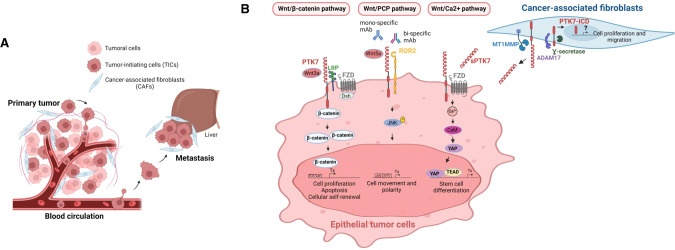 Fig. 1 (A) Schematic of PTK7-positive primary tumor progression, intravasation and distant liver metastasis involving tumor cells, TICs and CAFs; (B) PTK7 modulates three distinct Wnt signaling cascades (canonical β-catenin, Wnt/PCP-JNK, Wnt/Ca²⁺-YAP) in epithelial tumor cells. Ectodomain shedding by ADAM17 generates soluble sPTK7 for paracrine crosstalk with CAFs, while γ-secretase releases intracellular PTK7-ICD to regulate cellular proliferation and migration. Monospecific and bispecific anti-PTK7 mAbs are indicated as therapeutic strategies.1
The biological functions of PTK7 are focused on non-catalytic multi-protein complex docking and Wnt signal balancing:
Creative Biolabs offers high-quality PTK7 proteins through optimized eukaryotic heterologous expression systems, including full-length wild-type receptor and intracellular pseudo-kinase domain truncated variants with customized docking pocket structural characteristics. These products retain native extracellular Ig domain ligand affinity and complete intracellular scaffold binding capacity, suitable for Wnt signal complex interaction research and anti-metastatic small molecule compound screening workflows. All PTK7 batches undergo strict multi-step quality control including chromatographic purity analysis and cell-based scaffold functional validation to guarantee consistent experimental performance across diversified developmental and tumor research platforms.
Not finding the membrane protein product you need? Contact us to start your one-stop custom service!
Creative Biolabs provides custom-engineered PTK7 stable cell lines with overexpression and gene knockdown research models, fully optimized for systematic exploration of Wnt scaffold mechanisms and anti-invasive compound potency testing. Each cell line undergoes repeated multi-cycle stable target gene expression screening and complete scaffold complex assembly functional verification before delivery to ensure long-term stable repeatable performance in continuous developmental and tumor experimental assays.
Not finding the stable cell line product you need? Contact us to start your one-stop custom service!
High-specificity recombinant antibodies targeting PTK7 are developed via proprietary full-process antibody engineering platforms with rigorous multi-homolog cross-reactivity screening against other catalytic tyrosine kinase receptors. These antibody reagents are fully validated for multiple standard experimental workflows including epithelial cell membrane immunofluorescence localization staining, quantitative Western blot expression profiling and co-immunoprecipitation multi-protein scaffold complex detection, supporting high-precision quantitative characterization of PTK7 expression levels and subcellular distribution patterns under embryonic developmental and tumor pathological conditions.
Not finding the recombinant antibody product you need? Contact us to start your one-stop custom service!
Beyond catalog products, Creative Biolabs offers specialized custom services for PTK7 research:
PTK7 is a catalytically inactive tyrosine kinase scaffold receptor that docks Wnt signaling adaptors, fine-tunes planar cell polarity dynamics, and modulates tumor invasive Wnt signals.
PTK7 controls core embryonic patterning and its overexpression drives cancer metastasis. It is a vital core research target for developmental biology and tumor invasion mechanism exploration.
No, all PTK7 products and services are strictly for research use only, not intended for clinical diagnosis or treatment.
Offerings include full-length PTK7 scaffold proteins, high-specificity recombinant antibodies, and custom stable Wnt reporter cell lines, supporting developmental and metastatic tumor research projects.
PTK7 proteins are validated via multi-protein scaffold co-IP and planar polarity cell phenotypic assays to retain native Wnt balancing regulatory function.