
Creative Biolabs is offering the most comprehensive services for antibody development projects. With strict regulation and effective execution, we are dedicated to providing the most valuable solutions to complete your projects.
HighlightsCreative Biolabs is offering the most comprehensive services for antibody development projects. With strict regulation and effective execution, we are dedicated to providing the most valuable solutions to complete your projects.
HighlightsCreative Biolabs has established a broad range of platforms for developing novel antibodies or equivalents. These cutting-edge technologies enable our scientists to meet your demands from different aspects and tailor the most appropriate solution that contributes to the success of your projects.
HighlightsWith deep understanding in antibody-related realms and extensive project experience, Creative Biolabs offers a variety of references to help you learn more about our capacities and achievements, including infographic, flyer, case study, peer-reviewed publications, and all kinds of knowledge that can assist your projects. You are also welcome to contact us directly for more specific solutions.
HighlightsGet a real taste of Creative Biolabs, one of the most professional custom service providers in the world. We are committed to providing highly customized comprehensive solutions with the best quality to advance your projects.
Highlights Loading...
All listed services and products are For Research Use Only. Do Not use in any diagnostic or therapeutic applications.
PTPRZ1, or Receptor Tyrosine Phosphatase Z1, which has long been referred to as RPTPζ in the neuroscience field, is one of the signal proteins with the most unique structures in the genome—it is a hybrid that cannot be simply categorized, holding two completely distinct core molecular identities at the same time, neither of which can fully define it. It is a transmembrane protein, with half of its structure extending outside the cell and the other half remaining inside the cell. Starting with the extracellular portion, its function is identical to that of a proteoglycan. This region undergoes extensive modifications, specifically designed to adapt to and interact with the extracellular matrix environment. It carries a carbonic anhydrase-like domain and fibronectin repeat fragments, which, facing the surrounding neural environment, unfold into a complex, heavily modified surface that is perfectly suited to interact with various substances in the neural microenvironment. As for the intracellular portion, it contains two tandem phosphatase domains. The membrane-proximal D1 domain is the principal catalytically active tyrosine phosphatase domain, whereas the distal D2 domain is generally considered regulatory and has limited or pseudophosphatase-like catalytic activity. Through its active phosphatase domain, PTPRZ1 can remove phosphate groups from tyrosine residues, counteracting signaling processes initiated by kinases. Kinases are the "pens" that write signals, adding phosphate groups to proteins to activate signaling pathways; PTPRZ1 is the "eraser" that wipes out signals, removing the added phosphate groups and cutting off already activated signaling cascades. Its biological functions also fully match this unique structure; its functions align exactly with how its structure is formed. This protein is mainly concentrated in the central nervous system of developing and adult individuals, and it is rarely found in other locations. Within the central nervous system, glial cells and neural progenitor cells use it to regulate the migration and differentiation of nerve cells, as well as the structural construction of the entire neural tissue, relying on it to support neural growth and daily operation. In disease-related research, it has also been discovered that in glioma research models, the expression level of this receptor rises sharply, far exceeding that in normal neural tissue. Not only is the increase in quantity significant, but its phosphatase activity is also associated with the signaling pathway rewiring that occurs in these tumors, meaning the disordered signaling processes in tumors are inextricably linked to its activity. This makes PTPRZ1 an important research target for investigating glioma-associated signaling mechanisms and tumor biology in basic and preclinical research models.
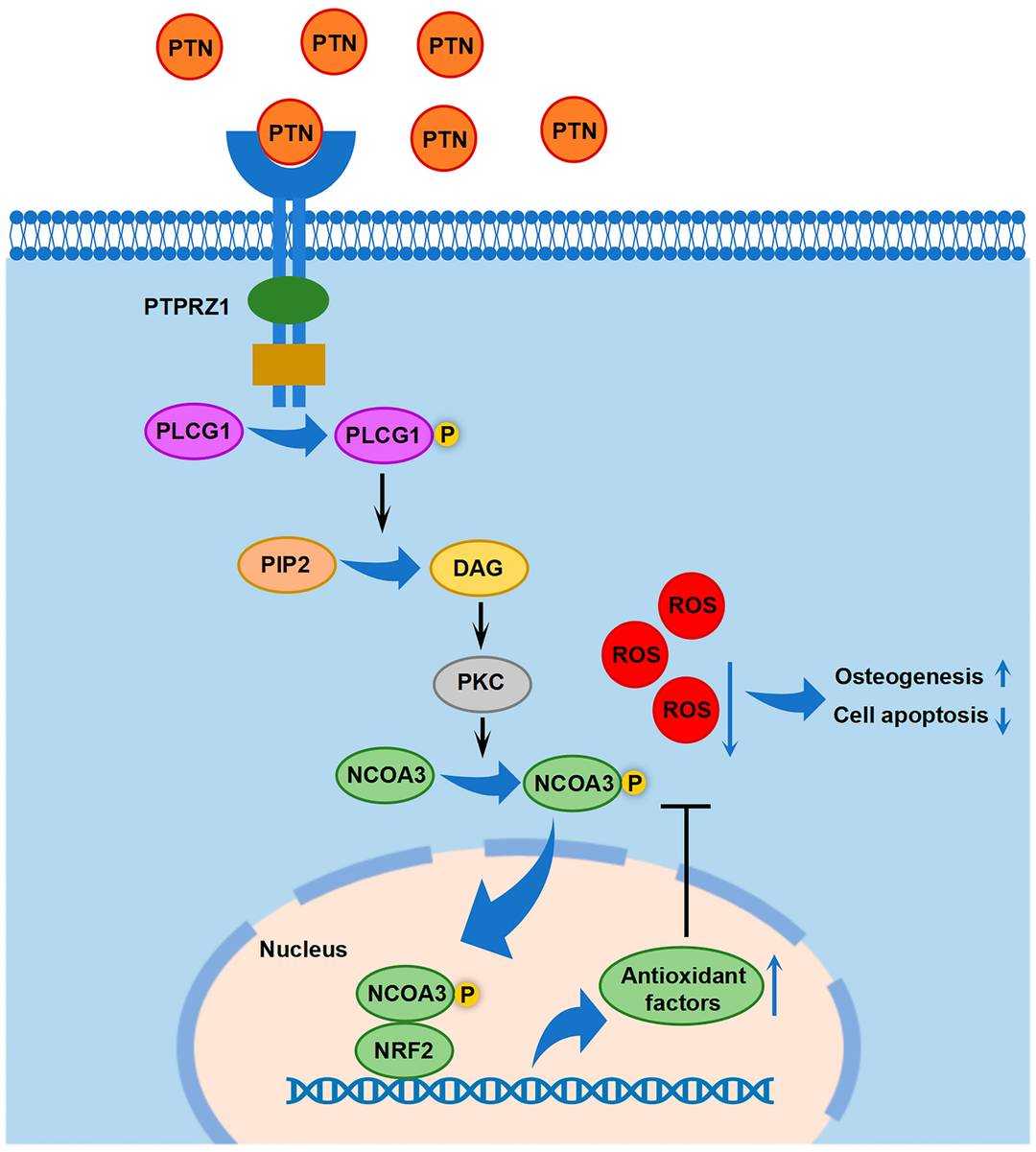 Fig.1 Schematic diagram showing the downstream cascade signaling by which PTN regulates rBMSC functions.1
Several research currents keep converging on this receptor-phosphatase:
To produce a usable PTPRZ1, it is first necessary to fully understand its dual-structured hybrid property—this protein is spliced together from two completely distinct functional domains, and to qualify as a valid research-grade material, both domains must meet the required standards simultaneously. The modified extracellular region has a complex structure and requires the addition of various necessary post-translational modifications, so it can only be successfully expressed using a dedicated system that supports this complex processing workflow; the other phosphatase domain must retain its inherent catalytic activity stably. If even one of these requirements is unmet, the product is not qualified. If the resulting product only satisfies one of the two requirements while the other falls short, it can never replicate the true state of native PTPRZ1, and is completely unusable for formal research. We have specifically optimized a eukaryotic expression system to produce full-length PTPRZ1. The inherent folding and processing support capacity of this system perfectly matches the unique structural requirements of this hybrid protein, ensuring both domains are properly developed with no neglect of either. All products undergo release testing before leaving the facility, including purity verification using the SDS-PAGE method. If your research requires a specific mutation background, designated ligand conditions, or adaptation to the format of the binding assays or phosphatase assays you use, we can adjust the protein preparation protocol to align with your experimental design—products always serve research, and we never force your research to accommodate off-the-shelf products.
Not finding the membrane protein product you need? Contact us to start your one-stop custom service!
Cell models used for PTPRZ1-related research must also uphold the integrity of the full-length protein's dual functions, with no room for error. If the receptor in the cells only has a properly folded extracellular region but an inactivated phosphatase, or conversely only a functional phosphatase with a defective extracellular region, this model can never replicate the true state of this hybrid protein. Experimental results generated using such a model will all be incorrect, and completely fail to reflect the authentic performance of the protein in its native state. The stable cell lines we offer include versions that overexpress wild-type PTPRZ1, as well as variants carrying various mutations. Researchers can use these cell lines to dissect the individual roles of the two phosphatase domains, and study their respective impacts on protein function. Every cell clone completes a full set of characterization tests before leaving the facility; before you start your experiments after receiving the cell line, all its basic characteristics have already been fully confirmed, so you do not need to spend extra time repeatedly verifying the reliability of the cell line. If your project requires a specific mutation background, designated expression level, or a timed protein expression schedule tailored to your intervention experiment workflow, this cell line platform can also be fully customized to your needs—the model is built to fit your experiment, and we never force your research to accommodate pre-made finished products.
Not finding the stable cell line product you need? Contact us to start your one-stop custom service!
Antibody work on PTPRZ1 faces the hybrid problem: the receptor-phosphatase family shares the tandem-domain architecture, and the decorated extracellular region shares features with the broader proteoglycan landscape—two directions from which generic clones can drift into cross-reactivity. The recombinant panel here is screened for genuine PTPRZ1 discrimination. Diverse formats are available, so detection can follow whichever face of the hybrid an experiment interrogates. Sequence-defined production keeps lot-to-lot performance steady, and where a project needs a different conjugate, validation against a specific sample type, or an adjustment in clone format to fit a particular workflow, that can be arranged on request—the panel flexes to meet the experimental design it serves.
Not finding the recombinant antibody product you need? Contact us to start your one-stop custom service!
In addition to our catalog products, Creative Biolabs specializes in custom services for membrane protein and antibody discovery & development. Using our deep knowledge and sophisticated platforms we can support you with:
Kinases add phosphate groups to tyrosine residues; receptor phosphatases remove them. PTPRZ1 pairs this erasing chemistry with an extracellular recognition surface, coupling outside-in information to signaling reversal.
Elevated expression in glioma research models and phosphatase-linked signaling rewiring anchor active investigation, with the receptor serving as both a marker and a mechanistic variable.
Neural development, glioma research, receptor-phosphatase mechanism, and extracellular-matrix signaling are the standing territories of use.
All PTPRZ1 products and services are provided strictly for preclinical research. They are not designed, validated, or authorized for any use involving human subjects.









