Creative Biolabs is offering the most comprehensive services for antibody development projects. With strict regulation and effective execution, we are dedicated to providing the most valuable solutions to complete your projects.
HighlightsCreative Biolabs is offering the most comprehensive services for antibody development projects. With strict regulation and effective execution, we are dedicated to providing the most valuable solutions to complete your projects.
HighlightsCreative Biolabs has established a broad range of platforms for developing novel antibodies or equivalents. These cutting-edge technologies enable our scientists to meet your demands from different aspects and tailor the most appropriate solution that contributes to the success of your projects.
HighlightsWith deep understanding in antibody-related realms and extensive project experience, Creative Biolabs offers a variety of references to help you learn more about our capacities and achievements, including infographic, flyer, case study, peer-reviewed publications, and all kinds of knowledge that can assist your projects. You are also welcome to contact us directly for more specific solutions.
HighlightsGet a real taste of Creative Biolabs, one of the most professional custom service providers in the world. We are committed to providing highly customized comprehensive solutions with the best quality to advance your projects.
Highlights Loading...
All listed services and products are For Research Use Only. Do Not use in any diagnostic or therapeutic applications.
Ring finger protein 43 (RNF43) is an integral membrane E3 ubiquitin ligase encoded by the RNF43 gene, belonging to RING-type ubiquitin transferase family and acting as the primary negative regulator of canonical Wnt signal transduction and epithelial proliferative homeostasis. RNF43 is broadly expressed across polarized epithelial cell populations of digestive and glandular tissues, with evolutionarily conserved extracellular ligand-binding loops and cytoplasmic RING ubiquitin ligase domains across species, serving as an essential modulator for Wnt receptor lysosomal sorting, transmembrane receptor ubiquitination and proliferative signal attenuation. RNF43-mediated ubiquitination activity exerts decisive effects on restraining excessive canonical Wnt cascade activation, limiting unregulated epithelial cell proliferation and maintaining balanced tissue regenerative turnover under physiological conditions. Furthermore, RNF43 coordinates downstream signaling cascades governing cell cycle control, epithelial differentiation and stem cell compartment equilibrium to safeguard intact tissue architecture stability. Distinct from other RING ubiquitin ligases with divergent substrate targeting profiles, RNF43 carries unique non-redundant duties in targeted Wnt receptor turnover at cell surfaces, rendering it indispensable for regular epithelial growth control, stem cell signal balance and overall tissue tumor suppression.
RNF43 executes biological functions through cytoplasmic RING domain catalysis of ubiquitin molecule transfer to surface Wnt receptor complexes, triggering tagged receptor internalization and lysosomal degradation to reduce cellular Wnt signal responsiveness, which restricts proliferative transcriptional programs driven by sustained Wnt pathway activity. Its conserved functional domains mediate substrate receptor recognition and ubiquitin conjugation, enabling precise tuning of canonical Wnt signaling intensity and epithelial proliferative signal transmission. RNF43-dependent signaling sustains systemic epithelial tissue equilibrium, covering restrained Wnt proliferative cycles, coordinated stem cell differentiation and persistent hyperproliferation surveillance. RNF43 participates in an extensive spectrum of biological processes, such as Wnt receptor ubiquitination, canonical pathway signal suppression, epithelial cell cycle regulation and somatic stem cell homeostasis. Loss-of-function mutation or expression silencing of RNF43 severely amplifies unconstrained Wnt transcriptional activity, disturbs epithelial growth balance and elevates susceptibility to epithelial neoplastic lesions, including gastrointestinal adenomatous proliferations and malignant epithelial tumors. Therefore, RNF43 constitutes a pivotal research target for investigating ubiquitin ligase enzymology, Wnt developmental signaling and epithelial oncogenic pathogenic mechanisms.
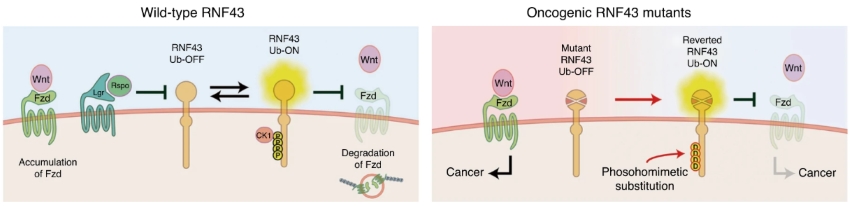 Fig. 1 Wild-type RNF43 acts as a tunable E3 ubiquitin ligase: Wnt ligand triggers its Ub-ON state to induce Frizzled ubiquitination and lysosomal degradation, while R-spondin-LGR signaling switches RNF43 to Ub-OFF and stabilizes membrane Fzd. Oncogenic phosphomimetic RNF43 mutants reverse this regulatory cycle, abolishing Fzd clearance and causing persistent hyperactive Wnt signaling that promotes tumorigenesis.1
The biological functions of RNF43 are focused on RING domain-mediated E3 ubiquitin catalysis, Wnt receptor turnover and epithelial proliferative signal restraint:
Creative Biolabs offers high-quality RNF43 proteins via optimized expression systems, covering full-length RNF43 and isolated RING ligase domain variants. These products retain native spatial conformation and intrinsic ubiquitin transferase biological activity, suitable for E3 ligase catalytic activity analysis, Wnt receptor interaction studies and small molecule compound screening targeting epithelial neoplastic disorders. All RNF43 proteins undergo rigorous quality control to guarantee consistent functional performance and reliable application across diverse research platforms.
Not finding the membrane protein product you need? Contact us to start your one-stop custom service!
Creative Biolabs provides custom engineered RNF43 stable cell lines, including overexpression and gene silencing models. These cell line models are optimized for Wnt pathway regulation research, epithelial proliferative phenotype observation and anti-tumor compound response profiling. Each cell line undergoes strict validation procedures to ensure steady target expression levels and uniform functional performance across multiple experimental scenarios.
Not finding the stable cell line product you need? Contact us to start your one-stop custom service!
High-specificity recombinant antibodies targeting RNF43 are developed with advanced antibody engineering workflows, without cross-reactivity against other RING ubiquitin ligase family homologs. These antibodies receive multi-scenario functional validation, applicable to protein expression profiling, epithelial membrane localization detection, ligase-substrate binding interaction assessment and tumor biology research, enabling precise characterization of RNF43 expression patterns, subcellular compartment distribution and functional modulation under physiological and pathological states.
Not finding the recombinant antibody product you need? Contact us to start your one-stop custom service!
Beyond catalog products, Creative Biolabs offers specialized custom services for RNF43 research:
RNF43 is a membrane E3 ubiquitin ligase that mediates Wnt receptor ubiquitination and lysosomal degradation to suppress canonical proliferative Wnt signaling cascades.
RNF43 exerts irreplaceable control over epithelial Wnt proliferative balance; functional loss triggers unchecked epithelial hyperproliferation and tumorigenesis, establishing it as a vital research target.
No, all RNF43 products and services are strictly for research use only, not intended for clinical diagnosis or treatment.
Offerings include RNF43 proteins, high-specificity recombinant antibodies and custom stable cell lines for Wnt signaling and epithelial tumor research.
RNF43 proteins undergo functional verification via ubiquitin transferase catalytic activity assessment, Wnt substrate binding analysis and conformational stability evaluation.