
Creative Biolabs is offering the most comprehensive services for antibody development projects. With strict regulation and effective execution, we are dedicated to providing the most valuable solutions to complete your projects.
HighlightsCreative Biolabs is offering the most comprehensive services for antibody development projects. With strict regulation and effective execution, we are dedicated to providing the most valuable solutions to complete your projects.
HighlightsCreative Biolabs has established a broad range of platforms for developing novel antibodies or equivalents. These cutting-edge technologies enable our scientists to meet your demands from different aspects and tailor the most appropriate solution that contributes to the success of your projects.
HighlightsWith deep understanding in antibody-related realms and extensive project experience, Creative Biolabs offers a variety of references to help you learn more about our capacities and achievements, including infographic, flyer, case study, peer-reviewed publications, and all kinds of knowledge that can assist your projects. You are also welcome to contact us directly for more specific solutions.
HighlightsGet a real taste of Creative Biolabs, one of the most professional custom service providers in the world. We are committed to providing highly customized comprehensive solutions with the best quality to advance your projects.
Highlights Loading...
All listed services and products are For Research Use Only. Do Not use in any diagnostic or therapeutic applications.
SCN10A, also known as voltage-gated sodium channel alpha subunit 10, encodes the pore-forming core region of Nav1.8. Nav1.8 is one of the pharmacologically most unique ion channels in the human genome, and does not belong to the same category as the vast majority of sodium channels in the human body. Ordinary sodium channels described in textbooks, which support the action potentials of cells throughout the body, cease to function when exposed to tetrodotoxin, but SCN10A can continue to conduct current and operate normally even in a toxin-containing environment. This tetrodotoxin resistance is not a random minor feature, but a core characteristic that defines the identity of this channel—by virtue of this property, it is classified into a dedicated branch of sodium channels that exclusively serve peripheral tissues, and is clearly distinguished from ordinary sodium channels in the central nervous system from birth. This protein is assembled from four homologous repeat domains, each of which contains 6 transmembrane helices. Within each domain, the S4 transmembrane segment functions as the principal voltage sensor, and all components enclose a pore that only allows sodium ions to pass through. Its dynamic properties are fundamentally different from those of ordinary sodium channels described in textbooks: it activates slowly, and inactivates even more slowly; during the membrane repolarization phase, that is, the process in which a cell's electrical activity returns from an activated state to a resting state, it can generate a resurgent current that can influence the firing pattern of nerve cells. If the function of this channel is disrupted in preclinical research models, quantifiable changes occur in all core animal physiological processes related to pain: responses to cold, mechanical pressure, and inflammatory stimuli all become abnormal. This directly confirms that SCN10A is the most upstream molecule in the pain generation pathway, with no room for ambiguity, and it is one of the molecules that can most directly influence the experience of pain.
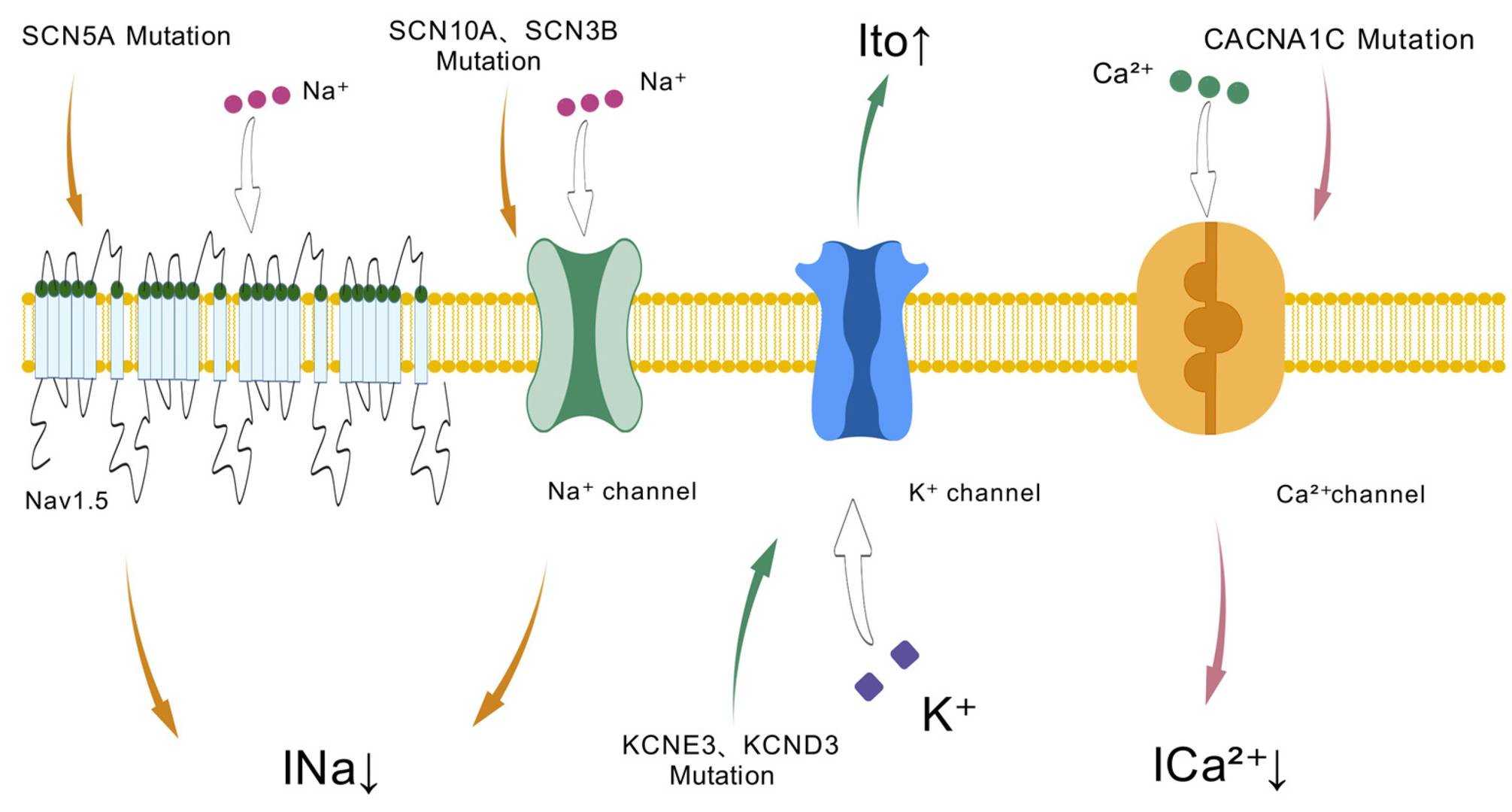 Fig.1 Ion channel dysfunction in Brugada syndrome.1
Several research currents keep converging on this channel:
To produce a qualified SCN10A protein sample suitable for reliable experiments, the core priority is to preserve its unique biophysical gating properties, which are the source of this channel's biological value. If these properties are lost, the resulting protein is not true Nav1.8. If a sample can still conduct sodium ions but loses its signature slow inactivation characteristic, or loses its ability to resist tetrodotoxin, it completely fails to embody the core value that makes Nav1.8 the primary target in neuroscience and pain research, which amounts to wasting the entire purpose of studying this channel. The full-length SCN10A protein isolated by our laboratory from an optimized eukaryotic expression platform—this platform is purpose-built to fold and process large, complex membrane proteins, and can fully retain the native functional properties of the protein, avoiding the aforementioned problem of losing core characteristics. If your research project requires a specific genetic variation background, defined pharmacological experimental conditions, or a protein preparation format compatible with specific electrophysiological equipment, all parameters of our products can be adjusted according to your experimental protocol—our preparation scheme adapts to your experimental design, rather than requiring you to adapt to our standard products.
Not finding the membrane protein product you need? Contact us to start your one-stop custom service!
Cellular models for SCN10A work turn on expression density and gating competence working together—a channel that reaches the surface without its specialized kinetics cannot inform pain-biology questions. Wild-type overexpression lines and many variants let researchers probe how the slow kinetics are implemented. Each clone is characterized before release, so the line's behavior is established before experiments begin. Should your program call for a particular variant background, a specific density tier tuned to your recording configuration, or an expression schedule built around your stimulation protocol, the platform can be tailored to fit; the cell line is constructed to serve the experiment it will run in.
Not finding the stable cell line product you need? Contact us to start your one-stop custom service!
Antibody work on SCN10A faces the nine-member family problem: the voltage-gated sodium channels share their repeat-domain scaffold, and their intracellular regions—the most accessible epitope territory—are similar enough that generic clones drift into cross-reactivity that corrupts quantitation. Our recombinant panel here is screened for genuine Nav1.8 discrimination. Sequence-defined production keeps lot-to-lot performance steady, and where a project needs a different conjugate, validation against a specific sample type, or an adjustment in clone format to fit a particular workflow, that can be arranged on request—the panel flexes to meet the experimental design it serves.
Not finding the recombinant antibody product you need? Contact us to start your one-stop custom service!
Extending well beyond our standard catalog, we deliver fully customizable discovery and manufacturing solutions meticulously tailored to the sophisticated demands of SCN10A-targeted research and precompound development:
Expression concentrated in sensory ganglia confines the channel's biology to the peripheral nervous system, shaping both the models researchers build and the intervention strategies that remain plausible.
The nine family members span a range of kinetics, pharmacologies, and expression territories, with Nav1.8 occupying the slow-kinetic, toxin-resistant, peripherally restricted corner. Comparative work uses this spread as a mapping tool.
The channel's distinctive pore and kinetics offer pharmacological handles that its siblings lack, making selective modulation an achievable research goal and a standing direction in probe-development programs.
All SCN10A products and services are provided strictly for preclinical research. They are not designed, validated, or authorized for any use involving human subjects.









