Creative Biolabs is offering the most comprehensive services for antibody development projects. With strict regulation and effective execution, we are dedicated to providing the most valuable solutions to complete your projects.
HighlightsCreative Biolabs is offering the most comprehensive services for antibody development projects. With strict regulation and effective execution, we are dedicated to providing the most valuable solutions to complete your projects.
HighlightsCreative Biolabs has established a broad range of platforms for developing novel antibodies or equivalents. These cutting-edge technologies enable our scientists to meet your demands from different aspects and tailor the most appropriate solution that contributes to the success of your projects.
HighlightsWith deep understanding in antibody-related realms and extensive project experience, Creative Biolabs offers a variety of references to help you learn more about our capacities and achievements, including infographic, flyer, case study, peer-reviewed publications, and all kinds of knowledge that can assist your projects. You are also welcome to contact us directly for more specific solutions.
HighlightsGet a real taste of Creative Biolabs, one of the most professional custom service providers in the world. We are committed to providing highly customized comprehensive solutions with the best quality to advance your projects.
Highlights Loading...
All listed services and products are For Research Use Only. Do Not use in any diagnostic or therapeutic applications.
Synthesis of cytochrome c oxidase 1 (SCO1) is a small protein that carries a disproportionately heavy burden. Without it, cells cannot properly assemble the enzyme complex that completes the final step of mitochondrial respiration—the core process that supplies energy to the cell simply cannot proceed normally. The enzyme in question is cytochrome c oxidase, also known as complex IV in the respiratory chain. It sits at the very end of the electron transport chain, the final checkpoint of the entire mitochondrial energy production line. It is responsible for transferring electrons to oxygen, and pumps hydrogen ions to maintain a transmembrane concentration gradient—this gradient is the energy source for the synthesis of ATP, the universal energy currency that cells use to sustain all life activities. Copper incorporation is essential for complex IV function, and SCO1 contributes to copper delivery and redox control during complex IV assembly, particularly in the maturation of the CuA center of COX2. Without this process, complex IV assembly and activity can be impaired. SCO1 resides in the mitochondrial intermembrane space, the gap between the mitochondrial double membranes, remains bound to the membrane at all times, and stays near the site of enzyme assembly. It carries an evolutionarily conserved metal-binding motif, the core tool that enables its function: this sequence participates in copper binding and transfer associated with CuA-site maturation. SCO1's role extends beyond simple metal binding, because its copper-handling and redox functions contribute to proper complex IV biogenesis. Loss of SCO1 function can therefore impair complex IV assembly and mitochondrial respiratory capacity, with downstream effects on ATP production, membrane-potential maintenance, and mitochondrial redox status. If a gene mutation that inactivates SCO1 appears in a research model, severe mitochondrial assembly defects can occur, allowing researchers to examine how defective SCO1-dependent copper handling affects cellular respiration and energy metabolism.
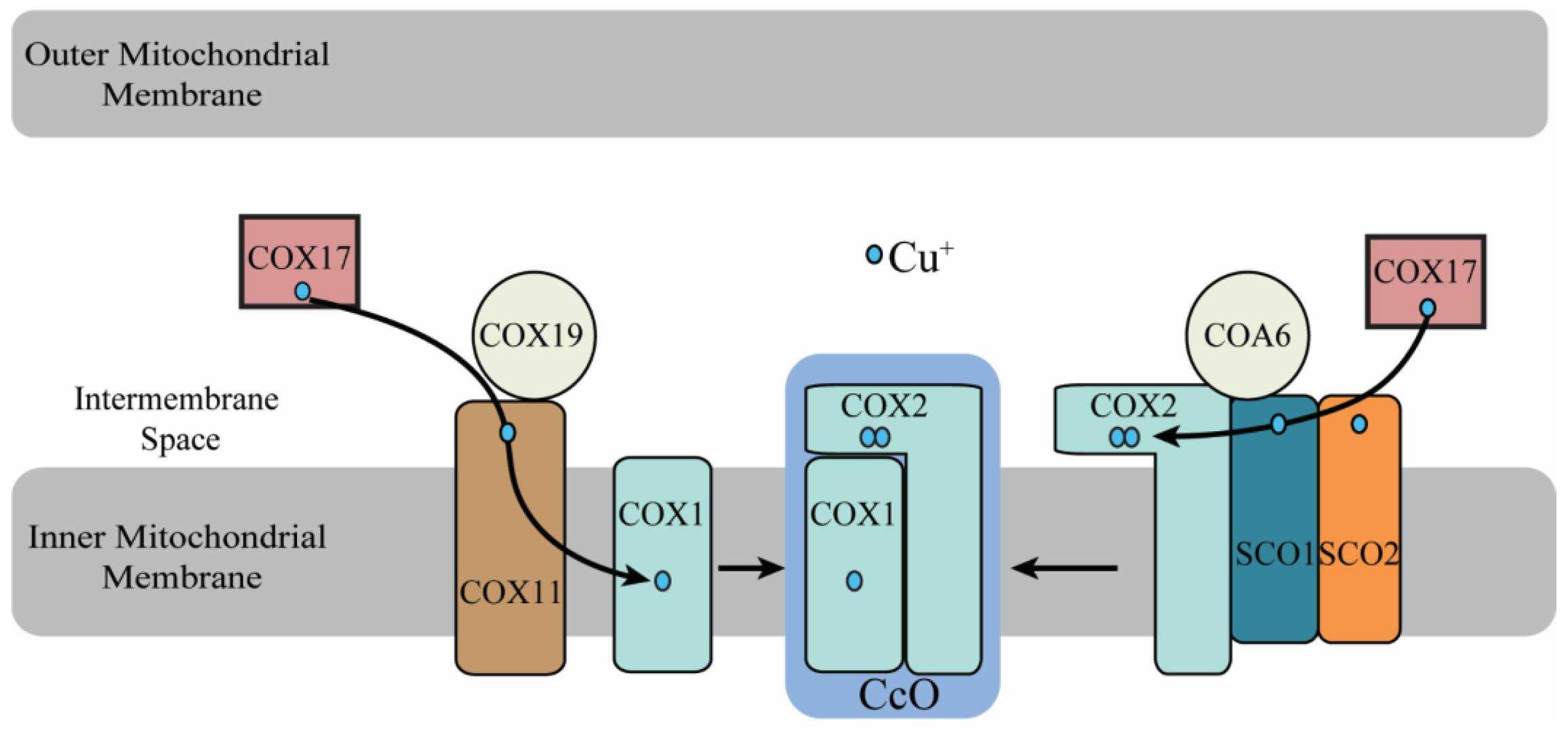 Fig.1 A schematic diagram of the mitochondrial copper delivery pathway to cytochrome c oxidase.1
Several research currents keep converging on this chaperone:
To produce functional SCO1, the core priority is to treat copper binding as a non-negotiable, top priority task. If the SCO1 you produce cannot even be confirmed to have bound copper, that protein is nothing like the molecular chaperone that functions normally in cells—it is equivalent to obtaining a tool missing its core component, and cannot be used for experiments. Its handling must meet the sensitive requirements of the redox environment. This is not an insignificant minor detail, but a prerequisite for obtaining valid, interpretable experimental data. If the environment is incorrect, SCO1 will be inactivated before it even enters the laboratory, and all data obtained will be useless. We use an optimized expression system to produce full-length SCO1, with standardized metal-specific processing protocols built into every step of preparation. We monitor the copper binding state throughout the entire process from protein production to purification and storage, and select appropriate preparation formats to ensure its metal-binding motif remains functional at all times, so that it can properly exert its innate copper delivery function, and is ready to use in reliable experiments immediately upon receipt.
Not finding the membrane protein product you need? Contact us to start your one-stop custom service!
Cellular models for SCO1 work carry the assembly-deficiency variable: expression changes move respiratory competence itself, so lines must be built and characterized with precision. Wild-type overexpression lines and variants let researchers probe how the binding chemistry couples to delivery. Each clone is characterized before release, so the line's behavior is established before experiments begin. Should your program call for a particular variant background, a specific density tier, or an expression schedule built around your assembly-monitoring timeline, the platform can be tailored to fit; the cell line is constructed to serve the experiment it will run in.
Not finding the stable cell line product you need? Contact us to start your one-stop custom service!
Antibody work on SCO1 faces the sibling problem: the conserved metal-binding motif and flanking sequence shared with its SCO sibling—and with related copper chaperones more broadly—give generic clones a reason to cross-react, corrupting quantitation in samples where multiple chaperones operate. Our recombinant panel here is screened for genuine SCO1 discrimination. Different formats are available, so detection can follow whichever region of the compact protein an experiment interrogates. Sequence-defined production keeps lot-to-lot performance steady, and where a project needs a different conjugate, validation against a specific sample type, or an adjustment in clone format to fit a particular workflow, that can be arranged on request—the panel flexes to meet the experimental design it serves.
Not finding the recombinant antibody product you need? Contact us to start your one-stop custom service!
Extending well beyond our standard catalog, we deliver fully customizable discovery and manufacturing solutions meticulously tailored to the sophisticated demands of SCO1-targeted research and precompound development:
Copper is chemically reactive; free copper can cause oxidative damage, yet it is an essential substance for the function of multiple enzymes. Chaperones can safely bind copper, deliver it precisely to its destination, and convert this potentially harmful element into a controllable and utilizable resource.
These two chaperones cooperate with each other, but the specific division of labor model—whether they are each responsible for different steps with partial functional redundancy, or transfer copper sequentially in a collaborative manner—remains an active research direction, and relevant mutation studies are continuously improving the relevant conclusions.
Respiratory complex assembly, copper homeostasis, mitochondrial biology, and metalloenzyme mechanism research are core fields that have long centered their research on this chaperone.
All SCO1 products and services are provided strictly for preclinical research. They are not designed, validated, or authorized for any use involving human subjects.