
Creative Biolabs is offering the most comprehensive services for antibody development projects. With strict regulation and effective execution, we are dedicated to providing the most valuable solutions to complete your projects.
HighlightsCreative Biolabs is offering the most comprehensive services for antibody development projects. With strict regulation and effective execution, we are dedicated to providing the most valuable solutions to complete your projects.
HighlightsCreative Biolabs has established a broad range of platforms for developing novel antibodies or equivalents. These cutting-edge technologies enable our scientists to meet your demands from different aspects and tailor the most appropriate solution that contributes to the success of your projects.
HighlightsWith deep understanding in antibody-related realms and extensive project experience, Creative Biolabs offers a variety of references to help you learn more about our capacities and achievements, including infographic, flyer, case study, peer-reviewed publications, and all kinds of knowledge that can assist your projects. You are also welcome to contact us directly for more specific solutions.
HighlightsGet a real taste of Creative Biolabs, one of the most professional custom service providers in the world. We are committed to providing highly customized comprehensive solutions with the best quality to advance your projects.
Highlights Loading...
All listed services and products are For Research Use Only. Do Not use in any diagnostic or therapeutic applications.
Syndecan-1 (SDC1) is a type I transmembrane heparan sulfate proteoglycan, as well as the founding member of the syndecan proteoglycan family, consisting of four structurally-related members (SDC1–SDC4). SDC1 is highly expressed in terminal differentiated plasma cells (PCs), differentiating keratinocytes and other various epithelial cell types, whose expression levels gradually are upregulated by tissue injury, wound healing and neoplastic transformation. Matrix metalloproteinases (MMPs), ADAMs, and heparanase can cleave SDC1 from the cell surface, resulting in a soluble form (soluble SDC1; sSDC1) with retained ligand-binding capacity that functions as a decoy receptor or a signaling agonist in the tumor microenvironment. Indeed, SDC1 expression has been found to be altered in many malignat cancers such as multiple myeloma, breast cancer, lung adenocarcinoma, colorectal carcinoma and glioblastoma [3] making this molecule a NOTICING master diagnostician biomarker and as well promising therapeutic target. CD138 has thus become the gold-standard immunohistochemical marker for plasma cell identification in hematopathology, and this protein's multifaceted roles in exosome biogenesis, glycocalyx maintenance, and growth factor coreception continue to expand its research significance.
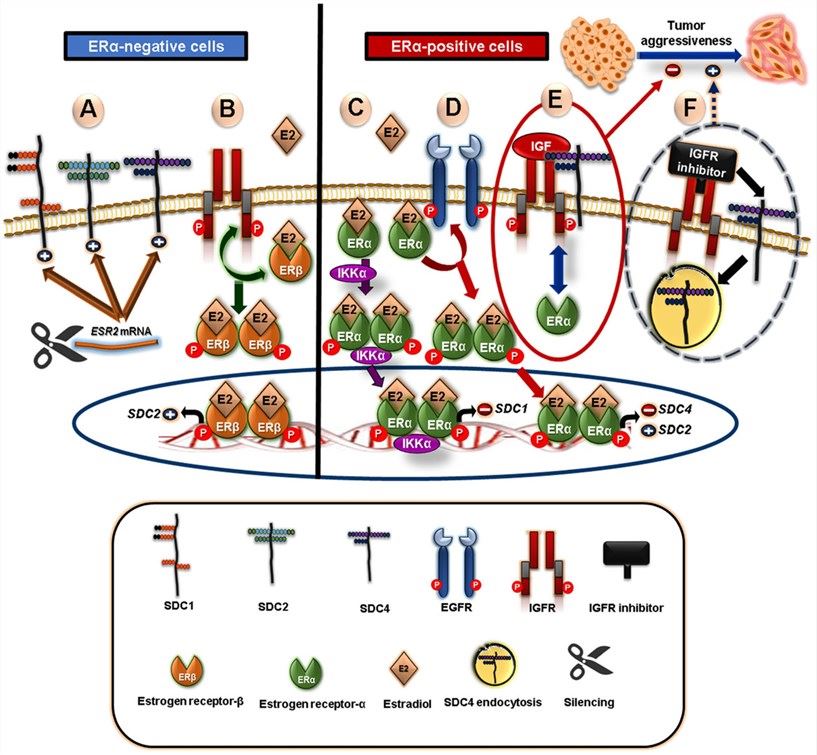 Fig.1 Schematic diagram showing the possible crosstalk between syndecans (SDCs) and estrogen receptors (ER) in breast cancer cells.1
The multifunctionality of SDC1 is partially based on its unique ability to tether multiple different extracellular ligands and intracellular signaling machinery:
Creative Biolabs provides a range of SDC1 membrane and recombinant protein products that support structural and functional studies of this heavily glycosylated proteoglycan. Our membrane protein technology provides SDC1 in research-ready formats suitable for diverse experimental requirements. These protein preparations are designed for applications such as ELISA, antibody production and characterization, binding assays, exosome-related studies, and functional studies involving cell-matrix interactions. They offer researchers reproducible tools to investigate SDC1 interactions with growth factors, ECM components, and intracellular adaptor proteins. Available SDC1 protein formats can also support studies of ligand binding and other molecular interactions relevant to SDC1 biology.
Not finding the membrane protein product you need? Contact us to start your one-stop custom service!
Creating robust cellular models is important to address SDC1 research. Creative Biolabs – Custom-engineered SDC1 Membrane Protein Stable Cell Lines with Reliable High-Expression Target SDC1 These stable cell lines serve as an excellent platform for screening drugs, ligand binding assays, exosome biogenesis assays, cell migration assays and high-throughput screening to study SDC1 biology and pharmacology. Our expertise results in producing the best expression and cell-sensitivity to speed up your research pipeline. We sketched two SDC1-overexpressing lines for cell-matrix adhesion and shedding mechanism research, whereas we sketched SDC1-knockdown lines for loss-of-function ran pill to loss alsowth action investigations with validated expression confirmed by flow cytometry (using CD138 antibodies), Western blotting and functional heparin-binding assays.
Not finding the stable cell line product you need? Contact us to start your one-stop custom service!
We offer a full line up of high-affinity recombinant antibodies against SDC1, tailored for the most stringent research requirements. Monoclonal antibodies generated via modern recombinant methods have enhanced specificity, sensitivity and reproducibility compared with conventional polyclonal antibodies. Widespread validated applications for our SDC1 Recombinant Antibodies as well assensitive and specific detection assays include Western Blotting (WB), ELISA, Flow Cytometry (FCM), Immunofluorescence (IF), Immunocytochemistry(ICC) immunohistochemistry(IHC) and Immunoprecipitation(IP) allowing accurate identification and quantification of SDC1 from diverse sample types such as formalin-fixed paraffin-embedded(FFPE) tissue sections, bone marrow aspirates, and serum samples. Based on our findings we have generated these antibodies with specificity for various SDC1 epitopes. These reagents will enable a thorough profiling of both membrane-bound and soluble forms of SDC1 in health and disease settings.
Not finding the recombinant antibody product you need? Contact us to start your one-stop custom service!
Creative Biolabs has specialized custom services for membrane protein and antibody discovery & development beyond our catalog products. With our deep experience & advanced platforms, we can help you with:
No, all reagents provided with these services are designated for research use only and cannot be used for diagnostic testing or therapeutic purposes.
Yes, we established stable lines expressing high levels of SDC1 on the cell surface as validated by flow cytometry and heparan sulfate staining. Every batch is released with FGF2 binding capacity and measurements of fibronectin-dependent adhesion – in other words, a simple standardized cellular platform to study mechanisms without having to transiently transfect multiple times.
Yes, the protein is purified and diluted into a pre-defined buffer (physiological pH) that maintains core protein fold and glycosaminoglycan attachment as well as being endotoxin monitored.
Absolutely. These can be GAG-deficient mutants, domain truncations, tag fusions (His or Fc), GST Biotin) and special formulation. Our scientific team works directly with clients to develop constructs best-suited for their desired application, whether that be a cryo-EM-grade sample or an immunization-grade antigen.








