
Creative Biolabs is offering the most comprehensive services for antibody development projects. With strict regulation and effective execution, we are dedicated to providing the most valuable solutions to complete your projects.
HighlightsCreative Biolabs is offering the most comprehensive services for antibody development projects. With strict regulation and effective execution, we are dedicated to providing the most valuable solutions to complete your projects.
HighlightsCreative Biolabs has established a broad range of platforms for developing novel antibodies or equivalents. These cutting-edge technologies enable our scientists to meet your demands from different aspects and tailor the most appropriate solution that contributes to the success of your projects.
HighlightsWith deep understanding in antibody-related realms and extensive project experience, Creative Biolabs offers a variety of references to help you learn more about our capacities and achievements, including infographic, flyer, case study, peer-reviewed publications, and all kinds of knowledge that can assist your projects. You are also welcome to contact us directly for more specific solutions.
HighlightsGet a real taste of Creative Biolabs, one of the most professional custom service providers in the world. We are committed to providing highly customized comprehensive solutions with the best quality to advance your projects.
Highlights Loading...
All listed services and products are For Research Use Only. Do Not use in any diagnostic or therapeutic applications.
Surfactant protein C (SFTPC), also known as pulmonary surfactant-associated protein C, is extremely small in size yet possesses very unique biophysical properties. Its mature polypeptide chain contains only 35 amino acids, with a molecular weight of approximately 3.7 kDa, making it one of the most compact functional proteins in the set of proteins secreted by the lungs. Despite its small size, it has a strong hydrophobic core—an area that repels water and tends to move into oily lipid environments. This region forms an α-helical conformation, a spiral-shaped spatial structure that allows it to insert deep into the Phospholipid Monolayer and bilayers; phospholipids are the core components that make up all cell membranes. SFTPC is only synthesized by type II alveolar epithelial cells. When first synthesized, it is not in its final mature form, but exists as a larger precursor protein. This precursor undergoes two key processing steps within the cell's secretory pathway: first, proteases cleave off excess fragments to enable its maturation, then lipid modifications are added. After this, it is first stored in lamellar bodies, which are specialized structures that store surfactant, before it is ultimately transported to the air-liquid interface of the alveoli—the thin film where air inside the alveoli meets the internal bodily fluid. Once there, it works alongside surfactant proteins A, B, and D, as well as a set of complex phospholipids, to reduce the surface tension of the alveoli. This prevents the alveoli from collapsing permanently at the end of each exhalation, when they shrink to their smallest size.
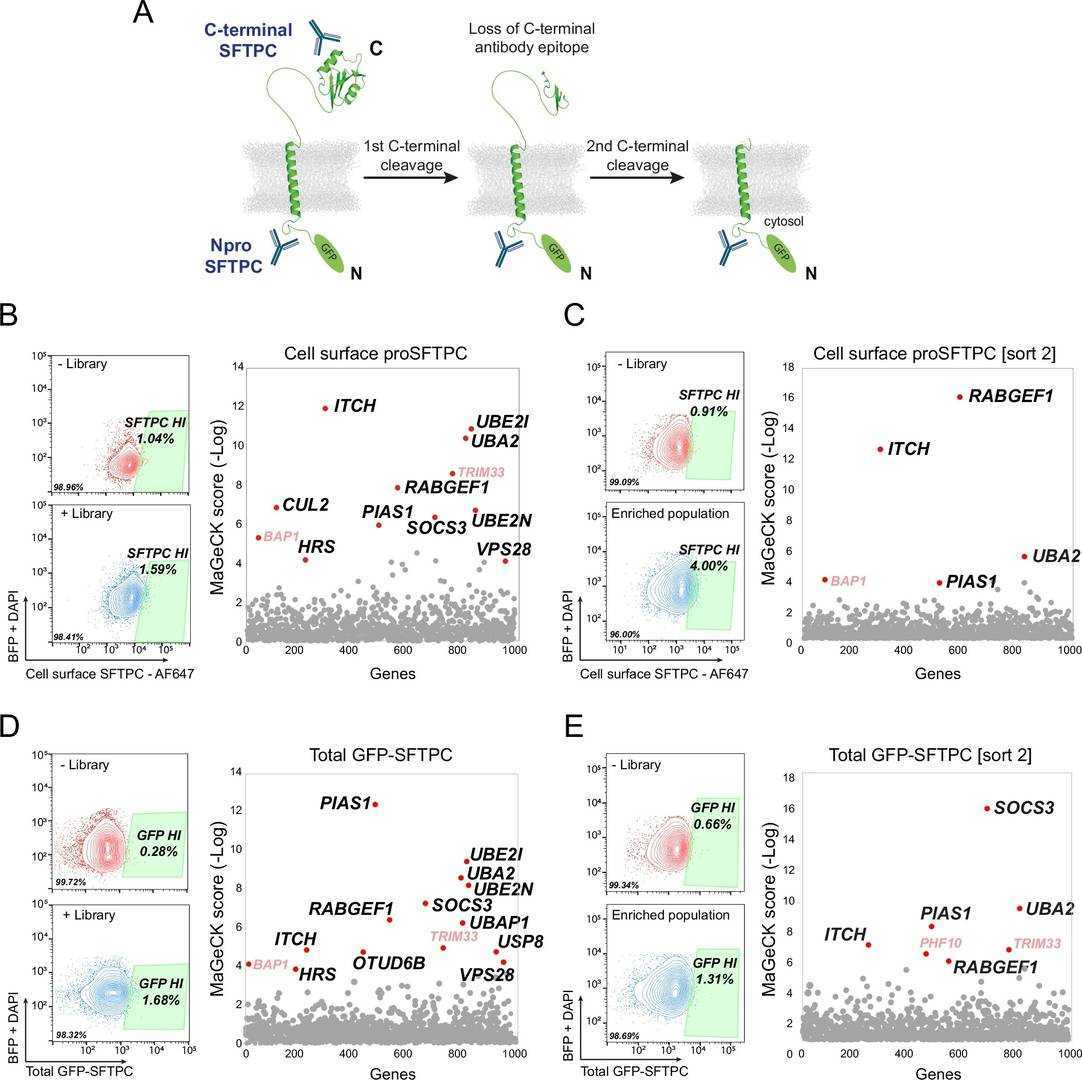 Fig.1 A forward genetic screen identifies candidate proteins involved in SFTPC processing and trafficking.1
Beyond this core biophysical function, SFTPC is also a central focus of basic pulmonary research:
We have developed a series of SFTPC protein products for research in membrane biophysics, structural biology, and pulmonary biology. For studies requiring the membrane-associated precursor, full-length proSFTPC preparations with defined sequences can be provided using appropriate expression systems. Product format and characterization can be selected according to the intended research application. For studies focused on mature SFTPC, peptide formats prepared by chemical synthesis or recombinant approaches can also be provided. Quality assessment is performed as appropriate for the specific product format. Product records document relevant information such as sequence, preparation format, processing history, and available characterization data, supporting sample traceability and research reproducibility.
Not finding the membrane protein product you need? Contact us to start your one-stop custom service!
Establishing a cell platform that can fully reproduce the in vivo biosynthesis and quality control processes of SFTPC is an essential, critical step for pulmonary epithelial cell research and preclinical evaluation of compounds. We have constructed stable SFTPC cell lines by integrating cutting-edge technologies. These cell lines can be stably passaged without easily losing the ability to express SFTPC, and can maintain authentic expression levels consistent with the native in vivo state, neither excessively high nor too low. Our collection of cell line resources not only includes cells that continuously express autosomal wild-type SFTPC, but also covers a series of different mutant variants. Every clonal cell line has undergone strict identification and confirmation, with accurate and error-free identity and characteristics. All these cell resources, which can be scaled up for culture to meet the needs of large-scale experiments, serve as the core foundation for conducting research on surfactant biology and optimizing reagents targeting the SFTPC pathway.
Not finding the stable cell line product you need? Contact us to start your one-stop custom service!
When paired with the series of sequence-specific, high-affinity monoclonal antibodies that we have carefully developed, your SFTPC research progress can be accelerated. These antibodies are specially designed to effectively overcome the research challenges posed by the structural complexity of SFTPC, this hydrophobic surfactant protein itself. Our antibodies can specifically recognize the complete SFTPC peptide without binding to other unrelated fragments, and have also completed comprehensive pre-validation of their performance, covering the following detection scenarios: quantitative Western blot detection under reducing and non-reducing conditions, direct and sandwich ELISA detection, flow cytometry analysis, and confocal laser scanning microscopy observation. These validated, wide-ranging application scenarios enable researchers to analyze SFTPC expression in a variety of experimental biological environments, and also allow for the design of more precise research antibodies for fundamental pulmonary biology research.
Not finding the recombinant antibody product you need? Contact us to start your one-stop custom service!
Extending well beyond our standard catalog, we deliver fully customizable discovery and manufacturing solutions meticulously tailored to the sophisticated demands of SFTPC-targeted research and compound development:
No. The entire range of SFTPC-directed proteins, stable expression systems, and affinity reagents is reserved exclusively for preclinical investigation. These materials have not been qualified for application to biological specimens collected with the aim of assessing donor pulmonary status or respiratory physiology.
Yes. The immunization approach leverages antigen presentations that preserve either the full-length precursor architecture or the mature hydrophobic core in its native membrane context, thereby enriching for clones with distinct domain selectivity.
Yes. We offer engineered cellular models in which the precursor is synthesized and subjected to documented maturation events, yielding processed species that accumulate within membrane-bound storage structures.
Our integrated catalogue spans three principal classes: recombinant SFTPC proteins in diverse biochemical presentations, stable expression systems with validated precursor processing and routing, and sequence-defined antibodies mapping to distinct maturation-stage determinants.









