Creative Biolabs is offering the most comprehensive services for antibody development projects. With strict regulation and effective execution, we are dedicated to providing the most valuable solutions to complete your projects.
HighlightsCreative Biolabs is offering the most comprehensive services for antibody development projects. With strict regulation and effective execution, we are dedicated to providing the most valuable solutions to complete your projects.
HighlightsCreative Biolabs has established a broad range of platforms for developing novel antibodies or equivalents. These cutting-edge technologies enable our scientists to meet your demands from different aspects and tailor the most appropriate solution that contributes to the success of your projects.
HighlightsWith deep understanding in antibody-related realms and extensive project experience, Creative Biolabs offers a variety of references to help you learn more about our capacities and achievements, including infographic, flyer, case study, peer-reviewed publications, and all kinds of knowledge that can assist your projects. You are also welcome to contact us directly for more specific solutions.
HighlightsGet a real taste of Creative Biolabs, one of the most professional custom service providers in the world. We are committed to providing highly customized comprehensive solutions with the best quality to advance your projects.
Highlights Loading...
All listed services and products are For Research Use Only. Do Not use in any diagnostic or therapeutic applications.
Solute carrier family 16 member 3 (SLC16A3), commonly referred to by transport biologists as monocarboxylate transporter 4 (MCT4), is the protein that allows glycolytically active cells to sustain glycolytic energy metabolism by exporting lactate together with protons, thereby limiting intracellular lactate accumulation and acidification. SLC16A3 is a 12-pass transmembrane protein that uses proton-coupled transport of monocarboxylates—including lactate, pyruvate, and ketone bodies—across the plasma membrane in a specific symport stoichiometric relationship. While there are 14 known MCT family members, SLC16A3 represents the lower-affinity/high-capacity end of the spectrum; i.e., it binds its substrate weakly, but transports it very quickly and in large quantities when required due to concentration gradients. The design of SLC16A3 is deliberate. When designing a protein that will continuously transport the lactate produced by glycolytically active cells, you need to provide a pathway for rapid flow of material rather than precise control of that material's movement. Finally, SLC16A3 is significantly upregulated in response to hypoxic and/or proliferative states within tissues—conditions that result in dramatic increases in glycolytic flux. It is within the context of cancer metabolism research that SLC16A3 has gained such widespread attention today. Tumors growing under the "Warburg effect" produce massive amounts of lactate and rely upon SLC16A3 as their primary export mechanism. Inhibition or deletion of SLC16A3 leads to a rapid collapse in intracellular pH, disruption of glycolytic flux and cell stress—all effects that have maintained SLC16A3 as a target for ongoing preclinical studies for several years.
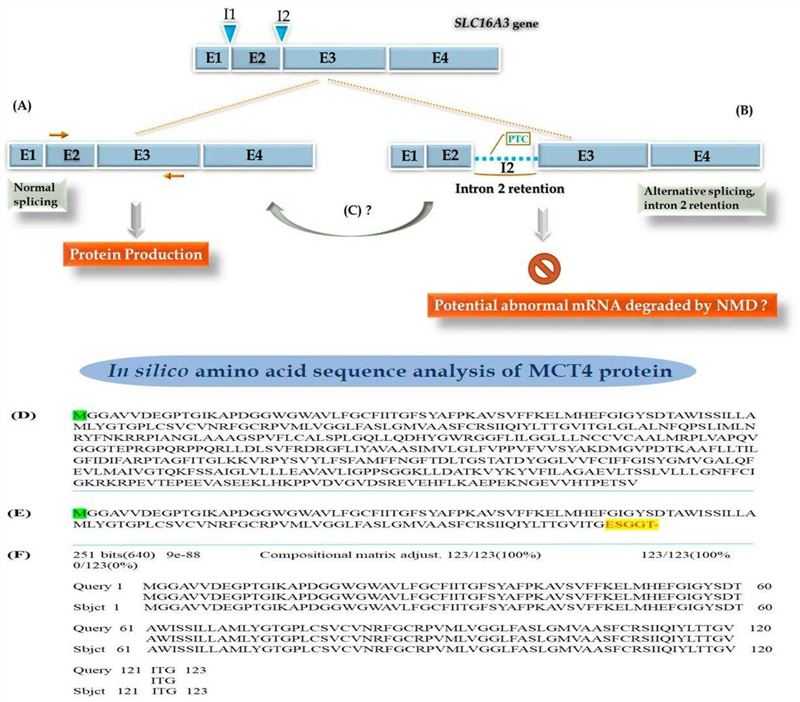 Fig.1 Alternative splicing of the Slc16a3 gene giving rise to intron retention.1
Several research currents keep converging on this transporter:
The first step in producing credible SLC16A3 is to solve the assembly issue. There are twelve transmembrane domains that need to be folded properly; there needs to be an assembled pathway for the substrate; and most importantly, there must be a valid chaperone relationship as well, since if a transporter cannot get to the cell surface, it cannot be examined at the cell surface. To produce full-length SLC16A3, you will use optimized eukaryotic expression systems that provide appropriate folding support based upon the architecture of SLC16A3. To test the quality of the SLC16A3 being produced, we perform release testing which includes checking for purity using SDS-PAGE, examining for monodispersity using analytical size exclusion chromatography (SEC), and determining the level of aggregation present in the sample using light scattering analyses. Your protocol may require a specific chaperone configuration, pH conditions, or even a presentation that matches your chosen transport assay. We can modify the format of the sample to meet the requirements of your protocol — our preparation is tailored to suit the experimental design.
Not finding the membrane protein product you need? Contact us to start your one-stop custom service!
The SLC16A3 cellular model depends on both the level of expression (density) and the availability of co-chaperone proteins. A transporter can only export when it has reached the cell surface as a fully assembled complex. Overexpression of wild type models can provide known levels of expression for studying transport and glycolysis. Prior to being released, each clone is evaluated: surface expression levels are compared with calibrated standards to determine the clones characteristics prior to experimental use. If your program requires a specific variant background, a unique chaperone configuration, or a specific expression schedule that fits into your glycolytic flux protocol, then we can customize the platform to accommodate these requirements. We create a customized cell line that meets the needs of the experiment you plan to use it for.
Not finding the stable cell line product you need? Contact us to start your one-stop custom service!
The antibody development for SLC16A3 has to deal with the 14-member family issue. There is a high level of sequence similarity in the transmembrane regions of the SLC16 carrier proteins. Therefore, when generic clones are produced they will cross-react with other monocarboxylate transporters. This cross-reactivity will affect the quantitative analysis of the amount of SLC16A3 in samples that have more than one type of monocarboxylate transporter. In this study, we selected only those clones that were capable of specifically binding to SLC16A3. We then verified each clone's ability to discriminate between SLC16A3 and other monocarboxylate transporters by using several different methods including; lysate quantitation, cell surface staining of cells expressing SLC16A3, fixed tissue distribution mapping, and live cell imaging of localization and internalization. We developed both chaperone complex-aware formats that recognize the heteromeric form of the transporter as well as clones that selectively bind to individual subunits of the transporter. Thus, depending upon what experimental question is addressed, the appropriate format can be chosen. All clones were produced using sequence-defined production processes, which allowed us to maintain consistent performance from lot-to-lot. Additionally, if an experimenter requires a clone with a different conjugate, wants to validate a clone on a specific type of sample, or would like to alter the clone format to fit their workflow, we are able to accommodate such requests upon request.
Not finding the recombinant antibody product you need? Contact us to start your one-stop custom service!
Extending well beyond our standard catalog, we deliver fully customizable discovery and manufacturing solutions meticulously tailored to the sophisticated demands of SLC16A3-targeted research and precompound development:
SLC16A3's products/services were developed solely as preclinical research tools. These products/services have not been tested or approved for use in clinical trials with humans.
It's enough to give me a short overview of your application, what kind of format you want it to have, and some ideas on acceptance criteria. We can then work on the technical details.
Catalog items work well for standard detection or transport workflows. Custom production makes sense when constructs, formats, or quality attributes step beyond routine specifications. A short consultation is usually enough to decide.
Yes. Custom formats and integrated multi-component engagements are routine, with unified quality frameworks keeping specifications aligned across components.