Creative Biolabs is offering the most comprehensive services for antibody development projects. With strict regulation and effective execution, we are dedicated to providing the most valuable solutions to complete your projects.
HighlightsCreative Biolabs is offering the most comprehensive services for antibody development projects. With strict regulation and effective execution, we are dedicated to providing the most valuable solutions to complete your projects.
HighlightsCreative Biolabs has established a broad range of platforms for developing novel antibodies or equivalents. These cutting-edge technologies enable our scientists to meet your demands from different aspects and tailor the most appropriate solution that contributes to the success of your projects.
HighlightsWith deep understanding in antibody-related realms and extensive project experience, Creative Biolabs offers a variety of references to help you learn more about our capacities and achievements, including infographic, flyer, case study, peer-reviewed publications, and all kinds of knowledge that can assist your projects. You are also welcome to contact us directly for more specific solutions.
HighlightsGet a real taste of Creative Biolabs, one of the most professional custom service providers in the world. We are committed to providing highly customized comprehensive solutions with the best quality to advance your projects.
Highlights Loading...
All listed services and products are For Research Use Only. Do Not use in any diagnostic or therapeutic applications.
The solute carrier family 22 member 5 (SLC22A5) is an quietly important transport system in cellular metabolism. Long chain fatty acids require a "shuttle" to cross into the mitochondria to be used for energy. This shuttle is known as carnitine. For the carnitine shuttle to function properly, there must be enough carnitine available. SLC22A5 is the transporter that supplies the carnitine needed for the shuttle to work. SLC22A5 is made up of twelve trans-membrane alpha helices which create a sodium-coupled conduit. This conduit allows SLC22A5 to bring carnitine into cells from the blood, gut lumen and tubular fluid, even when carnitine levels in those areas are much higher than inside the cell. It does so using a high-affinity, high-specificity pump that continuously functions to provide the energy needed by the heart, muscles and all other tissues that burn fat for energy. The substrate personality of SLC22A5 can be viewed as having two aspects. One aspect is carnitine, which SLC22A5 transports with sodium-coupled precision and high selectivity. Another aspect is a larger number of other organic cations such as zwitterions and weak bases that use the same conduit through sodium-independent routes with lower affinities. Due to the dual nature of SLC22A5, it has become an area of interest in drug-transport research. Many drugs can be transported by SLC22A5, and since SLC22A5 is located in several different organs including the kidneys, intestines and placenta, it can serve as a constant factor in studies of absorption, distribution and clearance. A genetic variation in humans that causes impaired carnitine uptake creates a well-defined deficiency condition in research subjects. This provides researchers with a natural loss-of-function series that can be used to study the physiological effects of impaired carnitine uptake such as reduced fatty-acid oxidation and energy depletion in tissues that rely on fats for energy.
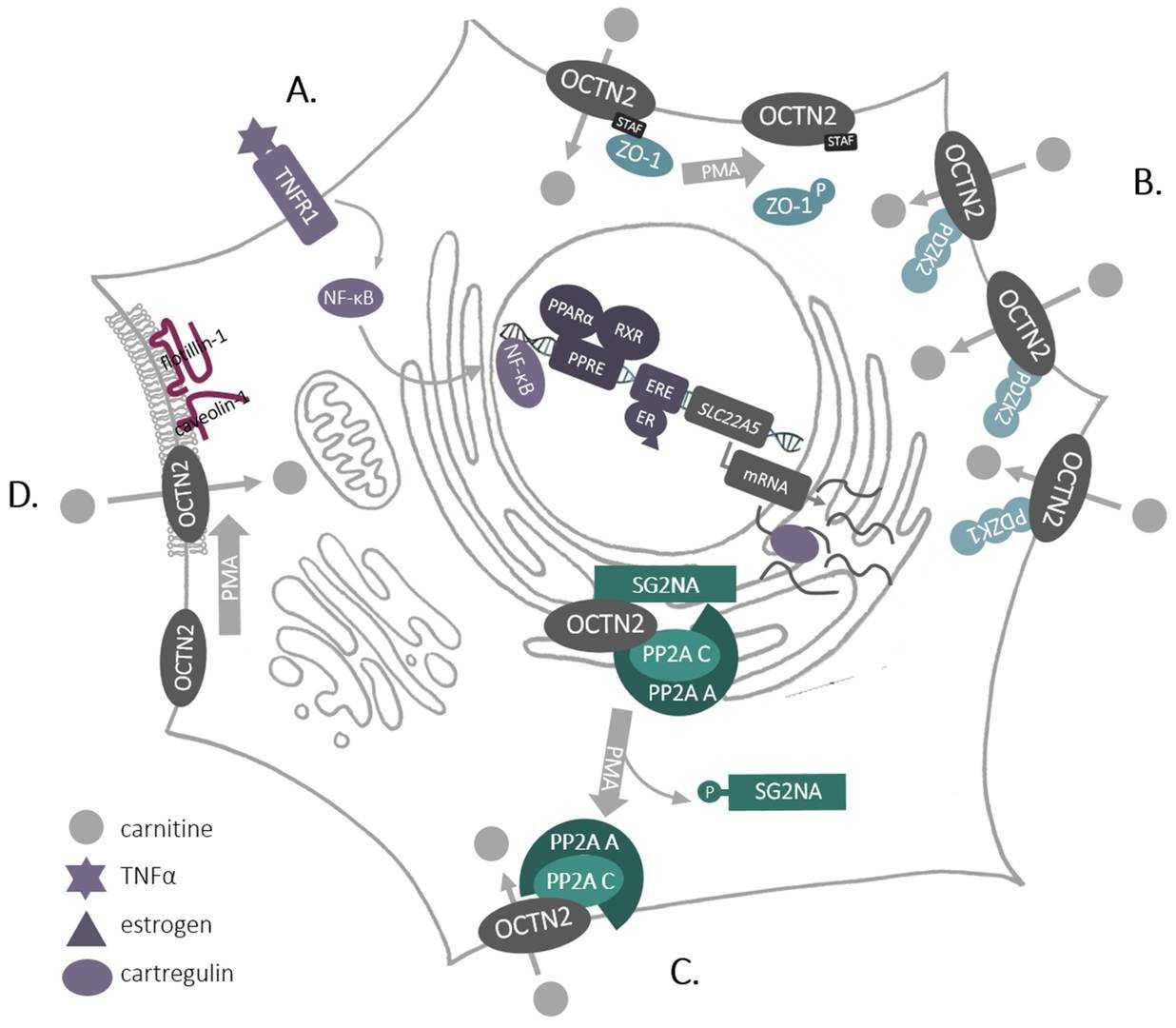 Fig.1 Regulation of SLC22A5/OCTN2 in the mammalian cell.1
Several research currents keep converging on this transporter:
The first step in producing a credible version of SLC22A5 is to maintain the sodium coupling throughout all of its constructs. Any preparation which loses its ability to bind sodium will also lose the carnitine uptake activity that is the hallmark of the transporter. In addition, preparations of SLC22A5 that are partially folded may pass quality control testing for purity but fail to provide any functional transport data. Full-length SLC22A5 is produced using our optimized eukaryotic expression system. Depending upon the requirements of your study (i.e., specific variant background, specific ionic environment, presentation suitable for a particular type of transport assay) the preparation may be modified according to your protocol - the preparation is designed based on the experimental design.
Not finding the membrane protein product you need? Contact us to start your one-stop custom service!
The cell model for SLC22A5 research relies on both the amount of protein on the cell surface (protein density) and whether the protein can couple to sodium. Only when a transporter has reached the cell surface with all components necessary for sodium-coupling, does that transporter function to provide carnitine. Overexpression of the wild type protein provides us with known protein densities that we use in our uptake and competition studies. Variant clones allow us to study mechanisms of reduced activity in many of the most prevalent activity-reducing backgrounds. All clones are characterized prior to being released to researchers so that we know how each clone behaves prior to starting any experimental work. If you require a specific variant background, protein density, or expression schedule based upon your uptake protocol, our platform can be customized to meet your needs. Our cell lines were designed specifically to conduct the experiments that you intend to perform.
Not finding the stable cell line product you need? Contact us to start your one-stop custom service!
Antibody development for SLC22A5 must account for the structural similarity shared across the SLC22 transporter family, particularly within the transmembrane core, as this similarity may increase the risk of cross-reactivity. Our antibody screening workflow prioritizes discrimination of SLC22A5 from related transporters and supports the selection of antibody formats appropriate for different research applications and sample contexts. Alternative conjugates, sample-specific assessment, and clone-format customization can be discussed according to individual experimental requirements.
Not finding the recombinant antibody product you need? Contact us to start your one-stop custom service!
Extending well beyond our standard catalog, we deliver fully customizable discovery and manufacturing solutions meticulously tailored to the sophisticated demands of SLC22A5-targeted research and precompound development:
Catalog items work well for standard detection or transport workflows. Custom production makes sense when constructs, formats, or quality attributes step beyond routine specifications. A short consultation is usually enough to decide.
Yes. Custom formats and integrated multi-component engagements are routine, with unified quality frameworks keeping specifications aligned across components.
Reactivity is validated against the antigen source species, and performance in other species depends on sequence conservation. Checking reactivity documentation against the sample origin is the fastest way to confirm fit.
All SLC22A5 products and services are provided strictly for preclinical research. They are not designed, validated, or authorized for any use involving human subjects.