Creative Biolabs is offering the most comprehensive services for antibody development projects. With strict regulation and effective execution, we are dedicated to providing the most valuable solutions to complete your projects.
HighlightsCreative Biolabs is offering the most comprehensive services for antibody development projects. With strict regulation and effective execution, we are dedicated to providing the most valuable solutions to complete your projects.
HighlightsCreative Biolabs has established a broad range of platforms for developing novel antibodies or equivalents. These cutting-edge technologies enable our scientists to meet your demands from different aspects and tailor the most appropriate solution that contributes to the success of your projects.
HighlightsWith deep understanding in antibody-related realms and extensive project experience, Creative Biolabs offers a variety of references to help you learn more about our capacities and achievements, including infographic, flyer, case study, peer-reviewed publications, and all kinds of knowledge that can assist your projects. You are also welcome to contact us directly for more specific solutions.
HighlightsGet a real taste of Creative Biolabs, one of the most professional custom service providers in the world. We are committed to providing highly customized comprehensive solutions with the best quality to advance your projects.
Highlights Loading...
All listed services and products are For Research Use Only. Do Not use in any diagnostic or therapeutic applications.
Solute Carrier Family 4 Member 1, abbreviated as SLC4A1. It also has two other previously widely used names—Band 3 protein, and Anion Exchanger 1 (AE1). It is a membrane glycoprotein that spans the cell membrane multiple times, and it is also the first discovered member of the SLC4 bicarbonate transporter superfamily. Structurally, the membrane-spanning mode of this protein has distinctive features: it has 14 transmembrane α-helices, which are divided into two groups with inverted topological arrangements, and together they fully pass through the lipid bilayer of the cell membrane. After spanning the membrane, these helices enclose a dedicated cavity in the center of the protein for conducting anions; this cavity can be accessed from both the inner and outer sides of the cell membrane to complete substance transport. In addition to the transmembrane domain, it also has a large N-terminal domain that remains inside the cell, extending into the cytoplasm to serve as a fixed anchoring scaffold for several important intracellular substances—including cytoskeletal components, various enzymes involved in glycolysis, and hemoglobin in red blood cells, all of which rely on this domain to be fixed in the correct position to perform their functions. SLC4A1 is abundantly expressed on the cell membrane of red blood cells, where it is responsible for catalyzing a core physiological reaction: enabling the electroneutral exchange of chloride and bicarbonate across the cell membrane at a 1:1 ratio that produces no net charge change. This transport process is an essential condition for the human body to expel carbon dioxide from the entire body. The specific process is as follows: CO2 produced by metabolism in various tissues of the body first converts into bicarbonate that can be transported by plasma in peripheral blood vessels with the cooperation of SLC4A1. When this bicarbonate flows with the blood to the capillary beds of the lungs, it can convert back into CO2 again, and ultimately be expelled from the body through respiration.
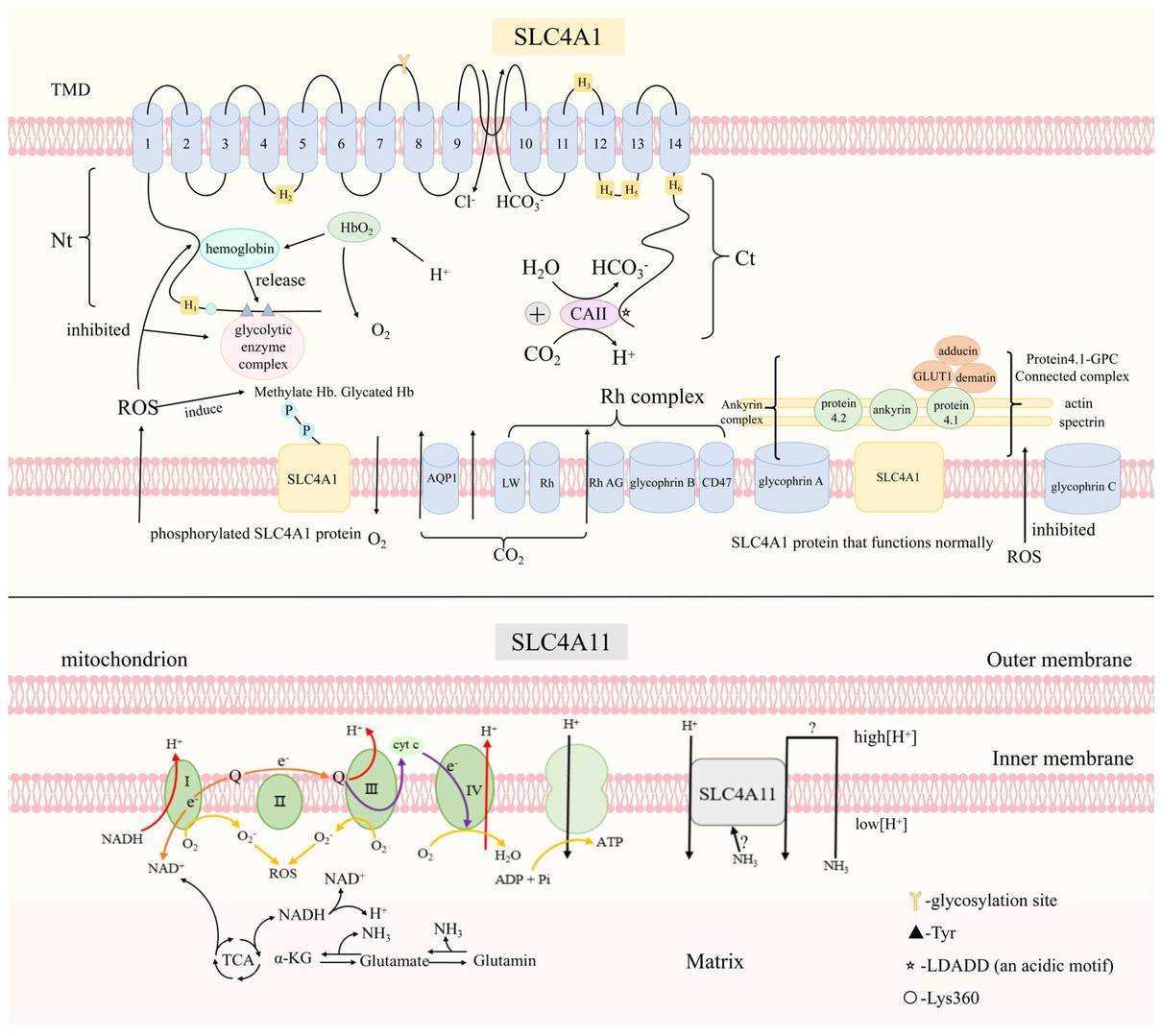 Fig.1 The role of SLC4A1 and SLC4A11.1
The physiological processes that SLC4A1 can coordinate are far more than simple ion transport:
We designed and constructed the full-length SLC4A1 membrane protein with high fidelity and completely accurate topology, which is specifically developed to overcome the long-standing bottlenecks in the biochemical research of 14-transmembrane transporters. SLC4A1 is a protein located on the cell membrane; the full-length version we have produced this time has a spatial structure that fully matches the correct natural topology. Our production process integrates cutting-edge membrane protein expression technologies, paired with a formulation that stabilizes the lipid environment, maintaining the natural conformation of the carrier protein throughout the entire process to ensure the protein retains its native state. This standardized, stable preparation system supports all types of biochemical analysis. Every batch of produced raw materials undergoes strict quality control and functional verification to ensure consistent performance across different experiments.
Not finding the membrane protein product you need? Contact us to start your one-stop custom service!
Establishing an original cell platform that can accurately reproduce the native biological properties of SLC4A1 membranes is critical for transport physiology research and early-stage compound evaluation. If a proprietary cell platform can be developed where the SLC4A1 membranes in the platform exhibit all biological properties identical to their natural counterparts, this platform will be an indispensable, core tool for both research projects on substance transmembrane transport in physiological processes and the early-stage evaluation of candidate compounds during drug development. We used advanced molecular technologies to construct SLC4A1 cell lines capable of stable passaging. In these cells, SLC4A1 always maintains correct plasma membrane localization and fully normal transport function, never mislocalized or non-functional. Our product portfolio includes not only commonly used cells expressing wild-type SLC4A1, but also a complete set of cell lines with different mutations, which can cover the research needs of various experimental scenarios, with different mutants adaptable to diverse research requirements. Every cell line has undergone comprehensive qualification certification. These scalable cell culture resources are an essential core foundation for the research reagents used to study membrane transport mechanisms and optimize reagents targeting the SLC4A1 pathway; whether scientists are studying the specific mechanisms of substance transmembrane transport, or optimizing research reagents targeting the pathway where SLC4A1 is located, these cell resources are an indispensable foundational condition.
Not finding the stable cell line product you need? Contact us to start your one-stop custom service!
We have carefully developed a complete set of sequence-specific, high-affinity monoclonal antibodies to help you advance your SLC4A1 research projects. SLC4A1 itself is a protein that crosses the cell membrane multiple times and is responsible for anion exchange, with a highly complex spatial structure. Our antibodies are rationally designed to specifically overcome this structural complexity, and only bind accurately and stably to correctly folded SLC4A1 without misrecognizing targets. Every antibody reagent has completed comprehensive pre-validation, including quantitative Western blot analysis under reducing and non-reducing conditions, direct and sandwich ELISA assays, flow cytometry analysis, and confocal microscopy observation. These verifications cover all commonly used detection scenarios in research. These multi-scenario functionally validated antibodies enable researchers to reliably characterize SLC4A1 expression in various biological environments, and also support the development of more targeted research tools for membrane biology, helping relevant researchers to advance their SLC4A1 research projects more efficiently.
Not finding the recombinant antibody product you need? Contact us to start your one-stop custom service!
Extending well beyond our standard catalog, we deliver fully customizable discovery and manufacturing solutions meticulously tailored to the sophisticated demands of SLC4A1-targeted research and precompound development:
Yes. The antibody generation strategy leverages immunogen formats that preserve the native membrane skeleton association context, thereby enriching for clones that recognize epitopes stabilized upon cytoskeletal tethering.
Yes. The protein collection features preparations engineered to preserve the characteristic multi-pass architecture and translocation pathway essential for substrate exchange.
Yes. We provide engineered cellular models in which the carrier is exteriorized with confirmed capacity for mediating substrate exchange across the membrane barrier.
Our standard catalogue spans three principal material classes: recombinant SLC4A1 proteins in diverse biochemical presentations, stable expression systems with validated surface integration, and sequence-defined antibodies mapping to distinct topological regions.