Creative Biolabs is offering the most comprehensive services for antibody development projects. With strict regulation and effective execution, we are dedicated to providing the most valuable solutions to complete your projects.
HighlightsCreative Biolabs is offering the most comprehensive services for antibody development projects. With strict regulation and effective execution, we are dedicated to providing the most valuable solutions to complete your projects.
HighlightsCreative Biolabs has established a broad range of platforms for developing novel antibodies or equivalents. These cutting-edge technologies enable our scientists to meet your demands from different aspects and tailor the most appropriate solution that contributes to the success of your projects.
HighlightsWith deep understanding in antibody-related realms and extensive project experience, Creative Biolabs offers a variety of references to help you learn more about our capacities and achievements, including infographic, flyer, case study, peer-reviewed publications, and all kinds of knowledge that can assist your projects. You are also welcome to contact us directly for more specific solutions.
HighlightsGet a real taste of Creative Biolabs, one of the most professional custom service providers in the world. We are committed to providing highly customized comprehensive solutions with the best quality to advance your projects.
Highlights Loading...
All listed services and products are For Research Use Only. Do Not use in any diagnostic or therapeutic applications.
Solute carrier family 6 member 19 (SLC6A19), formerly designated B0AT1 is an integral membrane protein of 540 amino acids. It is predominantly expressed in the apical membrane of epithelial cells and primarily at renal proximal convoluted tubule and small intestine but there are low levels was also detected in stomach, pancreas, liver prostate than skin. It serves as the major determinant of renal amino acid homeostasis, reabsorbing >95% neutral amino acids filtered by glomerulus in human kidney. In the intestinal tract, it mediates dietary free neutral amino acid absorption to complement peptide transport systems for efficient acquisition of nitrogen. Pathogenic variants in SLC6A19 are confirmed etiologic for the autosomal recessive disorder characterized by neutral aminoaciduria, pellagra-like skin rash and cerebellar ataxia with psychiatric phenotype. The clinical application of pharmacological inhibition of SLC6A19 is not limited to rare disease, as new research indicates potential use that involves blockade of renal reabsorption, potentially alleviating proximal tubule metabolic overload and decreasing the rate at which chronic kidney diseases progress.
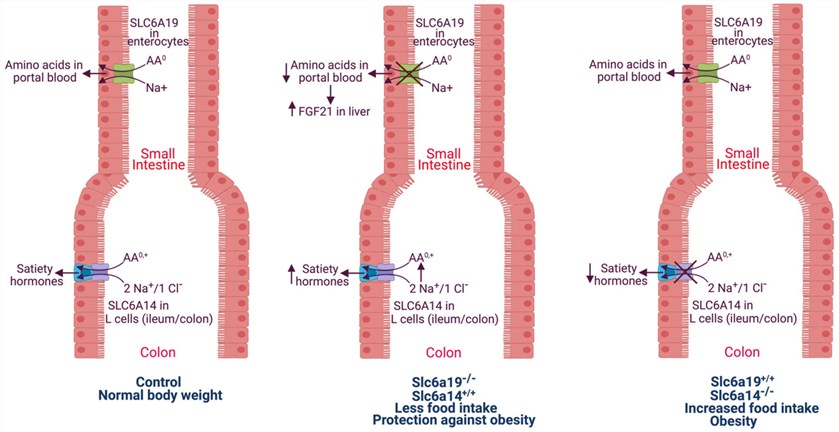 Fig.1 Functional crosstalk between SLC6A19 in the proximal small intestine and SLC6A14 in ileum and colon in the control of food intake and body weight.1
The functional spectrum of SLC6A19 is extensive, spanning a variety of physiological and therapeutic contexts:
Structural and pharmacological studies of SLC6A19 are hampered by the requirement for an appropriate lipid environment, conformational dynamics during the transport cycle, as well as the involvement of accessory proteins in surface trafficking. We tackle these challenges with a bespoke custom SLC6A19 protein design platform that provides membrane protein research constructs for structural biology, ligand-binding studies, and transport-related research. Our engineering team uses structural insights and codon-optimized gene synthesis to design constructs tailored to specific experimental requirements while considering key substrate- and ion-binding features of the transporter. For every project, you start with a comprehensive technical consultation to align the protein design architecture with your specific purpose. Specific accessory proteins, expression systems, preparation formats, and validation strategies are determined according to individual project requirements.
Not finding the membrane protein product you need? Contact us to start your one-stop custom service!
Functional expression of an amino acid transport, a reliable screen for inhibitors and studies on the interaction with accessory proteins all require robust cellular models that express SLC6A19 at their apical membrane. This example demonstrates the generation of stable cell lines with homogeneous levels of a single SLC6A19 transporter by virtue of optimized transduction and selection protocols. Ours is a cell-engineering platform utilizing lentiviral delivery, transposon integration and targeted knock-in approaches for precise genetic control. Subsequently, each line is rigorously selected for clonal purity (monoclonal selection) and fully phenotyped to confirm not only surface transporter density but also sodium-dependent phenylalanine uptake activity.
Not finding the stable cell line product you need? Contact us to start your one-stop custom service!
The availability of sequence-defined, high-affinity antibodies against SLC6A19 will be important for both detecting the transporter in kidney and intestinal tissue and mapping its apical membrane localization; indeed, similar antibodies have already been used to distinguish one member of this solute carrier family from another (SLC6A18 - B0AT3) or a different broader class altogether (e.g., Snat1/Sn at2/Slc38a4slc vs. other members that confer sodium-dependent transport). Creative Biolabs has designed comprehensive recombinant antibody discovery programs against both extracellular and intracellular SLC6A19 epitopes. Antibody Development Pipeline: We provide multi-platform selection with downstream engineering, immunogen design integrated into a single pipeline to deliver binders that possess the specificity, affinity and developability profiles for research applications. Our reproducible approach utilizes recombinant expression and clonal sequencing to remove the batch-to-batch variability that is seen with conventional polyclonal sera for a renewable, fully characterized reagent.
Not finding the recombinant antibody product you need? Contact us to start your one-stop custom service!
Beyond catalog products, Creative Biolabs provides sophisticated discovery services covering all needs for SLC6A19 research:
No. All SLC6A19 proteins, cell lines, antibodies, and custom services supplied by Creative Biolabs are designated for research use only.
Yes, we have reliably established dual-stable lines which constitutively express full-length SLC6A19 to approximate an amount threshold for collectrin over a bolus dependence time period.
Yes, the protein is purified in a mild non-ionic detergent buffer and then subjected to size-exclusion chromatography (SEC) into a lipid-compatible system. This allows for immediate incorporation into synthetic membranes in stopped-flow fluorimetry or radiolabeled substrate accumulation assays without the need to additionally dialyze out detergent.
Well, the immunogen is a region that highly conserved among all mammalian species - therefore we can get reliable detection in mouse and rat kidney and intestinal preparations without needing to use multiple various goods for each individual animal genus.