Creative Biolabs is offering the most comprehensive services for antibody development projects. With strict regulation and effective execution, we are dedicated to providing the most valuable solutions to complete your projects.
HighlightsCreative Biolabs is offering the most comprehensive services for antibody development projects. With strict regulation and effective execution, we are dedicated to providing the most valuable solutions to complete your projects.
HighlightsCreative Biolabs has established a broad range of platforms for developing novel antibodies or equivalents. These cutting-edge technologies enable our scientists to meet your demands from different aspects and tailor the most appropriate solution that contributes to the success of your projects.
HighlightsWith deep understanding in antibody-related realms and extensive project experience, Creative Biolabs offers a variety of references to help you learn more about our capacities and achievements, including infographic, flyer, case study, peer-reviewed publications, and all kinds of knowledge that can assist your projects. You are also welcome to contact us directly for more specific solutions.
HighlightsGet a real taste of Creative Biolabs, one of the most professional custom service providers in the world. We are committed to providing highly customized comprehensive solutions with the best quality to advance your projects.
Highlights Loading...
All listed services and products are For Research Use Only. Do Not use in any diagnostic or therapeutic applications.
Secretory leukocyte peptidase inhibitor (SLPI) is a small secreted mucosal glycoprotein encoded by the SLPI gene, produced by epithelial and myeloid secretory cells and distributed in mucosal extracellular fluid and epithelial membranes. It carries cysteine-rich conserved domains that selectively neutralize tissue-damaging serine proteases, while inhibiting pro-inflammatory transcription factor activation to relieve mucosal injury.
Under physiological conditions, basal SLPI secretion maintains balanced protease activity without suppressing normal immune surveillance. Upon pathogen invasion or mucosal damage, extracellular SLPI binds activated proteases to block extracellular matrix degradation, supporting epithelial barrier repair and inflammatory signal attenuation. Its mucosal protective function cannot be fully substituted by other antiprotease proteins; SLPI deficiency aggravates protease-driven tissue erosion and excessive inflammation, whereas stable SLPI expression sustains epithelial homeostasis, making it a core research target for mucosal secretory protein and inflammatory mechanism research.
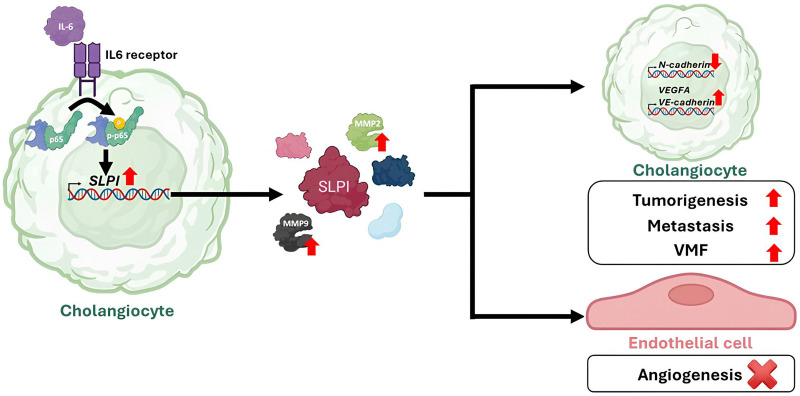 Fig. 1 IL-6/NF-κB-mediated SLPI upregulation promotes cholangiocarcinoma tumorigenesis, metastasis and vascular remodeling via MMP2/MMP9.1
Beyond physiological barrier protection, SLPI also participates in tumor-related signaling pathways. As shown in relevant studies, IL-6/NF-κB signaling induces SLPI upregulation in cholangiocytes. Elevated SLPI further increases MMP2/MMP9 activity, accelerating cholangiocarcinoma tumorigenesis, cell metastasis and vascular remodeling, while suppressing endothelial angiogenesis. This dual property renders SLPI a valuable research marker for both mucosal injury and tumor progression studies.
The biological functions of SLPI are focused on serine protease inhibition, epithelial barrier stabilization and mucosal inflammatory control:
Creative Biolabs offers high-quality SLPI proteins through optimized expression systems, including full-length secreted antiprotease glycoprotein and isolated protease-binding domain variants. These products retain native serine protease neutralization biological activity, suitable for extracellular protease interaction assays and mucosal inflammatory mechanism research. All SLPI proteins undergo strict quality control to ensure consistent performance and reliable application across diverse research platforms.
Not finding the membrane protein product you need? Contact us to start your one-stop custom service!
Creative Biolabs provides custom-engineered SLPI stable cell lines, including overexpression and blank control models. These cell lines are optimized for secretory antiprotease expression profiling and mucosal inflammatory signal functional analysis. Each cell line undergoes stringent validation to ensure stable expression profiles and consistent functional performance in diverse experimental contexts.
Not finding the stable cell line product you need? Contact us to start your one-stop custom service!
High-specificity recombinant antibodies targeting SLPI are developed via advanced antibody engineering technologies, with no cross-reactivity with other secreted antiprotease family proteins. These antibodies are validated for mucosal extracellular fluid and epithelial membrane localization detection and mucosal tissue secretion profiling, and can be combined with serine protease detection reagents to analyze complete SLPI inhibitory complexes in mucosal epithelial cell models.
Not finding the recombinant antibody product you need? Contact us to start your one-stop custom service!
Beyond catalog products, Creative Biolabs offers specialized custom services for SLPI research:
SLPI is a secreted mucosal glycoprotein that neutralizes inflammatory serine proteases to protect epithelial barriers and restrain local mucosal inflammation.
SLPI acts as a critical link between extracellular protease activity and mucosal tissue homeostasis, governing epithelial injury repair and local immune balance.
No, all SLPI products and services are strictly for research use only, not intended for clinical diagnosis or treatment.
Offerings include full-length SLPI secretory antiprotease glycoproteins, isoform-specific detection antibodies and custom stable cell lines for mucosal barrier research.
SLPI proteins are validated via serine protease neutralization functional testing.