
Creative Biolabs is offering the most comprehensive services for antibody development projects. With strict regulation and effective execution, we are dedicated to providing the most valuable solutions to complete your projects.
HighlightsCreative Biolabs is offering the most comprehensive services for antibody development projects. With strict regulation and effective execution, we are dedicated to providing the most valuable solutions to complete your projects.
HighlightsCreative Biolabs has established a broad range of platforms for developing novel antibodies or equivalents. These cutting-edge technologies enable our scientists to meet your demands from different aspects and tailor the most appropriate solution that contributes to the success of your projects.
HighlightsWith deep understanding in antibody-related realms and extensive project experience, Creative Biolabs offers a variety of references to help you learn more about our capacities and achievements, including infographic, flyer, case study, peer-reviewed publications, and all kinds of knowledge that can assist your projects. You are also welcome to contact us directly for more specific solutions.
HighlightsGet a real taste of Creative Biolabs, one of the most professional custom service providers in the world. We are committed to providing highly customized comprehensive solutions with the best quality to advance your projects.
Highlights Loading...
All listed services and products are For Research Use Only. Do Not use in any diagnostic or therapeutic applications.
SRY box transcription factor 1(SOX1) is a soluble nuclear polypeptide encoded by SOX1 gene, which is specifically located in the nucleus of neural progenitors in the early stage of development, and is a key transcription regulator in the stage of tissue development. The protein has no transmembrane hydrophobic fragment and extracellular domain, and its core structure is a highly conserved high mobility group (HMG)DNA binding frame with variable N-and C-terminal regulatory sequences at both ends, which constitutes a unique topological structure of nuclear transcription factors. Biochemical studies have confirmed that SOX1 can specifically bind to DNA sulcus region through HMG domain, stably anchor chromatin, recruit nuclear co-regulatory complexes, and accurately regulate the transcription level of target genes.
Insufficient expression of SOX1 in nucleus will destroy the fate and differentiation order of progenitor cells during the maturation of nerve tissue. The gradient expression of SOX1 in nucleus can form a dose-dependent transcription buffer effect, balance the self-renewal and differentiation process of neural progenitor cells, and maintain the steady state of neural development. Different accumulation thresholds of nuclear SOX1 can be established at different developmental stages of the organism, and its C-terminal regulatory region can dynamically adjust the binding strength of protein and chromatin neighboring regions for co-activation and co-inhibition complexes, so as to adapt to the transcription regulatory requirements at different developmental stages. In addition, the conserved arginine residues in HMG domain can form hydrogen bonds with DNA minor groove bases, ensuring the sequence specificity and chromatin anchoring stability of SOX1 binding to target genes, and accurately regulating the development and differentiation process of neural progenitor cells.
Variants within the SOX1 HMG coding segment might alter DNA minor groove contact residues and shift target sequence binding preference, which could disrupt ordered neural progenitor differentiation timing in developmental model systems. No other SOX family paralog fully replicates SOX1’s unique set of chromatin target loci in early neural lineages, though partial overlapping DNA binding sequence selectivity exists among related SOX transcription factors. SOX1 exists exclusively as soluble intranuclear protein without membrane integration or cytoplasmic steady-state accumulation. Its fully nuclear localization grants dual functional potential: sequence-specific chromatin anchoring and dosage-tunable recruitment of nuclear transcriptional regulatory assemblies. Lowered intranuclear SOX1 levels weaken fate-restricting transcriptional programs and accelerate uncoordinated progenitor differentiation, making this nuclear factor a suitable research target for early neural developmental regulation analysis.
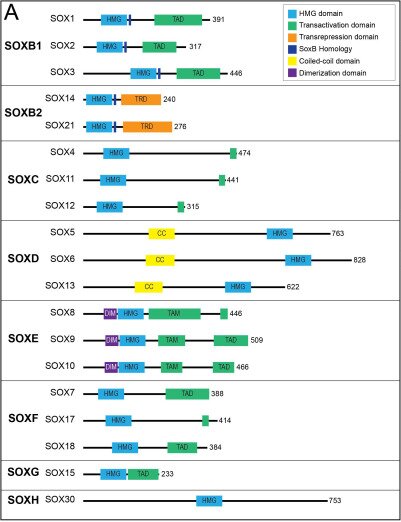 Fig. 1 Domain organization of SOX‑B1 subfamily transcription factor SOX1, illustrating conserved HMG‑box and C‑terminal trans‑activation domain.1
The biological functions of soluble nuclear SOX1 transcription factor are focused on sequence-selective chromatin anchoring and co-regulator complex recruitment:
Creative Biolabs offers purified SOX1 protein samples produced under unified preparation workflows, including full-length SOX1 constructs and isolated HMG DNA-binding domain variants. Truncated polypeptide fragments cannot support complete sequence-specific chromatin binding activity, while full-length forms fit early neural transcription research. All batches receive uniform quality screening. Functional assessments may only be performed under simulated intranuclear aqueous microenvironment setups. Conserved HMG box DNA contact structural features are preserved across batches to support comparative chromatin binding analysis between experimental groups. Full-length SOX1 samples retain intact minor groove interaction residues post-purification, supporting reliable detection of transient DNA-transcription factor complexes in comparative functional analysis.
Not finding the Protein product you need? Contact us to start your one-stop custom service!
Creative Biolabs provides cell research models with adjustable SOX1 expression levels, suitable for structural observation of soluble nuclear SOX transcription factors and early neural development research. Sample assessment covers intranuclear protein quantification and chromatin co-binding analysis, enabling side-by-side comparison of transcriptional buffering capacity under varying SOX1 abundances. These cell models can be paired with neural progenitor marker detection schemes to track differentiation timing shifts linked to SOX1 nuclear dosage changes.
Not finding the stable cell line product you need? Contact us to start your one-stop custom service!
Anti-SOX1 recombinant antibodies are generated via standardized workflows, compatible with nuclear compartment localization mapping and chromatin complex identification. The antibody series supports multi-dimensional observation of SOX1 distribution within early neural progenitor nuclei.
Not finding the recombinant antibody product you need? Contact us to start your one-stop custom service!
Beyond catalog products, Creative Biolabs offers specialized custom services for SOX1 research:
SOX1 may act as soluble nuclear transcription factor to bind neural regulatory DNA minor grooves and recruit co-regulator complexes tuning progenitor transcription programs.
Intranuclear SOX1 dosage might adjust neural progenitor differentiation timing, serving as a key mediator of early neural developmental homeostasis biological processes.
No, all SOX1 related products and services are strictly for research use only, and cannot be applied in clinical workflows. All material design and functional screening are optimized exclusively for basic laboratory research, without meeting clinical application criteria.
Offerings include full-length SOX1 protein, target-specific recombinant antibodies and tunable expression cell research models, supporting research on neural chromatin transcriptional regulation.
Laboratory analysis schemes may include regulatory DNA co-binding assays to assess minor groove sequence recognition capacity under simulated intranuclear environments.









