
Creative Biolabs is offering the most comprehensive services for antibody development projects. With strict regulation and effective execution, we are dedicated to providing the most valuable solutions to complete your projects.
HighlightsCreative Biolabs is offering the most comprehensive services for antibody development projects. With strict regulation and effective execution, we are dedicated to providing the most valuable solutions to complete your projects.
HighlightsCreative Biolabs has established a broad range of platforms for developing novel antibodies or equivalents. These cutting-edge technologies enable our scientists to meet your demands from different aspects and tailor the most appropriate solution that contributes to the success of your projects.
HighlightsWith deep understanding in antibody-related realms and extensive project experience, Creative Biolabs offers a variety of references to help you learn more about our capacities and achievements, including infographic, flyer, case study, peer-reviewed publications, and all kinds of knowledge that can assist your projects. You are also welcome to contact us directly for more specific solutions.
HighlightsGet a real taste of Creative Biolabs, one of the most professional custom service providers in the world. We are committed to providing highly customized comprehensive solutions with the best quality to advance your projects.
Highlights Loading...
All listed services and products are For Research Use Only. Do Not use in any diagnostic or therapeutic applications.
Sterol regulatory element binding transcription factor 1(SREBF1, also known as SREBP1) is an endoplasmic reticulum anchored precursor transcription factor encoded by SREBF1 gene. After protein shearing, it can form an active nuclear subtype, which is widely expressed in liver, adipose tissue and proliferating tumor cells. Unlike SREBF2, which mainly regulates cholesterol synthesis, mature SREBF1 activated by nucleus can specifically bind to sterol response elements (SREs), and target the transcription and expression of gene clusters related to fatty acid and triglyceride synthesis. In the physiological state of sterol deficiency, SREBF1 can enter the nucleus through proteolytic shearing, start the physiological lipid synthesis process, and provide sufficient lipid raw materials for cell membrane structure synthesis. However, under the pathological state of insulin stimulation or malignant transformation of cells, SREBF1 will be continuously overactivated, which will drive the abnormal de novo synthesis of lipids and provide material support for the rapid division and proliferation of tumor cells. Compared with conventional housekeeping transcription factors, SREBF1 has a unique function of specifically regulating fatty acid synthesis, and can not be compensated by other SREBP family subtypes. The loss of SREBF1 function can significantly inhibit the expression of lipid synthesis gene and block the proliferation of tumor cells; However, the sustained over-activation of this molecule will induce fatty degeneration of liver and accelerate the malignant progress of tumor, which is the core target of lipid transcription regulation mechanism research and metabolic anti-tumor drug screening.
SREBF1 realizes sterol sensing and transcription regulation through the shear transport cycle of endoplasmic reticulum-nucleus, and specifically recognizes and binds the downstream SRE nucleic acid sequence by relying on the conserved basic helix-loop-helix leucine zipper (bHLH-LZ) domain. Its unique DNA binding motif clearly distinguishes its function of targeting fatty acid metabolism from SREBF2, which regulates cholesterol metabolism, and forms a lipid regulation pathway with specific functions. SREBF1-mediated transcription cascade can link the sterol sensing signal with the cytoplasmic lipid synthesis and metabolism pathway, and dynamically regulate the lipid synthesis flux according to the nutritional status of the body and the signal of cell proliferation. This transcription factor is widely involved in many key physiological and pathological processes, such as adipocyte differentiation, liver lipid homeostasis maintenance and tumor cell metabolic reprogramming. Deficient SREBF1 signaling abolishes baseline fatty acid synthesis capacity. Therefore, SREBF1 represents a pivotal research target for lipogenic transcription study and metabolic compound screening.
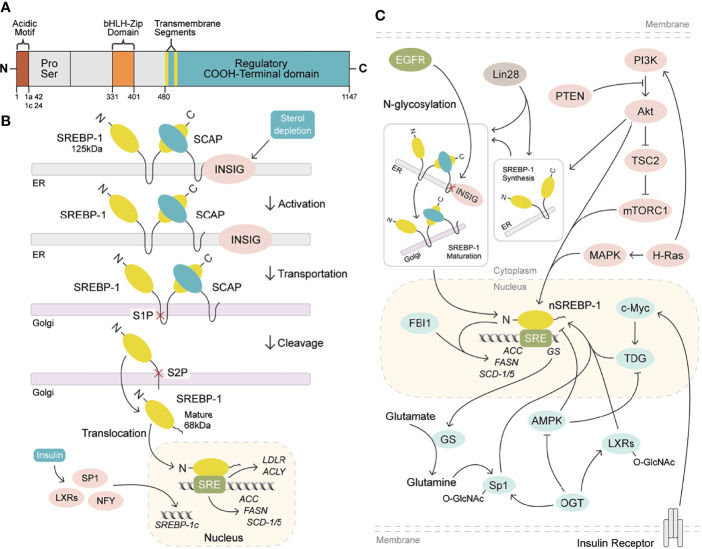 Fig. 1 Schematic diagram of SREBP-1 protein structure, sterol-dependent maturation cascade and oncogenic upstream signaling network.1
The biological functions of SREBF1 are focused on SRE DNA binding and fatty acid gene transactivation:
Creative Biolabs offers high-quality SREBF1 full-length precursor and mature nuclear isoform proteins, including isolated bHLH-LZ DNA-binding domain variants. These products retain native SRE DNA binding and transcriptional cofactor interaction activity, suitable for lipogenic transcriptional screening assays. All SREBF1 proteins undergo strict quality control to ensure consistent performance and reliable application across diverse research platforms.
Not finding the membrane protein product you need? Contact us to start your one-stop custom service!
Creative Biolabs provides custom-engineered SREBF stable cell lines, including overexpression and blank control models. These cell lines are optimized for lipogenic transcription profiling and fatty acid metabolic signal functional analysis. Each cell line undergoes stringent validation to ensure stable expression profiles and consistent functional performance in diverse experimental contexts.
Not finding the stable cell line product you need? Contact us to start your one-stop custom service!
High-specificity recombinant antibodies targeting SREBF1 are developed via advanced antibody engineering technologies, with no cross-reactivity with SREBF2 paralogs. These antibodies are validated for ER membrane and nuclear dual localization detection and liver/tumor tissue expression profiling, and can be combined with FASN detection reagents to analyze lipogenic transcriptional complexes in metabolic cell models.
Not finding the recombinant antibody product you need? Contact us to start your one-stop custom service!
Beyond catalog products, Creative Biolabs offers specialized custom services for SREBF1 research:
A1: SREBF1 is an ER-derived transcription factor that enters nucleus to bind SRE sequences and activate fatty acid synthesis target genes.
A2: SREBF1 acts as master switch of de novo lipogenesis, driving hepatic steatosis and cancer metabolic reprogramming.
A3: No, all SREBF1 products and services are strictly for research use only, not intended for clinical diagnosis or treatment.
A4: Offerings include full-length/pre-cleaved SREBF1 proteins, isoform-specific detection antibodies and custom stable cell lines for lipid transcription research.
A5: SREBF1 proteins are validated via SRE promoter DNA binding and lipogenic gene transactivation functional testing.








