Creative Biolabs is offering the most comprehensive services for antibody development projects. With strict regulation and effective execution, we are dedicated to providing the most valuable solutions to complete your projects.
HighlightsCreative Biolabs is offering the most comprehensive services for antibody development projects. With strict regulation and effective execution, we are dedicated to providing the most valuable solutions to complete your projects.
HighlightsCreative Biolabs has established a broad range of platforms for developing novel antibodies or equivalents. These cutting-edge technologies enable our scientists to meet your demands from different aspects and tailor the most appropriate solution that contributes to the success of your projects.
HighlightsWith deep understanding in antibody-related realms and extensive project experience, Creative Biolabs offers a variety of references to help you learn more about our capacities and achievements, including infographic, flyer, case study, peer-reviewed publications, and all kinds of knowledge that can assist your projects. You are also welcome to contact us directly for more specific solutions.
HighlightsGet a real taste of Creative Biolabs, one of the most professional custom service providers in the world. We are committed to providing highly customized comprehensive solutions with the best quality to advance your projects.
Highlights Loading...
All listed services and products are For Research Use Only. Do Not use in any diagnostic or therapeutic applications.
STEAP family member 1B (STEAP1B) is a six-transmembrane integral plasma membrane metalloreductase encoded by STEAP1B gene, a paralog of tumor-enriched STEAP1 with conserved heme-containing intramembrane catalytic domains specialized for reduction of extracellular ferric Fe³⁺ and cupric Cu²⁺ metal ions into bioavailable ferrous Fe²⁺ and cuprous Cu⁺ substrates prior to cellular metal ion uptake via SLC11A2/DMT1 and copper transporters. The polypeptide forms homotrimeric membrane assemblies with internal heme prosthetic groups embedded within conserved transmembrane helical pockets that transfer electrons from intracellular NADPH across the lipid bilayer to extracellular metal ion substrates. Under normal epithelial cell physiological conditions, basal STEAP1B metalloreductase activity sustains balanced cellular iron and copper pools required for heme synthesis, mitochondrial respiratory complex assembly and metalloenzyme catalytic function. In multiple solid tumor microenvironments, STEAP1B transcription is significantly upregulated to meet elevated metal demand for rapid proliferative biosynthetic pathways, fueling cell cycle progression and antioxidant redox buffering within malignant clones. Distinct from related STEAP paralogs with tissue-restricted expression, STEAP1B exhibits broad epithelial and tumor distribution and displays comparable dual iron/copper reductase activity, acting as a primary cell-surface metal processing enzyme with limited functional compensation by other STEAP isoforms in proliferative cell populations. Suppressed STEAP1B activity reduces intracellular bioavailable iron and copper pools, slows tumor cell division and sensitizes malignant cells to metal-targeted cytotoxic agents, while sustained STEAP1B overexpression accelerates proliferative metabolism and supports aggressive tumor growth, establishing STEAP1B as a core research target for transmembrane metalloreductase biology and tumor metal metabolism therapeutic screening.
STEAP1B executes core trans-membrane electron transfer metalloreductase function organized into plasma membrane homotrimeric complexes: cytoplasmic NADPH provides electron donors that traverse intramembrane heme cofactor chains within each STEAP1B subunit to reduce extracellular oxidized metal cations at the cell surface leaflet. Conserved histidine residues coordinate heme prosthetic groups within transmembrane pockets to maintain stable electron transport chains and prevent uncoupled reactive oxygen species leakage during metal reduction cycles. Extracellular metal ion reduction catalyzed by STEAP1B generates reduced metal substrates compatible with high-affinity divalent metal importers, coupling extracellular metal availability to intracellular biosynthetic demand. STEAP1B-dependent metal ion processing sustains balanced cellular metal redox homeostasis, covering controlled iron/copper uptake for mitochondrial metabolism and metalloprotein assembly while limiting toxic free oxidized metal ion accumulation at cell surfaces. STEAP1B participates in a broad spectrum of physiological and oncological processes including normal epithelial metal nutrient absorption, mitochondrial respiratory complex biogenesis and tumor proliferative metal metabolism reprogramming. Dysregulated STEAP1B overexpression expands intracellular bioavailable metal pools to support unrestrained malignant cell cycle progression. Therefore, STEAP1B represents a pivotal research target for six-transmembrane metalloreductase study and metal metabolism-targeted anti-tumor compound discovery.
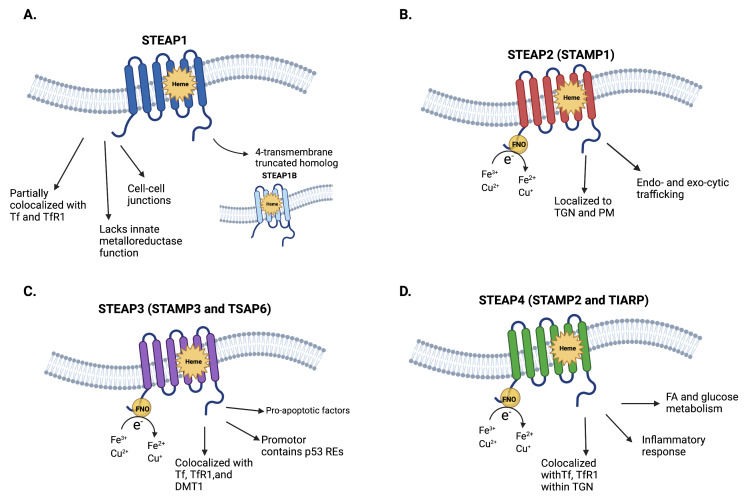 Fig. 1 Structural and functional comparison across four STEAP paralogs, covering metal ion reduction, subcellular distribution and variant features of truncated STEAP1B.1
The biological functions of STEAP1B are focused on heme-mediated trans-bilayer electron transfer, dual iron-copper metalloreduction and proliferative cell metal supply control:
Creative Biolabs offers high-quality STEAP1B proteins through optimized expression systems, including full-length six-transmembrane homotrimeric metalloreductase and isolated heme-containing catalytic transmembrane domain variants. These products retain native conformational characteristics and NADPH-dependent Fe³⁺/Cu²⁺ reductase biological activity, suitable for membrane metal enzyme interaction assays and tumor metal metabolism targeted compound screening. All STEAP1B proteins undergo strict quality control to ensure consistent performance and reliable application across diverse research platforms.
Not finding the membrane protein product you need? Contact us to start your one-stop custom service!
Creative Biolabs provides custom-engineered STEAP1B stable cell lines, including overexpression and catalytic site mutant loss-of-function control models. These cell lines are optimized for extracellular metal reduction profiling and tumor proliferative metal metabolism functional analysis. Each cell line undergoes stringent validation to ensure stable expression profiles and consistent functional performance in diverse experimental contexts.
Not finding the stable cell line product you need? Contact us to start your one-stop custom service!
High-specificity recombinant antibodies targeting STEAP1B are developed via advanced antibody engineering technologies, with no cross-reactivity with STEAP1 and other STEAP family metalloreductase paralogs. These antibodies are validated for epithelial and tumor cell plasma membrane localization detection and metal metabolism tissue expression profiling, and can be paired with SLC11A2 detection reagents to analyze complete cellular metal uptake cascade complexes in proliferative cell tumor research models.
Not finding the recombinant antibody product you need? Contact us to start your one-stop custom service!
Beyond catalog products, Creative Biolabs offers specialized custom services for STEAP1B research:
STEAP1B is a six-transmembrane heme metalloreductase that transfers intracellular electrons across the plasma membrane to reduce extracellular iron and copper ions for cellular uptake.
Tumor-selective upregulation of STEAP1B drives metal-dependent malignant proliferation, making it a unique target for metal metabolism anti-cancer therapeutic screening.
No, all STEAP1B products and services are strictly for research use only, not intended for clinical diagnosis or treatment.
Offerings include full-length STEAP1B homotrimeric membrane metalloreductase proteins, isoform-specific detection antibodies and custom stable cell lines for tumor metal metabolism research.
STEAP1B proteins are validated via NADPH-dependent extracellular ferric iron and cupric copper ion reductase functional testing.