
Creative Biolabs is offering the most comprehensive services for antibody development projects. With strict regulation and effective execution, we are dedicated to providing the most valuable solutions to complete your projects.
HighlightsCreative Biolabs is offering the most comprehensive services for antibody development projects. With strict regulation and effective execution, we are dedicated to providing the most valuable solutions to complete your projects.
HighlightsCreative Biolabs has established a broad range of platforms for developing novel antibodies or equivalents. These cutting-edge technologies enable our scientists to meet your demands from different aspects and tailor the most appropriate solution that contributes to the success of your projects.
HighlightsWith deep understanding in antibody-related realms and extensive project experience, Creative Biolabs offers a variety of references to help you learn more about our capacities and achievements, including infographic, flyer, case study, peer-reviewed publications, and all kinds of knowledge that can assist your projects. You are also welcome to contact us directly for more specific solutions.
HighlightsGet a real taste of Creative Biolabs, one of the most professional custom service providers in the world. We are committed to providing highly customized comprehensive solutions with the best quality to advance your projects.
Highlights Loading...
All listed services and products are For Research Use Only. Do Not use in any diagnostic or therapeutic applications.
STEAP2, STEAP2 metalloreductase, is a transmembrane metalloreductase encoded by the STEAP2 gene. This protein localizes to plasma membrane and intracellular membrane compartments within specific cell populations. The polypeptide contains multiple transmembrane helical segments and cytoplasmic oxidoreductase related domains. Transmembrane segments support metal ion related electron transport across membrane compartments. Cytoplasmic domains mediate cofactor interaction and intermolecular contacts with potential regulatory partners. Newly synthesized STEAP2 polypeptide folds within intracellular biosynthetic compartments. Proper folding and domain arrangement are prerequisites for efficient metalloreductase activity. Restricted cell populations express STEAP2 at detectable levels. Posttranslational modification events applied to STEAP2 polypeptide itself could tune its molecular availability within cellular space, and may adjust the extent of intermolecular contacts formed with potential binding partners. Distinct cellular contexts tend to shape the overall pool of functional STEAP2 molecules, as surrounding molecular environment can influence domain exposure and access toward candidate interaction partners. Variation of polypeptide abundance does not always correspond to equivalent enzymatic output, since intrinsic domain accessibility can place additional constraints on metalloreductase function.
STEAP2 mediated electron transport might support metal ion reduction related molecular events and may contribute to cellular metal homeostasis associated molecular cascades. Variation in STEAP2 expression level alters the total pool of accessible metalloreductase molecules within cellular environments. Residue alteration within transmembrane segments can impair electron transport capability. Sequence variation within cytoplasmic oxidoreductase related domains could disturb cofactor interaction behaviours without abolishing full length polypeptide folding. Shifts in intracellular STEAP2 abundance may reshape the range of available interacting molecules and modulate downstream molecular events linked to metal ion status. Different interaction partners may display uneven sensitivity toward STEAP2 mediated molecular events, which is proposed to generate graded biological responses inside cellular systems. Altered metalloreductase activity might indirectly reshape the composition of intracellular molecular complexes by changing metal ion associated status of selected binding partners. Such indirect effects do not rely on stable physical interaction between STEAP2 and every downstream effector molecule, and can expand the scope of molecular events influenced by this metalloreductase within complex cellular contexts.
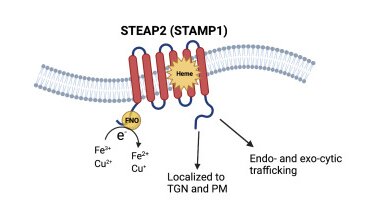 Fig. 1 Topology and catalytic feature of STEAP2 metalloreductase. STEAP2 is a multi pass integral membrane metalloreductase. Transmembrane helices support membrane integration, while embedded prosthetic groups enable electron transfer for metal ion reduction.1
The biological functions of STEAP2 are focused on electron transport, membrane integration and modulation of cellular metal homeostasis:
Creative Biolabs offers purified STEAP2 protein samples via standardized preparation workflows, including full length STEAP2 constructs and isolated individual domain variants. Isolated domain fragments cannot recapitulate complete multi domain coordinated behaviours observed for full length polypeptide, while full length constructs may be suited for metalloreductase and interaction associated research. All samples receive routine quality screening. Functional relevant observation may only be carried out with full length samples under appropriate simulated molecular environments. All sample batches follow unified processing standards to maintain consistent structural features for comparative laboratory analysis across separate test groups.
Not finding the membrane potein product you need? Contact us to start your one-stop custom service!
Creative Biolabs provides adjustable STEAP2 expression cell models with varied expression levels, applicable to integral membrane metalloreductase modular characteristic observation and molecular interaction related research. Sample evaluation includes sustained target expression detection and preliminary intermolecular interaction associated observation, which can support comparative analysis of metalloreductase associated behaviours under different expression statuses. These cell systems can be matched with diverse laboratory analysis schemes to observe changes of molecular engagement efficiency under different target expression abundances.
Not finding the stable cell line product you need? Contact us to start your one-stop custom service!
Antibody reagents targeting STEAP2 are generated via mature protein preparation workflows, compatible with multiple routine laboratory detection methods for cellular localization profiling and molecular complex identification, to support systematic analysis of STEAP2 distribution and metalloreductase associated molecular complexes across diverse laboratory research setups. The antibody series can cooperate with other common laboratory detection reagents to complete multi dimensional observation of target distribution inside tissue samples.
Not finding the recombinant antibody product you need? Contact us to start your one-stop custom service!
Beyond catalog products, Creative Biolabs offers specialized custom services for STEAP2 research:
STEAP2 may function as transmembrane metalloreductase and participate in electron transport, membrane integration and modulation of cellular metal homeostasis.
STEAP2 expression status may influence available metalloreductase pool for molecular interaction, serving as a regulatory mediator of cellular metal related biological processes.
No, all STEAP2 related products and services are strictly for research use only, not intended for clinical related operations. All material designs and functional tests are only optimized for basic laboratory research scenarios, without matching clinical application standards.
Offerings include full length STEAP2 protein, target specific recombinant antibodies and adjustable expression cell research models, supporting metalloreductase molecular interaction research.
These reagents are suited for research focused on STEAP2 driven molecular events, including modular domain function, molecular binding and electron transport related mechanistic studies under laboratory research only settings.









