
Creative Biolabs is offering the most comprehensive services for antibody development projects. With strict regulation and effective execution, we are dedicated to providing the most valuable solutions to complete your projects.
HighlightsCreative Biolabs is offering the most comprehensive services for antibody development projects. With strict regulation and effective execution, we are dedicated to providing the most valuable solutions to complete your projects.
HighlightsCreative Biolabs has established a broad range of platforms for developing novel antibodies or equivalents. These cutting-edge technologies enable our scientists to meet your demands from different aspects and tailor the most appropriate solution that contributes to the success of your projects.
HighlightsWith deep understanding in antibody-related realms and extensive project experience, Creative Biolabs offers a variety of references to help you learn more about our capacities and achievements, including infographic, flyer, case study, peer-reviewed publications, and all kinds of knowledge that can assist your projects. You are also welcome to contact us directly for more specific solutions.
HighlightsGet a real taste of Creative Biolabs, one of the most professional custom service providers in the world. We are committed to providing highly customized comprehensive solutions with the best quality to advance your projects.
Highlights Loading...
All listed services and products are For Research Use Only. Do Not use in any diagnostic or therapeutic applications.
Syntaxin 4 (STX4) is a Qa-SNARE protein with a molecular weight of 35 kDa, belonging to the syntaxin family. Its structure is divided into three functionally distinct parts: the foremost N-terminus has a region responsible for regulatory functions, the central SNARE motif can form a coiled-coil structure, and the rearmost C-terminus has a transmembrane anchoring domain that firmly anchors this protein to the plasma membrane — the cell's outer membrane. STX4 is mostly localized at three specific sites: first, the basolateral surface of polarized epithelial cells; second, the plasma membrane of adipocytes; third, dendritic and postsynaptic membrane compartments in certain neuronal populations. At these locations, it acts as the primary "acceptor" on the plasma membrane, specifically binding to vesicle-associated v-SNARE proteins that are delivered by transport vesicles. STX4 does not complete post-acceptance tasks alone; it assembles a stable four-helix bundle structure together with SNAP23/25 and synaptobrevin/VAMP. Relying on this core structure, STX4 can spearhead the assembly of all the machinery required for complete cell membrane fusion, driving four key physiological processes: insulin granule exocytosis, insertion of GLUT4 vesicles into the cell membrane, cytokine release, and neurotransmitter secretion. In adipose and muscle tissues, the STX4-mediated fusion of GLUT4 storage vesicles with the plasma membrane is an important terminal docking and fusion step in insulin-stimulated GLUT4 trafficking and contributes to the efficiency of cellular glucose uptake.
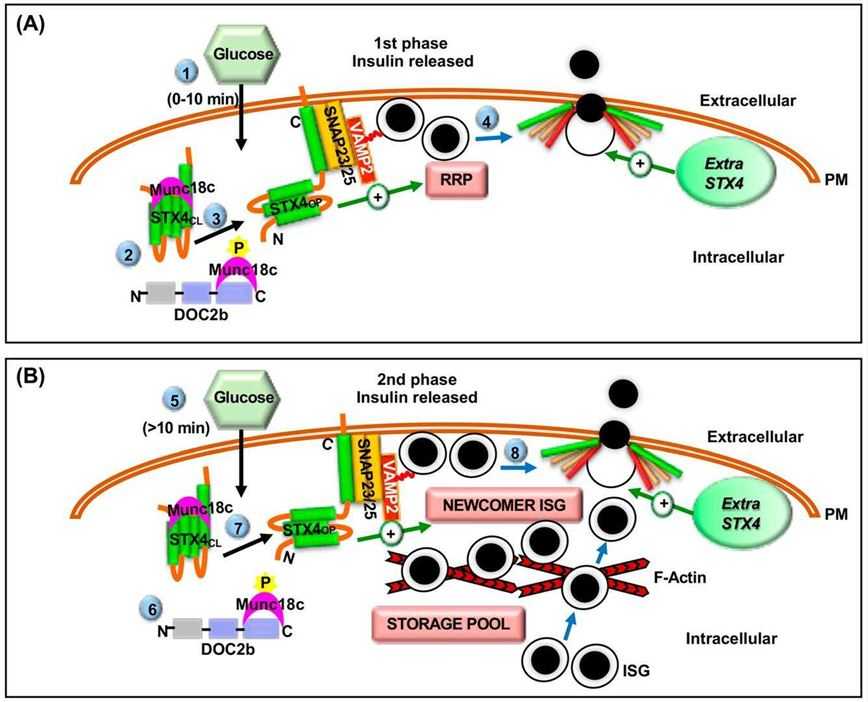 Fig.1 Roles of Syntaxin 4 in regulating ISG Pools and GSIS.1
STX4 coordinates a wide range of cellular functions, far exceeding its basic structural role as a membrane-anchored SNARE protein:
We have developed the full-length, topologically accurate STX4 membrane protein, and the core goal of developing this protein is to solve the long-standing inherent problems encountered when studying the biophysical properties of SNARE proteins. To produce this qualifying protein, our production process integrates the most advanced membrane protein expression technologies available, in order to preserve its native structure that enables it to participate in membrane fusion activities. This fully functional state can be stably maintained in our optimized preparation, and will not easily undergo conformational changes that lead to inactivation. Every batch of this protein preparation has undergone strict quality control. The standardized integrated technology platform that supports the production of these preparations can also meet the diverse needs of various biochemical studies; related experiments of many direction can be carried out relying on this platform.
Not finding the membrane protein product you need? Contact us to start your one-stop custom service!
The importance of building a cell platform that can fully recapitulate the natural secretion process of STX4 cannot be overstated—whether for basic research on secretion mechanisms or the early-stage evaluation of candidate compounds, this reliable cell platform is the most core supporting element. The cell line bank we have developed is built to target this exact demand. It not only includes wild-type cell lines that can stably and continuously express STX4, but also a complete set of engineered variant cell lines, which can match various specific needs of different biochemical studies, eliminating the problem of not being able to access the required cell type. Moreover, every cell line has undergone strict identity verification and performance validation, confirming that it is exactly the type you need, and its functions fully meet experimental requirements. These scalable cell resources are an indispensable foundation for all related research—whether studying the intrinsic mechanisms of membrane transport, or optimizing experimental reagents targeting the STX4 pathway, these cells must be used as carriers to advance the work.
Not finding the stable cell line product you need? Contact us to start your one-stop custom service!
Recombinant antibodies targeting STX4 can be developed and characterized for target specificity and compatibility with research applications. Antibody formats, sample requirements, and cross-reactivity considerations can be evaluated according to project needs; application-specific performance should be supported by relevant validation data.
Not finding the recombinant antibody product you need? Contact us to start your one-stop custom service!
Extending well beyond our standard catalog, we deliver fully customizable discovery and manufacturing solutions meticulously tailored to the sophisticated demands of STX4-targeted research and compound development:
No. The entire collection of STX4-directed proteins, stable expression systems, and affinity reagents is designated solely for preclinical investigation. These materials have not been qualified for deployment on biological specimens collected with the purpose of tracking contributor physiological equilibrium or internal homeostasis.
Yes. The immunization strategy employs antigen formats that sample distinct conformational states along the regulatory cycle, thereby enriching for clones that recognize epitopes uniquely exposed in either the compact autoinhibited arrangement or the extended assembly-competent posture.
Yes. We distribute engineered expression systems in which the target is enriched at the outer membrane with documented capacity for supporting vesicular arrival and membrane merger processes.
Our standard catalogue spans three integrated categories: recombinant STX4 proteins in diverse biochemical presentations, stable expression systems with validated membrane integration, and sequence-defined antibodies mapping to distinct topological and conformational determinants.









