Creative Biolabs is offering the most comprehensive services for antibody development projects. With strict regulation and effective execution, we are dedicated to providing the most valuable solutions to complete your projects.
HighlightsCreative Biolabs is offering the most comprehensive services for antibody development projects. With strict regulation and effective execution, we are dedicated to providing the most valuable solutions to complete your projects.
HighlightsCreative Biolabs has established a broad range of platforms for developing novel antibodies or equivalents. These cutting-edge technologies enable our scientists to meet your demands from different aspects and tailor the most appropriate solution that contributes to the success of your projects.
HighlightsWith deep understanding in antibody-related realms and extensive project experience, Creative Biolabs offers a variety of references to help you learn more about our capacities and achievements, including infographic, flyer, case study, peer-reviewed publications, and all kinds of knowledge that can assist your projects. You are also welcome to contact us directly for more specific solutions.
HighlightsGet a real taste of Creative Biolabs, one of the most professional custom service providers in the world. We are committed to providing highly customized comprehensive solutions with the best quality to advance your projects.
Highlights Loading...
All listed services and products are For Research Use Only. Do Not use in any diagnostic or therapeutic applications.
Syntaxin 8 (STX8) is an endosome-localized SNARE transmembrane protein encoded by STX8 gene, belonging to syntaxin SNARE subfamily and acting as the core Q-SNARE effector of late endosome-lysosome membrane fusion. STX8 distributes predominantly on late endosomal limiting membranes, carrying evolutionarily conserved N-terminal regulatory folds and C-terminal coiled-coil SNARE motifs across species, serving as an essential modulator for trans-SNARE complex assembly and vesicle-cargo compartment merging. Beyond basal lysosomal degradation, STX also participates in the clearance of aggregated protein substrates and damaged organelles during cellular stress, coordinating cross-talk between endocytic pathways and autophagic clearance machinery to maintain cytoplasmic material homeostasis. When cellular metabolic pressure rises, STX8 expression undergoes subtle transcriptional adjustment to accelerate vesicle fusion efficiency, balancing substrate accumulation risk with cellular degradative capacity under sustained stress conditions. STX8-mediated SNARE complex formation exerts decisive effects on delivering endocytosed cargo to degradative lysosomes under physiological trafficking conditions. Furthermore, STX8 coordinates autophagosome-lysosome fusion cascades governing cellular waste clearance. Distinct from plasma membrane syntaxin paralogs, STX8 exhibits exclusive late endosomal localization with unique cargo sorting regulatory functions.
STX8 executes biological functions via coiled-coil domain heterotypic binding with lysosomal R-SNARE partners, assembling four-helix trans-SNARE bundles that drive lipid bilayer merging and cargo compartment fusion. Its N-terminal regulatory fold controls SNARE assembly kinetics to balance basal and stress-induced lysosomal trafficking. STX8 participates in endocytic cargo degradation, autophagic flux and intracellular nutrient recycling. Reduced STX8 expression impairs lysosomal fusion and accumulates undegraded cellular cargo. Therefore, STX8 constitutes a pivotal research target for endomembrane trafficking and autophagy regulatory mechanisms.
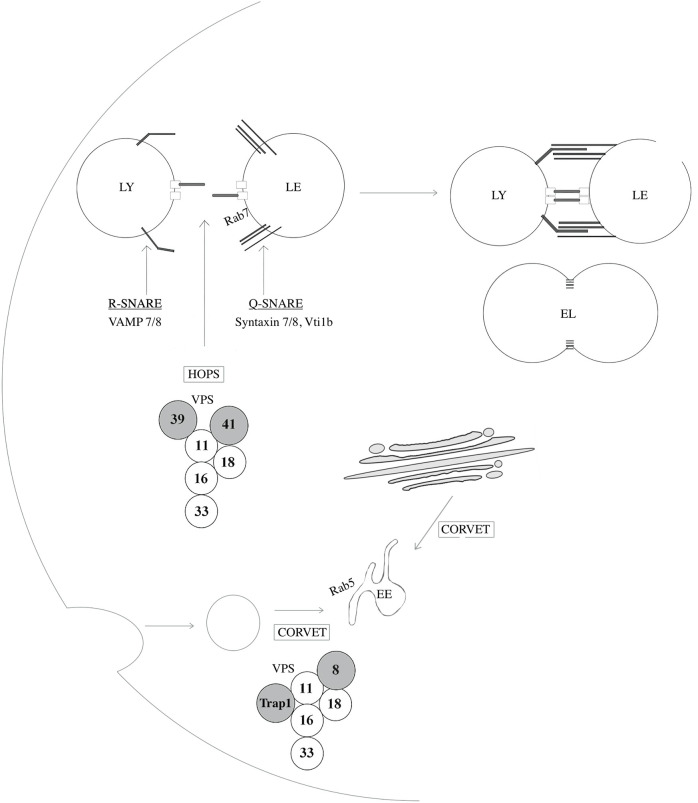 Fig. 1 Endosomal maturation and late endosome-lysosome membrane fusion machinery centered on STX8-containing Q-SNARE complex, regulated by CORVET/HOPS and Rab GTPases.1
The biological functions of STX8 are focused on Q-SNARE complex formation and late endosome-lysosome lipid bilayer merging:
Creative Biolabs offers high-quality STX8 proteins via optimized expression systems, covering full-length STX8 and isolated coiled-coil SNARE domain variants. These products retain native helical folding and intact heterotypic SNARE binding activity, suitable for in vitro vesicle fusion reconstitution and autophagy-related small molecule compound screening. Each batch undergoes sequential chromatographic purification steps to remove misfolded aggregates and truncated fragments, and each finished product is supplemented with compatible storage buffer to maintain long-term structural integrity during repeated freeze-thaw cycles. All STX8 proteins undergo rigorous quality control to guarantee consistent functional performance and reliable application across diverse research platforms.
Not finding the membrane protein product you need? Contact us to start your one-stop custom service!
Creative Biolabs provides custom engineered STX8 stable cell lines, including overexpression and gene silencing models. These cell lines are optimized for endosomal trafficking and autophagy phenotypic observation. Multiple rounds of clonal screening are performed to isolate homogeneous cell clones with stable long-term transgene expression, avoiding fluctuating protein levels during continuous cell passaging, and all cell strains are accompanied by complete expression verification data for user reference. Each cell line undergoes strict validation procedures to ensure steady target expression levels and uniform functional performance across multiple experimental scenarios.
Not finding the stable cell line product you need? Contact us to start your one-stop custom service!
High-specificity recombinant antibodies targeting STX8 are developed with advanced antibody engineering workflows, without cross-reactivity against other plasma membrane syntaxin family members. These antibodies receive multi-scenario functional validation covering immunofluorescence staining and co-IP interaction detection, formulated with mild preservative-free buffer to match most common intracellular staining and protein co-purification experimental schemes. All antibody batches are subjected to parallel cross-reactivity testing to eliminate off-target binding signals before delivery.
Not finding the recombinant antibody product you need? Contact us to start your one-stop custom service!
Beyond catalog products, Creative Biolabs offers specialized custom services for STX8 research:
STX8 is an endosomal Q-SNARE protein that assembles trans-SNARE complexes to drive late endosome and autophagosome fusion with lysosomes.
STX8 controls core cellular degradative trafficking pathways; its functional insufficiency impairs substrate clearance and disrupts cytoplasmic homeostasis, establishing it as a vital research target.
No, all STX8 products and services are strictly for research use only, not intended for clinical diagnosis or treatment.
Offerings include STX8 proteins, high-specificity recombinant antibodies and custom stable cell lines for endosomal trafficking and autophagy research.
STX8 proteins undergo functional verification via heterotypic SNARE binding and vesicle fusion assembly capacity evaluation.