
Creative Biolabs is offering the most comprehensive services for antibody development projects. With strict regulation and effective execution, we are dedicated to providing the most valuable solutions to complete your projects.
HighlightsCreative Biolabs is offering the most comprehensive services for antibody development projects. With strict regulation and effective execution, we are dedicated to providing the most valuable solutions to complete your projects.
HighlightsCreative Biolabs has established a broad range of platforms for developing novel antibodies or equivalents. These cutting-edge technologies enable our scientists to meet your demands from different aspects and tailor the most appropriate solution that contributes to the success of your projects.
HighlightsWith deep understanding in antibody-related realms and extensive project experience, Creative Biolabs offers a variety of references to help you learn more about our capacities and achievements, including infographic, flyer, case study, peer-reviewed publications, and all kinds of knowledge that can assist your projects. You are also welcome to contact us directly for more specific solutions.
HighlightsGet a real taste of Creative Biolabs, one of the most professional custom service providers in the world. We are committed to providing highly customized comprehensive solutions with the best quality to advance your projects.
Highlights Loading...
All listed services and products are For Research Use Only. Do Not use in any diagnostic or therapeutic applications.
Spectrin repeat containing nuclear envelope protein 1 (SYNE1) is a large multi domain protein encoded by SYNE1 gene. This protein localizes to outer nuclear membrane, which forms one lipid boundary of cell nucleus compartment. SYNE1 contains extensive spectrin repeat sequences distributed across large cytoplasmic facing region, alongside a C terminal single transmembrane segment embedded within outer nuclear lipid bilayer. Its N terminal spectrin repeat rich domain projects into cytoplasm, while short C terminal tail resides within perinuclear space between inner and outer nuclear membrane. SYNE1 polypeptide is translated in cytoplasmic ribosome compartments and trafficked toward nuclear envelope, where transmembrane segment inserts into outer nuclear membrane lipid bilayer. Multiple isoforms generated through alternative transcript processing exist, which differ in spectrin repeat count and cytoplasmic facing interaction interfaces. Protein abundance of SYNE1 varies among cell types according to mechanical coupling requirements between nucleus and cytoplasmic cytoskeleton networks. Different isoforms exhibit distinct tissue distribution patterns, adding further complexity to molecular interaction capacity within different cell contexts.
The cytoplasmic facing spectrin repeat rich segments of SYNE1 establish physical intermolecular contacts with diverse cytoskeleton component molecules in cytoplasm. Meanwhile its transmembrane anchored domain at outer nuclear membrane connects to protein complexes spanning perinuclear space toward inner nuclear membrane, thus forming physical linkage between cytoplasmic cytoskeleton network and nuclear interior compartments. This molecular bridge transmits mechanical cues across nuclear envelope and contributes to maintaining proper nuclear positioning inside cell volume. Individual spectrin repeat units fold into conserved structural modules which support flexible protein conformation while providing multiple docking sites for different cytoskeleton associated binding partners. Other nuclear envelope associated proteins cannot fully replicate the broad cytoskeleton binding capacity provided by full length SYNE1. Sequence alteration or reduction of SYNE1 abundance may weaken physical coupling between nucleus and cytoplasmic cytoskeleton and disturb normal nuclear positional arrangement within cell. Changed isoform composition may also reshape the spectrum of cytoskeleton partners that can be recruited to nuclear envelope interfaces.
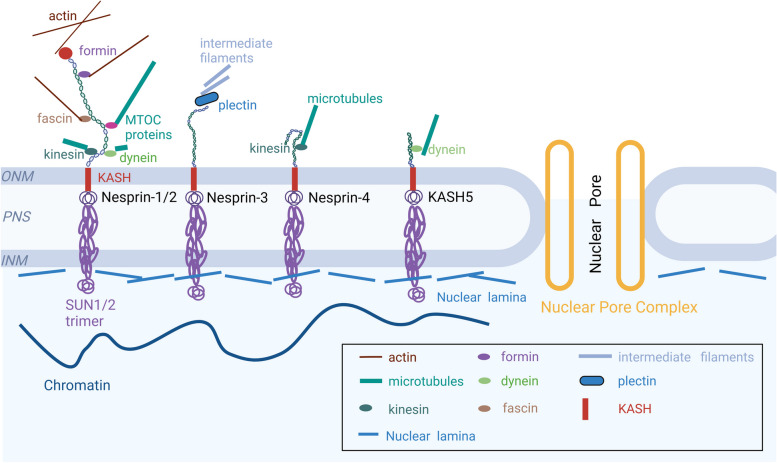 Fig. 1 SYNE1‑based mechanical linkage across nuclear envelope. Outer‑nuclear‑membrane‑localized SYNE1 possesses extended cytoplasmic segments to engage cytoskeleton components and forms trans‑perinuclear‑space molecular connections.1
The biological functions of SYNE1 are focused on outer nuclear membrane anchoring, cytoskeleton component recognition and mechanical bridge assembly between nucleus and cytoplasm:
Creative Biolabs offers purified SYNE1 membrane samples via standardized preparation workflows, including full length SYNE1 constructs and isolated domain truncated structural variants. Isolated partial domain fragments may not support complete multi partner cytoskeleton binding and nuclear envelope anchoring related behaviours, while full length constructs may be suited for nuclear envelope protein anchoring and cytoskeleton interaction related research. All samples receive routine quality screening, and functional relevant observation may only be carried out with full length samples under simulated membrane environments. All sample batches follow unified processing standards to maintain consistent structural features for comparative laboratory analysis across separate test groups.
Not finding the membrane protein product you need? Contact us to start your one-stop custom service!
Creative Biolabs provides adjustable SYNE1 expression cell models with varied expression levels, applicable to large multi domain nuclear envelope protein structural characteristic observation and nucleus cytoskeleton coupling related research. Sample evaluation includes sustained target expression detection and preliminary intermolecular interaction associated observation, which can support comparative analysis of protein associated behaviours under different expression statuses. These cell systems can be matched with diverse laboratory analysis schemes to observe changes of cytoskeleton binding related efficiency under different target expression abundances.
Not finding the stable cell line product you need? Contact us to start your one-stop custom service!
Antibody reagents targeting SYNE1 are generated via mature protein preparation workflows, compatible with multiple routine laboratory detection methods for subcellular localization profiling and molecular complex identification, to support systematic analysis of SYNE1 distribution and nuclear envelope associated molecular complexes across diverse laboratory research setups. The antibody series can cooperate with other common laboratory detection reagents to complete multi dimensional observation of target distribution inside tissue samples.
Not finding the recombinant antibody product you need? Contact us to start your one-stop custom service!
Beyond catalog products, Creative Biolabs offers specialized custom services for SYNE1 research:
SYNE1 may function as outer nuclear membrane anchored multi domain protein and participate in cytoskeleton partner binding and mechanical coupling between nucleus and cytoplasm.
SYNE1 expression status may influence nucleus cytoskeleton mechanical linkage, serving as a major regulatory mediator of nuclear envelope architecture related biological processes.
No, all SYNE1 related products and services are strictly for research use only, not intended for clinical related operations. All material designs and functional tests are only optimized for basic laboratory research scenarios, without matching clinical application standards.
Offerings include full length SYNE1 membrane protein, target specific recombinant antibodies and adjustable expression cell research models, supporting nuclear envelope architecture and cytoskeleton nucleus coupling research.
Laboratory observation schemes may include cytoskeleton partner intermolecular contact related tests to analyse molecule associated behaviours under simulated cellular environments.









