Creative Biolabs is offering the most comprehensive services for antibody development projects. With strict regulation and effective execution, we are dedicated to providing the most valuable solutions to complete your projects.
HighlightsCreative Biolabs is offering the most comprehensive services for antibody development projects. With strict regulation and effective execution, we are dedicated to providing the most valuable solutions to complete your projects.
HighlightsCreative Biolabs has established a broad range of platforms for developing novel antibodies or equivalents. These cutting-edge technologies enable our scientists to meet your demands from different aspects and tailor the most appropriate solution that contributes to the success of your projects.
HighlightsWith deep understanding in antibody-related realms and extensive project experience, Creative Biolabs offers a variety of references to help you learn more about our capacities and achievements, including infographic, flyer, case study, peer-reviewed publications, and all kinds of knowledge that can assist your projects. You are also welcome to contact us directly for more specific solutions.
HighlightsGet a real taste of Creative Biolabs, one of the most professional custom service providers in the world. We are committed to providing highly customized comprehensive solutions with the best quality to advance your projects.
Highlights Loading...
All listed services and products are For Research Use Only. Do Not use in any diagnostic or therapeutic applications.
Testicular expression protein 2(TEX2) is a tissue-specific transmembrane protein encoded by TEX2 gene, and its transcription and translation process is strictly limited to spermatocytes during meiosis of testis and spermatocytes after meiosis, mainly located in germ cell membrane and immature acrosome precursor vesicle structure of developing sperm. Different from the widely expressed somatic cell membrane regulatory protein, TEX2 is only expressed in testis tissue-specific time sequence, and its expression cycle is highly consistent with meiosis and sperm formation stages of spermatogenesis, which accurately regulates the establishment of germ cell polarity and acrosome precursor vesicle transport, and dominates the process of sperm morphological and structural remodeling. During the normal physiological development of testis, the staged up-regulation of TEX2 can coordinate the directional transport of vesicles to the front of sperm and promote the assembly and maturation of intact acrosome structure, and acrosome formation is a necessary prerequisite for sperm to penetrate egg cells and complete fertilization. When TEX2 has functional deletion mutation or transcription silencing, the acrosome biogenesis process of sperm will be significantly blocked, the polar structure of sperm head will be disordered, and the number of mature fertile sperm will be greatly reduced, which will directly destroy the normal development process of sperm. Broad-spectrum membrane proteins can't compensate TEX2's exclusive regulation function of germ cell development, and the expression of TEX2 is generally down-regulated in clinical idiopathic male infertility samples. Exogenous overexpression of TEX2 can effectively reverse the phenotype of sperm development defects, which is the core target of male germ cell development biology research and targeted treatment screening for infertility.
TEX2 is firmly anchored in the lipid bilayer of sperm cell membrane, which specifically performs the functions of maintaining the polarity of germ cells and regulating the transport of acrosome vesicles, and mediates the targeted transport and structure formation of vesicles by relying on intracellular conservative binding motifs and acrosome assembly cofactors. Its strict restricted expression characteristics in testicular tissue and significant functional differentiation with housekeeping membrane proteins make it have unique ability to regulate sperm maturation after meiosis. TEX2-mediated vesicle directional transport mechanism closely couples the meiosis process of germ cells with the differentiation of sperm terminal structure, and dynamically regulates the orderly progress of sperm morphogenesis according to the time sequence of testicular development. This molecule is involved in the regulation of meiosis of spermatocytes and the orderly assembly of acrosome in sperm deformation stage. TEX2 expression defect will completely block the normal construction of acrosome, destroy the complete structure of sperm, and seriously damage the fertilization potential of male germ cells. To sum up, TEX2 is the key target for the study of testicular development mechanism and the development of targeted drugs for male infertility.
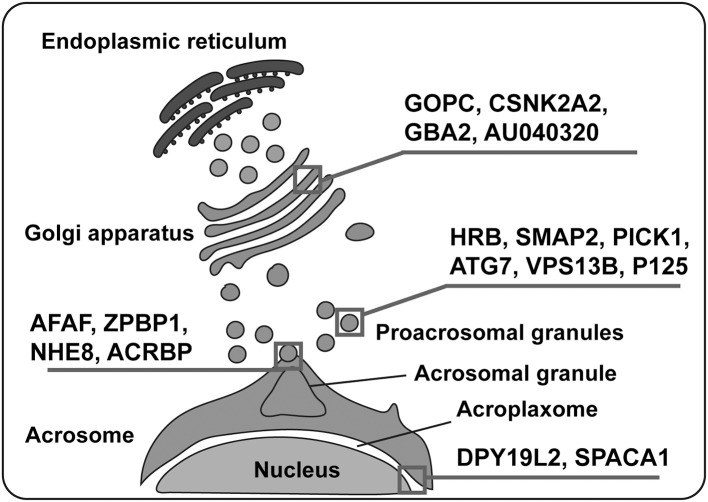 Fig. 1 Stepwise schematic illustrating Golgi-originated pro-acrosomal granule transport during spermiogenesis. TEX2, a spermatid-restricted integral membrane protein, facilitates trafficking of pro-acrosomal vesicles toward the spermatid anterior pole. Functional deficiency of TEX2 blocks acrosome assembly and contributes to male infertility.1
The biological functions of TEX2 are focused on spermatid polarity and pro-acrosomal vesicle trafficking:
Creative Biolabs offers high-quality TEX2 proteins through optimized germ cell-matched expression systems, including full-length transmembrane TEX2 and isolated cytoplasmic interaction domain variants. These products retain native vesicle trafficking binding activity, suitable for spermatogenic germ cell interaction and infertility screening assays. All TEX2 proteins undergo strict quality control to ensure consistent performance and reliable application across reproductive research platforms.
Not finding the membrane protein product you need? Contact us to start your one-stop custom service!
Creative Biolabs provides custom-engineered TEX2 stable cell lines, including germ cell-like overexpression and blank control models. These cell lines are optimized for testis-specific membrane protein profiling and spermatogenic differentiation signal analysis. Each cell line undergoes stringent validation to ensure stable expression profiles and consistent functional performance in diverse experimental contexts.
Not finding the stable cell line product you need? Contact us to start your one-stop custom service!
High-specificity recombinant antibodies targeting TEX2 are developed via advanced antibody engineering technologies, with no cross-reactivity with ubiquitous somatic membrane proteins. These antibodies are validated for spermatid membrane and pro-acrosome localization detection and testicular tissue expression profiling, and can be combined with acrosomal marker reagents to analyze germ cell maturation complexes in testis cell models.
Not finding the recombinant antibody product you need? Contact us to start your one-stop custom service!
Beyond catalog products, Creative Biolabs offers specialized custom services for TEX2 research:
A1: TEX2 is a testis-specific membrane protein that controls acrosome precursor vesicle trafficking and post-meiotic spermatid maturation.
A2: TEX2 is a unique germ cell biomarker whose downregulation directly links to impaired spermatogenesis and male infertility.
A3: No, all TEX2 products and services are strictly for research use only, not intended for clinical infertility diagnosis or treatment.
A4: Offerings include full-length TEX2 membrane proteins, germ cell-specific detection antibodies and custom stable cell lines for spermatogenesis research.
A5: TEX2 proteins are validated via acrosomal vesicle co-binding and germ cell differentiation functional testing.