
Creative Biolabs is offering the most comprehensive services for antibody development projects. With strict regulation and effective execution, we are dedicated to providing the most valuable solutions to complete your projects.
HighlightsCreative Biolabs is offering the most comprehensive services for antibody development projects. With strict regulation and effective execution, we are dedicated to providing the most valuable solutions to complete your projects.
HighlightsCreative Biolabs has established a broad range of platforms for developing novel antibodies or equivalents. These cutting-edge technologies enable our scientists to meet your demands from different aspects and tailor the most appropriate solution that contributes to the success of your projects.
HighlightsWith deep understanding in antibody-related realms and extensive project experience, Creative Biolabs offers a variety of references to help you learn more about our capacities and achievements, including infographic, flyer, case study, peer-reviewed publications, and all kinds of knowledge that can assist your projects. You are also welcome to contact us directly for more specific solutions.
HighlightsGet a real taste of Creative Biolabs, one of the most professional custom service providers in the world. We are committed to providing highly customized comprehensive solutions with the best quality to advance your projects.
Highlights Loading...
All listed services and products are For Research Use Only. Do Not use in any diagnostic or therapeutic applications.
TEX264 (Testis expressed 264, ER-phagy receptor) encodes a single-pass transmembrane protein functioning as an endoplasmic reticulum-resident autophagy receptor, detected within multiple vertebrate tissue compartments. This ER-anchored receptor carries a transmembrane helix, a cytosolic GyrI-like domain and disordered segments containing an LC3-interacting region (LIR). The LIR binds ATG8-family proteins, including LC3 and GABARAP, linking ER membranes to the autophagy machinery for selective ER degradation. Following biosynthesis, newly synthesized TEX264 undergoes folding and endomembrane system quality control processing. Mature receptor molecules anchor onto endoplasmic reticulum membrane surfaces, while partial protein pools remain stored within intracellular vesicular compartments to sustain protein maturation, membrane trafficking and physiological protein turnover. ER-resident abundance of TEX264 can be dynamically tuned to satisfy tissue specific reticulophagy regulation and endomembrane homeostatic adaptive demands.
Within endoplasmic reticulum membrane microenvironments, TEX264 engages LC3/GABARAP through its cytosolic LIR to promote selective delivery of ER portions to autophagosomes. Its disordered cytosolic region helps connect the ER membrane to the autophagic membrane. Perturbations to TEX264 structural integrity or expression magnitude may alter LIR-dependent binding or ER-phagy. Genetic-sequence alterations within the TEX264 coding locus may affect membrane anchoring, LIR accessibility, or protein stability. These mechanisms do not imply an obligatory heteromeric complex with unspecified membrane-protein subunits.
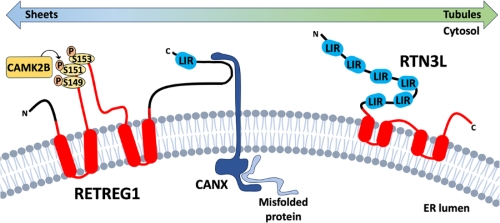 Fig. 1 Domain and membrane topology schematics of other ER-phagy-associated proteins: RETREG1/FAM134B, CANX and RTN3L. These provide comparative ER-phagy background; TEX264 and its LIR are not depicted.1
The biological functions of ER-anchored TEX264 are focused on LIR-dependent autophagy-protein binding and selective ER turnover:
Creative Biolabs offers purified TEX264 membrane protein samples generated under unified preparation workflows, including full length constructs and isolated domain truncated variants. Full-length constructs are suited to ER-localization and ER-phagy research, whereas defined cytosolic domains or LIR peptides may support LC3/GABARAP-binding studies. All batches receive uniform quality screening. The appropriate construct and assay depend on whether membrane localization, selective ER turnover, or a specific protein interaction is being studied. All sample batches follow unified processing standards to support comparative laboratory analysis across separate test groups. Suitability for a specific assay depends on construct design and experimental validation.
Not finding the Membrane potein product you need? Contact us to start your one-stop custom service!
Creative Biolabs provides adjustable TEX264 expression cell research models with tunable target expression levels, applicable to structural observation of single pass ER-resident ER-phagy transmembrane receptor and research into membrane partner molecular interaction. Sample evaluation includes sustained target protein expression detection and preliminary partner interaction observation, enabling side by side comparison of receptor binding behaviours under differing target protein abundances. These cell systems can pair with diverse laboratory analysis schemes to track changes in partner assembly efficiency alongside shifting TEX264 protein levels.
Not finding the stable cell line product you need? Contact us to start your one-stop custom service!
Anti-TEX264 recombinant antibodies are generated via standardized protein preparation workflows, compatible with routine laboratory detection techniques for endomembrane localization mapping and identification of receptor partner molecular complexes. The antibody series can work alongside common laboratory detection reagents to realise multi dimensional observation of target protein distribution within membrane enriched sample materials.
Not finding the recombinant antibody product you need? Contact us to start your one-stop custom service!
Beyond catalog products, Creative Biolabs offers specialized custom services for TEX264 research:
TEX264 is an ER-resident selective autophagy receptor. Its cytosolic LIR binds LC3/GABARAP-family proteins and promotes the autophagic clearance of ER portions.
TEX264 expression status could alter membrane protein complex assembly efficiency and local endomembrane coupled molecular interaction balance, serving as an important mediator of reticulophagy associated membrane homeostasis related biological processes.
No, TEX264 associated research reagents from Creative Biolabs are exclusively built for exploring ER phagy receptor dependent membrane regulatory mechanisms, and shall not be deployed for any clinical oriented workflows. These preparations are optimized for basic laboratory investigation and do not satisfy performance benchmarks required for clinical implementation.
Offerings include full length TEX264 membrane protein, target specific recombinant antibodies and tunable expression cell research models, supporting research on ER-phagy associated membrane homeostasis and receptor mediated membrane partner perception.
Laboratory observation schemes may include receptor partner interaction related tests to analyse molecular binding associated behaviours under simulated endoplasmic reticulum membrane microenvironment conditions.









