
Creative Biolabs is offering the most comprehensive services for antibody development projects. With strict regulation and effective execution, we are dedicated to providing the most valuable solutions to complete your projects.
HighlightsCreative Biolabs is offering the most comprehensive services for antibody development projects. With strict regulation and effective execution, we are dedicated to providing the most valuable solutions to complete your projects.
HighlightsCreative Biolabs has established a broad range of platforms for developing novel antibodies or equivalents. These cutting-edge technologies enable our scientists to meet your demands from different aspects and tailor the most appropriate solution that contributes to the success of your projects.
HighlightsWith deep understanding in antibody-related realms and extensive project experience, Creative Biolabs offers a variety of references to help you learn more about our capacities and achievements, including infographic, flyer, case study, peer-reviewed publications, and all kinds of knowledge that can assist your projects. You are also welcome to contact us directly for more specific solutions.
HighlightsGet a real taste of Creative Biolabs, one of the most professional custom service providers in the world. We are committed to providing highly customized comprehensive solutions with the best quality to advance your projects.
Highlights Loading...
All listed services and products are For Research Use Only. Do Not use in any diagnostic or therapeutic applications.
TGFB3 is one of three members of the transforming growth factor beta family and, perhaps more than any other member of this family, is most "quietly" unique. As with all members of the transforming growth factor beta family, TGFB3 is synthesized as a larger precursor molecule which then folds into two subunits and undergoes cleavage to produce two separate molecules. However, unlike other members of the transforming growth factor beta family, TGFB3 does not release the active cytokine immediately upon cleavage. Rather, the active cytokine is held within a latent form. This is accomplished through non-covalent attachment to its latency-associated propeptide which creates a latent complex. Once formed, this latent complex prevents the active cytokine from interacting with its receptor serine-threonine kinases until some external factor (such as integrin binding, proteolysis, or mechanical force) opens up the latent complex allowing the active cytokine to interact with the receptor serine-threonine kinases. Thus, TGFB3 controls activation of the cytokine, not synthesis of the cytokine. The delay in releasing the active cytokine is consistent with TGFB3's biological portfolio. TGFB3 functions in areas where time is critical: embryonic development and palate formation, where the TGFB3 gradient guides cellular migration and proliferation during tissue sculpting prior to birth; wound healing, where TGFB3 activity determines whether wounds will heal with or without scar formation; and maintenance of the extracellular matrix, where TGFB3 regulates deposition and remodeling of structural proteins in connective tissues. An early discovery in developmental biology research established TGFB3's identity—fetal wounds, which have high levels of TGFB3 activity, heal without scarring while adult wounds, which have different regulatory balances, do not. Although the mechanisms responsible for this difference are still being investigated, TGFB3 is central to these investigations.
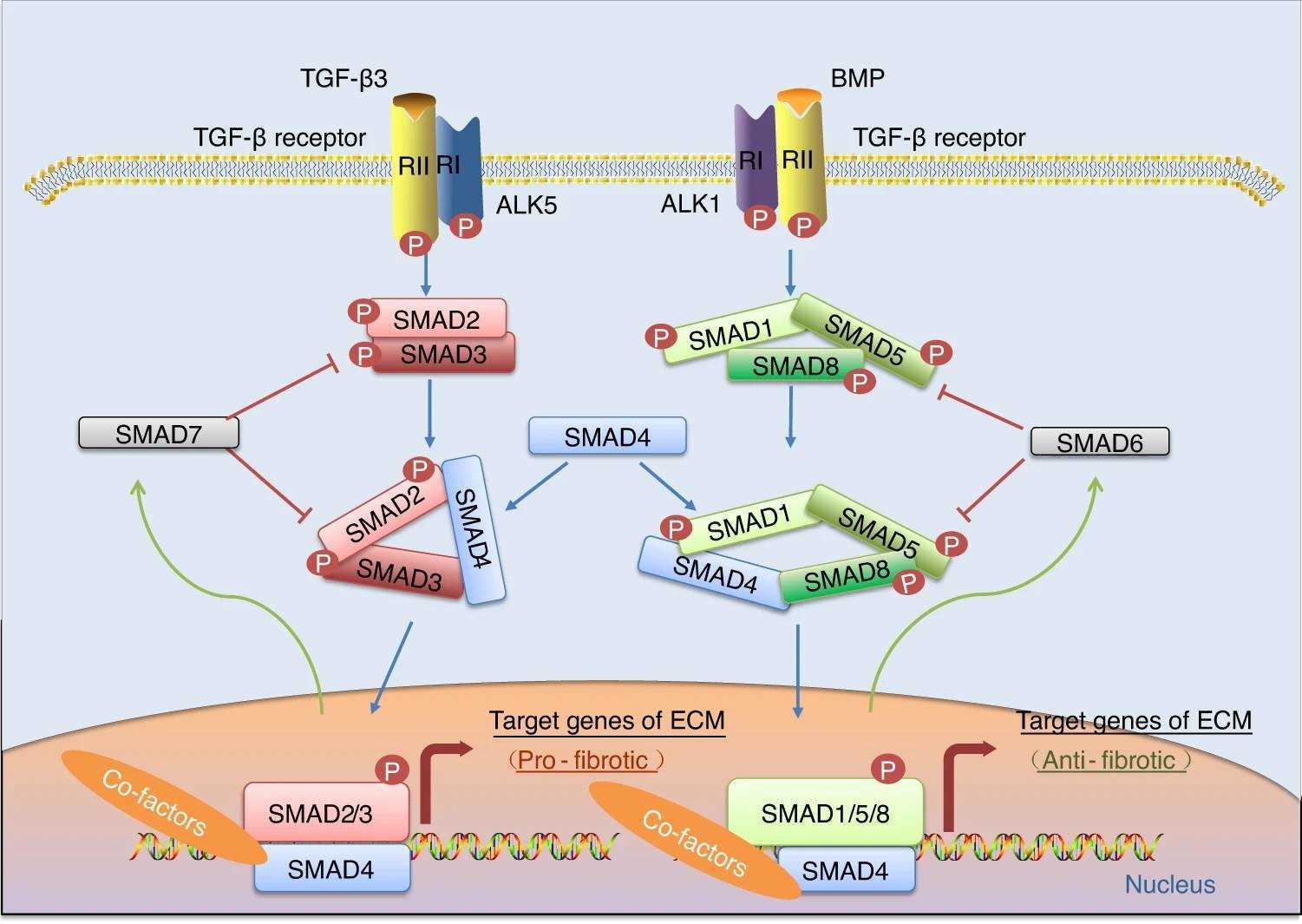 Fig.1 Schematic diagram showing the transforming growth factor-beta 3 (TGF-β3)-mediated R-Smad-dependent signaling pathway.1
Several themes keep recurring as the field pushes forward:
We work with TGFB3 in mind of its double-sided nature. The latent precursor must fold together as one unit — the propeptide cradles the mature dimer — or it won't function the way it does in nature. On the other hand, once the propeptide has been removed from the active form of TGFB3, it is highly active and can be mismanaged quickly. As a result, we develop recombinant native-sequence TGFB3 in optimized eukaryotic expression systems using formats that maintain the latent complex until we deliberately induce activation. For every batch of TGFB3 produced, we perform release testing to determine purity via SDS-PAGE, monodispersity via analytical size-exclusion chromatography, and aggregation status via light scattering analysis to ensure that we know the activation state of each preparation before we deliver it.
Not finding the protein product you need? Contact us to start your one-stop custom service!
The use of cellular models in studies on TGFB3 has unique constraints: The cytokine's effect is determined by both the amount secreted, the form in which it is secreted, and the time frame of its secretion. The availability of stable cell lines overexpressing the native precursor allows researchers to regulate the availability of latent complex. In addition, silencing lines allows them to eliminate the signal. Inducible formats enable researchers to isolate the beginning of expression from subsequent measurements of effects like matrix deposition or Smad phosphorylation. Our collection includes cell lines with wild-type expression levels at various rates of secretion, as well as lines with modifications in the processing region of the protein for different types of experiments. Prior to being released, each clone is characterized: The rate of secretion is measured and calibrated so that the investigator knows exactly how much of the cytokine will be produced by the line prior to initiating an experiment rather than having to estimate this information after the fact.
Not finding the stable cell line product you need? Contact us to start your one-stop custom service!
Recombinant antibodies targeting TGFB3 can be developed and characterized for target specificity and compatibility with research applications. Antibody formats, sample requirements, and cross-reactivity considerations can be evaluated according to project needs; application-specific performance should be supported by relevant validation data.
Not finding the recombinant antibody product you need? Contact us to start your one-stop custom service!
Extending well beyond our standard catalog, we deliver fully customizable discovery and manufacturing solutions meticulously tailored to the sophisticated demands of TGFB3-targeted research and compound development:
Both are common. Custom formats and integrated multi-component projects are handled under unified quality frameworks that keep specifications aligned.
Yes. Our scientific team remains available for assay guidance and troubleshooting for as long as you are using the materials.
Yes. Custom format requests and combined protein, cell line, and antibody engagements are routine for us and are managed under unified quality frameworks.
All TGFB3 products and services are provided strictly for preclinical research. They are not designed, validated, or authorized for any use involving human subjects.









