Creative Biolabs is offering the most comprehensive services for antibody development projects. With strict regulation and effective execution, we are dedicated to providing the most valuable solutions to complete your projects.
HighlightsCreative Biolabs is offering the most comprehensive services for antibody development projects. With strict regulation and effective execution, we are dedicated to providing the most valuable solutions to complete your projects.
HighlightsCreative Biolabs has established a broad range of platforms for developing novel antibodies or equivalents. These cutting-edge technologies enable our scientists to meet your demands from different aspects and tailor the most appropriate solution that contributes to the success of your projects.
HighlightsWith deep understanding in antibody-related realms and extensive project experience, Creative Biolabs offers a variety of references to help you learn more about our capacities and achievements, including infographic, flyer, case study, peer-reviewed publications, and all kinds of knowledge that can assist your projects. You are also welcome to contact us directly for more specific solutions.
HighlightsGet a real taste of Creative Biolabs, one of the most professional custom service providers in the world. We are committed to providing highly customized comprehensive solutions with the best quality to advance your projects.
Highlights Loading...
All listed services and products are For Research Use Only. Do Not use in any diagnostic or therapeutic applications.
TM4SF1 (Transmembrane 4 L six family member 1) encodes a four-pass transmembrane scaffold protein localizing predominantly to plasma-membrane compartments, with detectable fractions also present within late endocytic membrane structures. This protein is detectable across multiple tissue-derived cell populations and exhibits uneven tissue-level distribution patterns. Distinct from purely soluble intracellular factors, it contains four transmembrane segments paired with short cytosolic amino- and carboxyl-terminal domains and lacks independent catalytic functional modules. It acts as a membrane-resident scaffold subunit, cooperating with adjacent membrane-embedded protein components to shape cell-surface-associated molecular arrangements under physiological conditions. Insufficient adequate TM4SF1 protein abundance could disturb normal surface-complex organisation and interfere with downstream cell-membrane adaptive properties. TM4SF1 may provide molecular buffering to sustain appropriate membrane-microdomain-dependent molecular arrangement across cell populations. Distinct cellular developmental and adaptive stages bring varied cell-surface organisation demands, requiring diversified four-transmembrane scaffold proteins to support multicellular tissue physiological equilibrium. Membrane-localized TM4SF1 assembles with partner membrane protein units to counteract aberrant surface-complex arrangement shifts and help sustain stable plasma-membrane functional characteristics.
Genetic alterations occurring within TM4SF1 can alter the compositional stability of assembled cell-surface membrane complexes and reshape plasma-membrane-coupled molecular interaction readouts. Other L6-family homologues cannot fully recapitulate the combined capacity of TM4SF1 for plasma-membrane-specific multi-protein microdomain organisation and stable integration within plasma-membrane assemblies. Fluctuations in TM4SF1 expression levels tend to align with cellular surface-remodelling-related adaptive demands, making this target well-suited for research addressing four-transmembrane scaffold biology and cell-surface-complex homeostasis. Localized to plasma membranes and endocytic organelle membranes, TM4SF1 participates in heteromeric membrane-complex formation without driving constitutive persistent downstream signalling cascades. Its four-transmembrane domain architecture differentiates it from many other cell-surface scaffold proteins, supporting membrane-microdomain arrangement maintenance and selective physical contacts with partner membrane subunits. Loss of sufficient TM4SF1 function may interfere with cell-surface-complex organisation and diminish local cellular membrane adaptive buffering capacity, reinforcing its research value for studies focused on L6-family membrane-scaffold components.
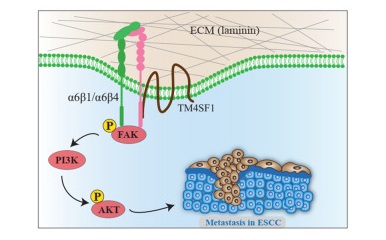 Fig. 1 Schematic illustration of molecular association between TM4SF1 and membrane-resident partner subunits within plasma-membrane compartments. The diagram depicts spatial proximity of four-transmembrane scaffold protein and other cell-surface components, representing the capacity for heteromeric membrane-protein complex formation.1
The biological functions of four-transmembrane TM4SF1 protein are focused on sustained heteromeric partner-complex interaction and plasma-membrane-homeostasis coordination:
Creative Biolabs offers purified TM4SF1 membrane samples produced under unified preparation workflows, including full-length TM4SF1 constructs and isolated domain variants. Truncated domain fragments cannot support complete surface-partner-complex assembly behaviours, while full-length constructs suit research focused on scaffold-subunit-partner interaction and plasma-membrane anchoring functional observation. All batches receive uniform quality screening. Functional-relevant observation may only be carried out with full-length samples under simulated plasma-membrane microenvironment setups. Consistent structural features are preserved across batches to support comparative laboratory analysis across separate test groups. Full-length TM4SF1 samples retain intact partner-interaction-domain conformation after standardized purification, which supports reliable detection of weak and transient subunit-partner contacts for comparative functional analysis.
Not finding the membrane protein product you need? Contact us to start your one-stop custom service!
Creative Biolabs provides adjustable TM4SF1 expression cell research models with varied expression levels, applicable to structural observation of four-pass membrane scaffold proteins and research into membrane-partner molecular interaction. Sample evaluation includes sustained target expression detection and preliminary partner-interaction observation, enabling side-by-side comparison of subunit-binding behaviours under differing expression abundances. These cell systems can pair with diverse laboratory analysis schemes to track changes in partner-assembly efficiency alongside shifting target protein levels.
Not finding the stable cell line product you need? Contact us to start your one-stop custom service!
Anti-TM4SF1 recombinant antibodies are generated via standardized protein preparation workflows, compatible with routine laboratory detection techniques for plasma-membrane localization mapping and identification of subunit-partner molecular complexes. The antibody series can work alongside common laboratory detection reagents to realize multi-dimensional observation of target distribution within cell-surface-enriched sample materials.
Not finding the recombinant antibody product you need? Contact us to start your one-stop custom service!
Beyond catalog products, Creative Biolabs offers specialized custom services for TM4SF1 research:
TM4SF1 might act as a four-pass transmembrane scaffold protein and participate in heteromeric plasma-membrane complex assembly to modulate cell-surface-complex arrangement and plasma-membrane homeostasis.
TM4SF1 expression status could alter membrane-partner-complex assembly efficiency and local plasma-membrane-coupled molecular-interaction balance, serving as a major scaffold mediator of cell-surface-associated biological processes.
No, TM4SF1-associated research reagents from Creative Biolabs are exclusively built for exploring membrane-scaffold-dependent cell-surface-complex regulatory mechanisms, and shall not be deployed for any clinical-oriented workflows. These preparations are optimized for basic laboratory investigation and do not satisfy performance benchmarks required for clinical implementation.
Offerings include full-length TM4SF1 membrane protein, target-specific recombinant antibodies and tunable expression cell research models, supporting research on plasma-membrane homeostasis and membrane-scaffold-mediated membrane-partner perception.
Laboratory observation schemes may include subunit-partner interaction related tests to analyse molecular-binding associated behaviors under simulated plasma-membrane environments.