
Creative Biolabs is offering the most comprehensive services for antibody development projects. With strict regulation and effective execution, we are dedicated to providing the most valuable solutions to complete your projects.
HighlightsCreative Biolabs is offering the most comprehensive services for antibody development projects. With strict regulation and effective execution, we are dedicated to providing the most valuable solutions to complete your projects.
HighlightsCreative Biolabs has established a broad range of platforms for developing novel antibodies or equivalents. These cutting-edge technologies enable our scientists to meet your demands from different aspects and tailor the most appropriate solution that contributes to the success of your projects.
HighlightsWith deep understanding in antibody-related realms and extensive project experience, Creative Biolabs offers a variety of references to help you learn more about our capacities and achievements, including infographic, flyer, case study, peer-reviewed publications, and all kinds of knowledge that can assist your projects. You are also welcome to contact us directly for more specific solutions.
HighlightsGet a real taste of Creative Biolabs, one of the most professional custom service providers in the world. We are committed to providing highly customized comprehensive solutions with the best quality to advance your projects.
Highlights Loading...
All listed services and products are For Research Use Only. Do Not use in any diagnostic or therapeutic applications.
Transmembrane 6 superfamily member 2 (TM6SF2), encoded by the TM6SF2 gene on chromosome 19p13.11 and also known as TM6SF2, is a polytopic membrane protein localized predominantly to the smooth endoplasmic reticulum (ER) and the ER-Golgi intermediate compartment (ERGIC). The gene encodes a protein of 351 amino acids with 7–10 predicted transmembrane domains. Recent cryo-electron microscopy structures of human TM6SF2 determined at 3.64 Å resolution reveal that the protein comprises 10 transmembrane helices and binds a single cholesterol molecule within a transmembrane cavity, assembling into homodimers and homotetramers. The C-terminal cytoplasmic tail contains a KKXX retrieval motif that mediates retrograde transport of the protein from post-ER compartments back to the ER, consistent with its cycling between the ERGIC and ER. TM6SF2 is expressed at the highest levels in hepatocytes and enterocytes, the cell types that synthesize and secrete apolipoprotein B (ApoB)-containing lipoproteins, with lower expression in other tissues.
TM6SF2 functions as a key regulator of hepatic lipid metabolism, specifically promoting the bulk lipidation of ApoB-containing very low density lipoproteins (VLDL) in a pre-Golgi compartment. Loss of TM6SF2 function impairs the addition of neutral lipids—primarily triglycerides and cholesteryl esters—to nascent ApoB particles, resulting in the secretion of lipid-depleted, smaller VLDL particles rather than a reduction in particle number. Consistent with this role, TM6SF2 physically interacts with ApoB-48 and with acyl-CoA synthetase long-chain family member 5 (ACSL5), an enzyme that activates long-chain polyunsaturated fatty acids for incorporation into lipoproteins. The E167K missense variant in TM6SF2, a common loss-of-function polymorphism, reduces cholesterol binding and ApoB interaction without disrupting the overall protein structure, thereby impairing VLDL lipidation. This variant is associated with increased hepatic triglyceride content and reduced plasma LDL-cholesterol and triglyceride levels, and is a major genetic risk factor for steatotic liver disease. These properties make TM6SF2 an important research target for studies of hepatic lipoprotein biogenesis, ER membrane protein function, cholesterol binding, and the molecular mechanisms linking lipid metabolism to liver disease.
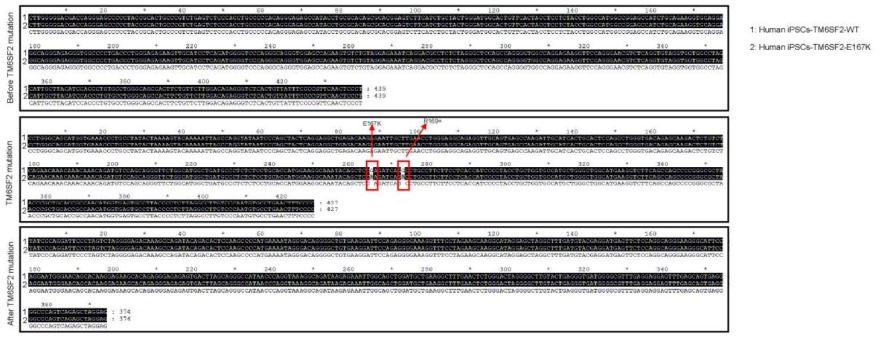 Fig. 1 Sanger Sequencing Comparison of iHep-TM6SF2-WT and iHep-TM6SF2-E167K Gene Sequences.1
TM6SF2, encoded by the TM6SF2 gene, functions as a polytopic ER membrane protein that regulates hepatic lipoprotein assembly and lipid secretion:
Creative Biolabs offers high-quality TM6SF2 membrane protein products produced using optimized expression systems. These include full-length polytopic transmembrane protein that retains the native multi-spanning architecture and cholesterol-binding cavity, as well as isolated domain variants. The transmembrane domain architecture mediates membrane integration, cholesterol binding, and ApoB interaction, making these proteins suitable for studies of VLDL lipidation, ER membrane protein function, and lipid-protein interaction characterization. All TM6SF2 proteins undergo strict quality control to support consistent performance across applicable research platforms.
Not finding the protein product you need? Contact us to start your one-stop custom service!
Creative Biolabs provides custom-engineered TM6SF2 stable cell lines, including overexpression and knockdown models. These cell lines are optimized for studies of VLDL lipidation, hepatic lipid metabolism, ER membrane protein function, and ApoB-containing lipoprotein secretion. Each cell line undergoes stringent validation to ensure stable expression profiles and consistent functional performance in diverse experimental contexts.
Not finding the stable cell line product you need? Contact us to start your one-stop custom service!
High-specificity recombinant antibodies targeting TM6SF2 are developed using antibody engineering technologies for research applications involving TM6SF2 expression and localization. These antibodies can be used in studies of TM6SF2 distribution in hepatocytes and enterocytes and may also support characterization of TM6SF2-containing lipoprotein assembly complexes in combination with appropriate detection reagents.
Not finding the recombinant antibody product you need? Contact us to start your one-stop custom service!
Beyond catalog products, Creative Biolabs offers specialized custom services for TM6SF2 research:
TM6SF2 is a polytopic ER membrane protein that promotes the bulk lipidation of ApoB-containing VLDL particles, enabling the addition of triglycerides and cholesteryl esters to nascent lipoproteins before secretion into the circulation.
TM6SF2 is a key regulator of hepatic lipoprotein biogenesis. Its common E167K variant is a major genetic risk factor for steatotic liver disease while protecting against coronary artery disease, making it important for studies of lipid metabolism and liver disease mechanisms.
No, all TM6SF2 products and services are strictly for research use only, not intended for clinical diagnosis or treatment.
Offerings include full-length TM6SF2 membrane proteins, domain variants, specific detection antibodies, and custom stable cell lines for lipid metabolism and ER membrane research.
TM6SF2 proteins are validated via cholesterol binding assays, ApoB interaction assays, and relevant functional characterization in applicable research platforms.









