Creative Biolabs is offering the most comprehensive services for antibody development projects. With strict regulation and effective execution, we are dedicated to providing the most valuable solutions to complete your projects.
HighlightsCreative Biolabs is offering the most comprehensive services for antibody development projects. With strict regulation and effective execution, we are dedicated to providing the most valuable solutions to complete your projects.
HighlightsCreative Biolabs has established a broad range of platforms for developing novel antibodies or equivalents. These cutting-edge technologies enable our scientists to meet your demands from different aspects and tailor the most appropriate solution that contributes to the success of your projects.
HighlightsWith deep understanding in antibody-related realms and extensive project experience, Creative Biolabs offers a variety of references to help you learn more about our capacities and achievements, including infographic, flyer, case study, peer-reviewed publications, and all kinds of knowledge that can assist your projects. You are also welcome to contact us directly for more specific solutions.
HighlightsGet a real taste of Creative Biolabs, one of the most professional custom service providers in the world. We are committed to providing highly customized comprehensive solutions with the best quality to advance your projects.
Highlights Loading...
All listed services and products are For Research Use Only. Do Not use in any diagnostic or therapeutic applications.
Transmembrane protein 127 (TMEM127) is a multi pass transmembrane protein encoded by TMEM127 gene. This protein predominantly localizes to endosomal and lysosomal related endomembrane compartments, with minor pool detectable at plasma membrane. TMEM127 contains multiple transmembrane helices embedded within organelle lipid bilayers. Short peptide segments face luminal and cytoplasmic sides of endomembrane compartments respectively. Polypeptide synthesis occurs on cytoplasmic ribosomes, then newly made polypeptide inserts into endoplasmic reticulum membrane before trafficking toward late endosome or lysosome related vesicle populations. TMEM127 shows broad expression across many cell types. Correct topological insertion into lipid bilayer is required for normal intracellular distribution. Misfolded variants are cleared by endoplasmic reticulum associated degradation pathways and fail to reach target endomembrane compartments. Different cell types adjust TMEM127 abundance according to intrinsic requirement for endomembrane associated protein complex assembly.
TMEM127 resides within limiting membrane of endomembrane vesicles and participates in molecular complex organization at cytoplasmic face of these organelles. Its cytoplasmic exposed segments provide docking sites for cytosolic regulatory protein partners. It does not function as ion channel or solute transporter, instead acting as a membrane anchored scaffold within endosomal lysosomal system. Variation in TMEM127 abundance alters availability of scaffold docking sites on target vesicle populations. Other multi pass transmembrane proteins from unrelated families cannot substitute for its specific partner recruitment profile. Sequence changes to cytoplasmic exposed peptide segments disturb binding toward cytosolic interaction partners, while alteration of transmembrane helices can disrupt proper vesicle targeting and protein topology without necessarily destroying partner binding capability. Changed TMEM127 levels influence assembly of protein complexes associated with endomembrane limiting membrane, and may shift the magnitude of protein recruitment events taking place on vesicle cytoplasmic surface.
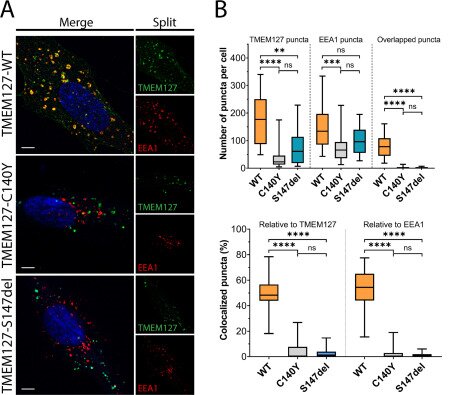 Fig. 1 Subcellular punctate distribution pattern of wild‑type TMEM127 on endosomal membrane compartments. Altered protein variants exhibit reduced vesicle‑associated punctate signals, indicating sequence‑dependent intracellular vesicle targeting behaviour of this multi‑pass transmembrane protein.1
The biological functions of TMEM127 are focused on endomembrane compartment scaffold assembly, cytosolic protein partner docking and vesicle associated complex organization:
Creative Biolabs offers purified TMEM127 membrane samples via standardized preparation workflows, including full length TMEM127 constructs and isolated transmembrane domain variants. Isolated transmembrane domain fragments may not support complete cytosolic partner docking and endomembrane scaffold related behaviours, while full length constructs may be suited for endomembrane anchored scaffold associated research. All samples receive routine quality screening, and functional relevant observation may only be carried out with full length samples under simulated membrane environments. All sample batches follow unified processing standards to maintain consistent structural features for comparative laboratory analysis across separate test groups.
Not finding the membrane protein product you need? Contact us to start your one-stop custom service!
Creative Biolabs provides adjustable TMEM127 expression cell models with varied expression levels, applicable to multi pass endomembrane transmembrane protein structural characteristic observation and vesicle associated scaffold function related research. Sample evaluation includes sustained target expression detection and preliminary intermolecular interaction associated observation, which can support comparative analysis of protein associated behaviours under different expression statuses. These cell systems can be matched with diverse laboratory analysis schemes to observe changes of partner recruitment efficiency under different target expression abundances.
Not finding the stable cell line product you need? Contact us to start your one-stop custom service!
Antibody reagents targeting TMEM127 are generated via mature protein preparation workflows, compatible with multiple routine laboratory detection methods for subcellular localization profiling and molecular complex identification, to support systematic analysis of TMEM127 distribution and endomembrane associated molecular complexes across diverse laboratory research setups. The antibody series can cooperate with other common laboratory detection reagents to complete multi dimensional observation of target distribution inside tissue samples.
Not finding the recombinant antibody product you need? Contact us to start your one-stop custom service!
Beyond catalog products, Creative Biolabs offers specialized custom services for TMEM127 research:
TMEM127 may function as multi pass endomembrane anchored scaffold protein and participate in cytosolic partner docking and vesicle associated molecular complex organization.
TMEM127 expression status may influence endomembrane compartment protein complex assembly, serving as a major regulatory mediator of vesicle associated scaffold related biological processes.
No, all TMEM127 related products and services are strictly for research use only, not intended for clinical related operations. All material designs and functional tests are only optimized for basic laboratory research scenarios, without matching clinical application standards.
Offerings include full length TMEM127 membrane protein, target specific recombinant antibodies and adjustable expression cell research models, supporting endomembrane vesicle associated protein function research.
Laboratory observation schemes may include endomembrane scaffold cytosolic partner interaction related tests to analyse protein associated behaviours under simulated cellular environments.