Creative Biolabs is offering the most comprehensive services for antibody development projects. With strict regulation and effective execution, we are dedicated to providing the most valuable solutions to complete your projects.
HighlightsCreative Biolabs is offering the most comprehensive services for antibody development projects. With strict regulation and effective execution, we are dedicated to providing the most valuable solutions to complete your projects.
HighlightsCreative Biolabs has established a broad range of platforms for developing novel antibodies or equivalents. These cutting-edge technologies enable our scientists to meet your demands from different aspects and tailor the most appropriate solution that contributes to the success of your projects.
HighlightsWith deep understanding in antibody-related realms and extensive project experience, Creative Biolabs offers a variety of references to help you learn more about our capacities and achievements, including infographic, flyer, case study, peer-reviewed publications, and all kinds of knowledge that can assist your projects. You are also welcome to contact us directly for more specific solutions.
HighlightsGet a real taste of Creative Biolabs, one of the most professional custom service providers in the world. We are committed to providing highly customized comprehensive solutions with the best quality to advance your projects.
Highlights Loading...
All listed services and products are For Research Use Only. Do Not use in any diagnostic or therapeutic applications.
TNFRSF10B (TNF receptor superfamily member 10b) encodes a type-I transmembrane receptor belonging to the TNF receptor superfamily, detectable across diverse human tissue cell populations. This membrane-anchored glycoprotein possesses extracellular cysteine-rich repeat domains responsible for partner recognition, a single-pass transmembrane helix, and a cytoplasmic segment containing characteristic death-domain architecture that mediates contacts with intracellular adaptor assemblies. Predominantly distributed at plasma-membrane and cell-surface compartments, minor TNFRSF10B protein pools are also present within intracellular vesicular and Golgi-associated membrane structures linked to receptor trafficking, surface delivery and molecular turnover processes. It assembles with membrane-resident ligand subunits and intracellular adaptor molecules to build heteromeric receptor complexes supporting cell-surface molecular crosstalk relevant to cellular adaptive status. Insufficient intact TNFRSF10B protein abundance may impair physiological surface-partner complex assembly and disturb downstream membrane-dependent cellular adaptive behaviours. Dynamic tissue microenvironments impose variable demands for TNF-family surface-receptor activities, requiring properly organised multimeric receptor assemblies to sustain multicellular tissue physiological equilibrium. Membrane-tethered TNFRSF10B cooperates with adjacent surface-localized molecular partners to mitigate abnormal receptor-complex rearrangement and stabilise plasma-membrane functional configurations.
Genetic sequence-level alterations within TNFRSF10B coding region may compromise structural integrity of plasma-membrane-localized heteromeric receptor-partner assemblies and reshape measurable outputs generated by cell-surface molecular-interaction events. Closely related TNF-receptor-superfamily paralogues cannot fully recapitulate the complete functional profile of TNFRSF10B during heteromeric surface-complex formation and stable membrane embedding. Shifts in TNFRSF10B protein abundance often align with cellular adaptive demands for death-domain-dependent surface-recognition events, rendering this type-I transmembrane receptor a valuable research subject for probing TNF-superfamily biology and cell-surface-membrane-homeostasis dynamics. Predominantly localised at plasma-membrane alongside minor intracellular membrane-bound fractions, TNFRSF10B participates in heteromeric receptor-complex assembly and will not sustain persistent downstream functional outputs without adequate extracellular partner-driven conformational triggering. Its composite cysteine-rich extracellular architecture coupled with intracellular death-domain module distinguishes this glycoprotein from many other cell-surface receptor components; these structural traits support maintenance of surface receptor-complex spatial arrangement and permit selective physical contacts with membrane-resident binding counterparts. Diminished functional competence of TNFRSF10B may disrupt orderly surface-partner complex assembly and weaken endogenous cellular adaptive buffering capacity, further underpinning its research value for death-receptor-oriented laboratory investigations.
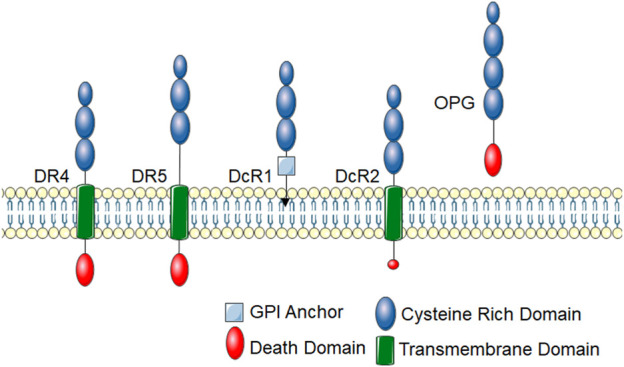 Fig. 1 Topology of human TRAIL receptor family. TNFRSF10B (DR5) is a type I transmembrane glycoprotein with extracellular cysteine rich domains, single transmembrane segment and cytoplasmic death domain.1
The biological functions of transmembrane TNFRSF10B (DR5) are focused on TRAIL recognition, receptor clustering, FADD/DISC assembly and death-domain-dependent apoptotic signaling:
Creative Biolabs offers purified TNFRSF10B membrane samples generated under unified preparation workflows, including full-length receptor constructs and isolated domain-truncated variants. Truncated domain fragments cannot support complete surface-partner-complex assembly behaviours, whereas full-length constructs suit research focused on receptor-partner interaction and plasma-membrane anchoring-related functional observation. All batches receive uniform quality screening. Function-oriented observation may only be performed using full-length samples under simulated plasma-membrane microenvironment setups. Consistent structural features are preserved across batches to support comparative laboratory analysis across separate test groups. Full-length TNFRSF10B samples retain intact partner-interaction-domain conformation after standardized purification, supporting reliable detection of weak and transient receptor-partner contacts for comparative functional analysis.
Not finding the Membrane potein product you need? Contact us to start your one-stop custom service!
Creative Biolabs provides adjustable TNFRSF10B expression cell research models with tunable target-expression levels, applicable to structural observation of type-I transmembrane TNF-superfamily death-domain receptor and research into membrane-partner molecular interaction. Sample evaluation includes sustained target-receptor expression detection and preliminary partner-interaction observation, enabling side-by-side comparison of receptor-binding behaviours under differing target-protein abundances. These cell systems can pair with diverse laboratory analysis schemes to track changes in partner-assembly efficiency alongside shifting TNFRSF10B protein levels.
Not finding the stable cell line product you need? Contact us to start your one-stop custom service!
Anti-TNFRSF10B recombinant antibodies are generated via standardized protein preparation workflows, compatible with routine laboratory detection techniques for plasma-membrane localization mapping and identification of receptor-partner molecular complexes. The antibody series can work alongside common laboratory detection reagents to realise multi-dimensional observation of target-receptor distribution within membrane-enriched sample materials.
Not finding the recombinant antibody product you need? Contact us to start your one-stop custom service!
Beyond catalog products, Creative Biolabs offers specialized custom services for TNFRSF10B research:
TNFRSF10B/DR5 is a TRAIL-binding death receptor that clusters after ligand engagement, recruits FADD to assemble the DISC and activates caspase-8/10-dependent extrinsic apoptosis signaling.
TNFRSF10B is a key model for studying TRAIL-dependent death-receptor signaling, including receptor clustering, FADD/DISC assembly and initiator-caspase activation.
No, TNFRSF10B-associated research reagents from Creative Biolabs are exclusively built for exploring TNF-superfamily-dependent cell-surface regulatory mechanisms, and shall not be deployed for any clinical-oriented workflows. These preparations are optimized for basic laboratory investigation and do not satisfy performance benchmarks required for clinical implementation.
Offerings include full-length TNFRSF10B membrane protein, target-specific recombinant antibodies and tunable-expression cell research models, supporting research on cell-membrane homeostasis and receptor-mediated membrane-partner perception.
Laboratory studies may assess TRAIL-dependent receptor clustering, FADD/DISC assembly and caspase-8/10 activation under defined experimental conditions.