
Creative Biolabs is offering the most comprehensive services for antibody development projects. With strict regulation and effective execution, we are dedicated to providing the most valuable solutions to complete your projects.
HighlightsCreative Biolabs is offering the most comprehensive services for antibody development projects. With strict regulation and effective execution, we are dedicated to providing the most valuable solutions to complete your projects.
HighlightsCreative Biolabs has established a broad range of platforms for developing novel antibodies or equivalents. These cutting-edge technologies enable our scientists to meet your demands from different aspects and tailor the most appropriate solution that contributes to the success of your projects.
HighlightsWith deep understanding in antibody-related realms and extensive project experience, Creative Biolabs offers a variety of references to help you learn more about our capacities and achievements, including infographic, flyer, case study, peer-reviewed publications, and all kinds of knowledge that can assist your projects. You are also welcome to contact us directly for more specific solutions.
HighlightsGet a real taste of Creative Biolabs, one of the most professional custom service providers in the world. We are committed to providing highly customized comprehensive solutions with the best quality to advance your projects.
Highlights Loading...
All listed services and products are For Research Use Only. Do Not use in any diagnostic or therapeutic applications.
TNF receptor superfamily member 11a (TNFRSF11A) is a single pass transmembrane receptor encoded by the TNFRSF11A gene. This protein presents at plasma membrane surfaces of bone lineage cell populations. Its extracellular segment contains repeated cysteine‑rich domain units that mediate ligand recognition. One transmembrane helix anchors the polypeptide into lipid bilayers, and an intracellular cytoplasmic region carries sequence motifs for adaptor molecule recruitment. Engagement with matching extracellular ligand can trigger receptor assembly rearrangement at cell surface.
Ligand binding promotes receptor multimer formation across plasma membrane. Multimerized receptor assemblies create docking platforms for cytoplasmic adaptor molecules, and initiate downstream intracellular signalling cascades. Variation in TNFRSF11A membrane abundance can change cellular sensitivity toward corresponding ligand molecules present within bone tissue microenvironments. Bone lineage cells can adjust receptor surface levels in response to local molecular cues. Extracellular cysteine‑rich domains define ligand binding selectivity, while cytoplasmic sequences mediate the recruitment of distinct intracellular effector molecules.
Sequence variants within TNFRSF11A coding region may disrupt extracellular ligand contact surfaces or alter cytoplasmic adaptor docking motifs. These changes can interfere with downstream signal activation triggered by natural ligand molecules within experimental systems. Other members from TNF receptor superfamily share partial domain similarity, yet they cannot fully replicate the ligand preference and downstream output profile defined by TNFRSF11A. Full length membrane‑anchored receptor represents its major functional molecular form. Its transmembrane topology supports two core biological functions. It detects soluble or membrane‑bound ligand molecules via extracellular domain assemblies, and it assembles cytoplasmic signalling complexes through intracellular sequence motifs. Lower abundance of functional TNFRSF11A receptor reduces cellular responsiveness to ligand inputs within bone tissue environments. This feature makes TNFRSF11A a meaningful research target for studies focused on bone cell signal regulation.
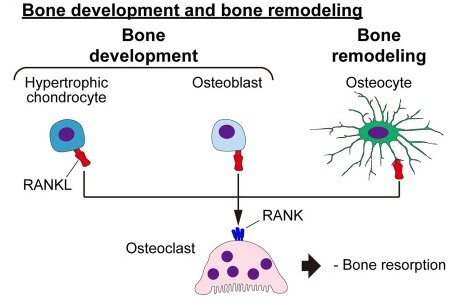 Fig. 1 Physiological TNFRSF11A‑RANKL signalling during bone development and bone remodelling. Ligand presented by bone‑derived cells binds to membrane‑localized TNFRSF11A receptor on osteoclast‑lineage cells and triggers signalling cascades leading to physiological bone resorption.1
The biological functions of integral membrane TNFRSF11A receptor center on extracellular ligand recognition and cytoplasmic signalling complex assembly:
Creative Biolabs offers purified TNFRSF11A membrane protein samples produced under unified preparation workflows, including full length TNFRSF11A constructs and isolated domain variants. Truncated polypeptide fragments cannot support complete ligand recognition and cytoplasmic signal complex assembly activity, while full length forms suit bone‑related receptor oriented research. All batches undergo uniform quality screening. Functional assessments may only be performed under simulated lipid bilayer microenvironment setups. Conserved extracellular ligand recognition domains and cytoplasmic adaptor docking motifs are preserved across batches to support comparative ligand interaction analysis between experimental groups. Full length TNFRSF11A membrane samples retain native domain interfaces after purification, supporting reliable detection of ligand dependent molecular rearrangement in comparative functional analysis.
Not finding the Membrane Protein product you need? Contact us to start your one-stop custom service!
Creative Biolabs provides cell research models with adjustable TNFRSF11A expression levels, suitable for observation of transmembrane TNF superfamily receptor and bone‑cell signal related studies. Sample assessment covers cell‑surface receptor abundance quantification and downstream signalling readout analysis, enabling side‑by‑side comparison of ligand response capacity under varying TNFRSF11A abundances. These cell models can be paired with ligand stimulation detection schemes to track signalling state shifts linked to modified receptor membrane dosage.
Not finding the stable cell line product you need? Contact us to start your one-stop custom service!
Anti TNFRSF11A recombinant antibodies are generated via standardized workflows, compatible with cell surface receptor localization mapping and receptor containing molecular complex identification. The antibody series supports multi dimensional observation of TNFRSF11A distribution on bone lineage associated cell surfaces.
Not finding the recombinant antibody product you need? Contact us to start your one-stop custom service!
Beyond catalog products, Creative Biolabs offers specialized custom services for TNFRSF11A research:
TNFRSF11A may act as transmembrane TNF superfamily receptor. It recognizes extracellular ligand molecules and assembles cytoplasmic signalling complexes to regulate behaviours of bone‑lineage cell populations.
Membrane abundance of functional TNFRSF11A might define cellular ligand responsiveness within bone tissue microenvironments, serving as a key mediator of bone tissue homeostasis.
No, all TNFRSF11A related products and services are strictly for research use only, and cannot be applied in clinical workflows. All material design and functional screening are optimized exclusively for basic laboratory research, without meeting clinical application criteria.
Offerings include full length TNFRSF11A membrane protein, target specific recombinant antibodies and tunable expression cell research models, supporting research on TNF superfamily receptor mediated bone cell signalling.
Laboratory analysis schemes may include co‑incubation assays with corresponding ligand molecules to evaluate receptor multimerization and downstream signal triggering capacity under simulated lipid bilayer environments.








