
Creative Biolabs is offering the most comprehensive services for antibody development projects. With strict regulation and effective execution, we are dedicated to providing the most valuable solutions to complete your projects.
HighlightsCreative Biolabs is offering the most comprehensive services for antibody development projects. With strict regulation and effective execution, we are dedicated to providing the most valuable solutions to complete your projects.
HighlightsCreative Biolabs has established a broad range of platforms for developing novel antibodies or equivalents. These cutting-edge technologies enable our scientists to meet your demands from different aspects and tailor the most appropriate solution that contributes to the success of your projects.
HighlightsWith deep understanding in antibody-related realms and extensive project experience, Creative Biolabs offers a variety of references to help you learn more about our capacities and achievements, including infographic, flyer, case study, peer-reviewed publications, and all kinds of knowledge that can assist your projects. You are also welcome to contact us directly for more specific solutions.
HighlightsGet a real taste of Creative Biolabs, one of the most professional custom service providers in the world. We are committed to providing highly customized comprehensive solutions with the best quality to advance your projects.
Highlights Loading...
All listed services and products are For Research Use Only. Do Not use in any diagnostic or therapeutic applications.
TNF receptor superfamily member 1B (TNFRSF1B, TNFR2) is a transmembrane immune receptor encoded by TNFRSF1B gene, widely expressed in stromal, endothelial and immune cell populations, localized exclusively to plasma membrane lipid bilayers. Distinct from TNFRSF1A pro-apoptotic paralog, TNFRSF1B engages membrane-bound TNF ligands to recruit cytoplasmic adaptor molecules that initiate cell survival and proliferative cascades rather than apoptotic pathways. Under steady systemic immune states, basal TNFRSF1B expression sustains mild tissue regenerative signaling without excessive inflammatory proliferation. Upon sustained TNF ligand exposure during infection or tissue injury, receptor ligation amplifies anti-apoptotic transcriptional programs to maintain stromal and immune cell viability. Unlike broadly expressed TNF receptors with dual death-inducing functions, TNFRSF1B carries cell-protective regulatory functions that cannot be fully compensated by other TNF superfamily receptors, linking membrane TNF recognition directly to tissue survival pathways. Loss of functional TNFRSF1B elevates cell death susceptibility and exacerbates tissue inflammatory damage, while sustained receptor signaling restrains apoptotic clearance, establishing TNFRSF1B as a core research target for TNF receptor biology and tissue-protective compound screening.
TNFRSF1B executes ligand-dependent survival receptor function embedded within cell surface bilayers, utilizing conserved extracellular cysteine-rich domains to selectively bind membrane-presented TNF molecules. Conserved ligand binding architectures distinguish its substrate preference from soluble TNF-binding TNFRSF1A receptors distributed across most somatic cells. TNFRSF1B-mediated receptor clustering bridges extracellular TNF stimulation and intracellular pro-survival signal transduction, balancing tissue regeneration and inflammatory injury magnitude according to local ligand abundance. TNFRSF1B participates in vascular maintenance, immune cell survival and chronic inflammatory tissue remodeling. Deficient TNFRSF1B signaling disrupts tissue protective responses and accelerates inflammatory cell death. Therefore, TNFRSF1B represents a pivotal research target for TNFR superfamily study and anti-inflammatory compound screening.
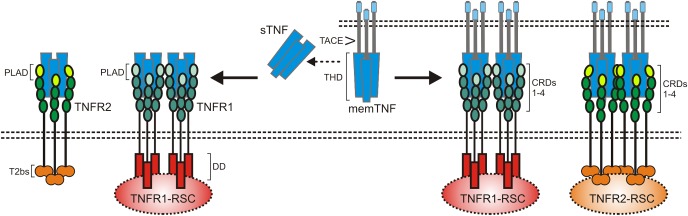 Fig. 1 Structural comparison diagram of TNFR1 and TNFR2 receptors, illustrating membrane-bound TNF (memTNF) / soluble TNF (sTNF) ligand selectivity, extracellular CRD domains, distinct cytoplasmic motifs (DD for TNFR1, PLAD/T2bs for TNFR2) and receptor signaling complex assembly.1
The biological functions of TNFRSF1B are focused on membrane TNF ligand binding, anti-apoptotic signal transduction and tissue homeostasis control:
Creative Biolabs offers high-quality TNFRSF1B proteins through optimized expression systems, including full-length TNFR2 receptor and isolated extracellular ligand-binding domain variants. These products are suitable for TNF receptor-ligand interaction assays and tissue protective modulator screening. All TNFRSF1B proteins undergo strict quality control to ensure consistent performance and reliable application across diverse research platforms.
Not finding the membrane protein product you need? Contact us to start your one-stop custom service!
Creative Biolabs provides custom-engineered TNFRSF1B stable cell lines, including overexpression and blank control models. These cell lines are optimized for TNFR receptor expression profiling and cell survival signal functional analysis. Each cell line undergoes stringent validation to ensure stable expression profiles and consistent functional performance in diverse experimental contexts.
Not finding the stable cell line product you need? Contact us to start your one-stop custom service!
High-specificity recombinant antibodies targeting TNFRSF1B are developed via advanced antibody engineering technologies. These antibodies are validated for stromal/immune cell plasma membrane localization detection and multi-tissue expression profiling, and can be combined with TNF ligand detection reagents to analyze complete TNFRSF1B signaling complexes in inflammatory cell models.
Not finding the recombinant antibody product you need? Contact us to start your one-stop custom service!
Beyond catalog products, Creative Biolabs offers specialized custom services for TNFRSF1B research:
TNFRSF1B is a TNF receptor that recognizes membrane-bound TNF to transmit anti-apoptotic signals supporting stromal and immune cell survival.
TNFRSF1B acts as a critical link between membrane TNF stimulation and tissue protective signaling, balancing inflammatory cell death and regeneration.
No, all TNFRSF1B products and services are strictly for research use only, not intended for clinical diagnosis or treatment.
Offerings include full-length TNFRSF1B receptor proteins, isoform-specific detection antibodies and custom stable cell lines for inflammatory survival research.
TNFRSF1B proteins are validated via membrane TNF ligand binding functional testing.








