
Creative Biolabs is offering the most comprehensive services for antibody development projects. With strict regulation and effective execution, we are dedicated to providing the most valuable solutions to complete your projects.
HighlightsCreative Biolabs is offering the most comprehensive services for antibody development projects. With strict regulation and effective execution, we are dedicated to providing the most valuable solutions to complete your projects.
HighlightsCreative Biolabs has established a broad range of platforms for developing novel antibodies or equivalents. These cutting-edge technologies enable our scientists to meet your demands from different aspects and tailor the most appropriate solution that contributes to the success of your projects.
HighlightsWith deep understanding in antibody-related realms and extensive project experience, Creative Biolabs offers a variety of references to help you learn more about our capacities and achievements, including infographic, flyer, case study, peer-reviewed publications, and all kinds of knowledge that can assist your projects. You are also welcome to contact us directly for more specific solutions.
HighlightsGet a real taste of Creative Biolabs, one of the most professional custom service providers in the world. We are committed to providing highly customized comprehensive solutions with the best quality to advance your projects.
Highlights Loading...
All listed services and products are For Research Use Only. Do Not use in any diagnostic or therapeutic applications.
The tumor necrosis factor superfamily (TNFSF) includes a member called tumor necrosis factor superfamily member 9 (TNFSF9), also known throughout immunology as the 4-1BB ligand or CD137 ligand. As a TNF superfamily member, TNFSF9 has a very specific role to play — it is responsible for "turning activated T cells up" instead of "on." This distinction is critical. Activated T cells start to respond when their antigen receptors bind with their target antigens, and they receive the necessary costimulatory signals. 4-1BB, which is the receptor for TNFSF9, appears after the initial activation of T cells, and its binding provides survival, proliferation, and effector-quality signals to help maintain the activated state of the T cells, but does not cause activation. The ligand providing these sustaining signals is TNFSF9, which is expressed on antigen-presenting cells such as dendritic cells, macrophages, and activated B cells — all types of cells that are involved in the generation of sustained T cell responses. There is a strong relationship between the amount of research conducted on 4-1BB costimulation and the number of people who believe it is important to investigate its effects. For example, some costimulation researchers focus on determining how 4-1BB engagement influences the ability of T cells to survive and produce high-quality effectors. Some tumor-immunity researchers are investigating ways to stimulate 4-1BB through agonistic approaches as a method for enhancing effector responses in animal models. Finally, the field of TNF-superfamily research has gained much from having a clear-cut example of a ligand-receptor pair with known trimeric structure and bidirectional signaling capabilities that can be studied using experimental methods. Reagents used in studying TNFSF9 have characteristics that reflect its nature as a trimeric TNF-family ligand. Reagents used for receptor studies must contain the TNF-homology domain assembled into a functional trimer; otherwise, results from receptor binding studies will be meaningless. Reagents must also respect the type II membrane topology of TNFSF9 when designing formats. Additionally, reagents used for membrane-bound formats are particularly relevant because TNF-family signaling is dependent upon direct cell-cell interactions. Finally, antibodies used in studies involving TNFSF9 must be specific enough to distinguish it from other members of the TNF-superfamily, since many members share the same TNF-homology domain, making generic antibodies unusable. All platforms described below were created based upon these requirements.
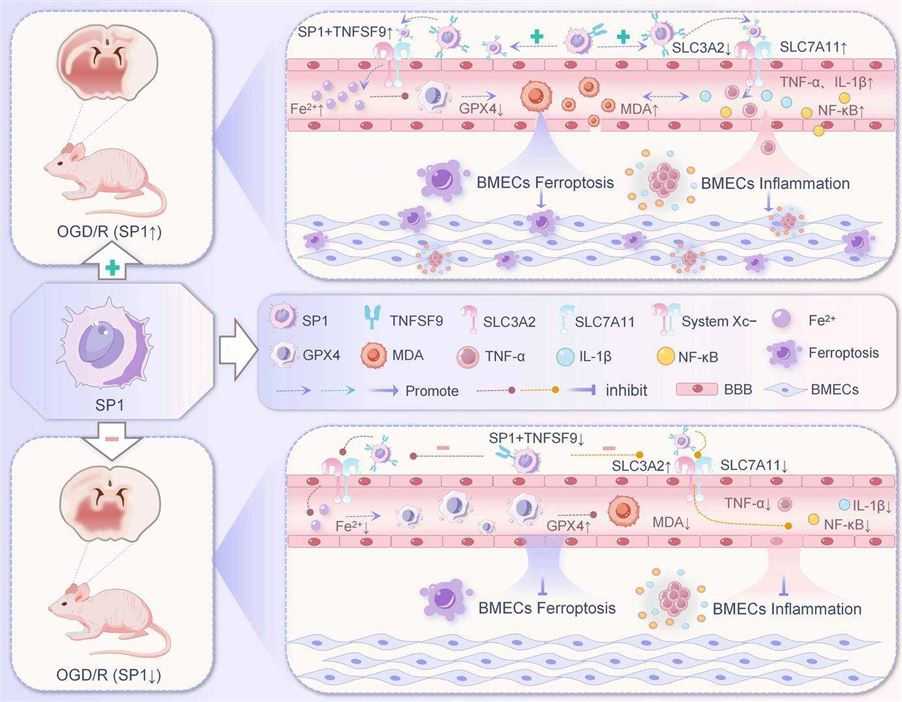 Fig.1 Relationship between SP1/TNFSF9/SLC3A2 signaling pathway and ferroptosis in BMECs.1
TNFSF9 mediates various types of immune responses that go far beyond what is implied by the term T-cell activator:
We are providing a top-of-the-line full-length oligomeric TNFSF9 membrane protein that is highly pure. This protein is designed to overcome the issues associated with the biochemical characteristics of the TNF superfamily of ligands. The production method we use utilizes advanced membrane protein expression technology and can support many different types of molecular biology research. All formulations have been tested under rigorous quality controls so that they meet the process requirements for numerous applications.
Not finding the membrane protein product you need? Contact us to start your one-stop custom service!
The establishment of a cellular system that closely mimics the endogenous TNFSF9 co-stimulatory pathway will be essential to both immune research and early drug discovery. Using state-of-the-art technology, we develop stable TNFSF9 cell lines that are able to express the target protein at its appropriate location (on the cell surface) as well as elicit a biologically relevant response when bound by the receptor. In addition to expressing the naturally occurring form of the TNFSF9 protein (wild-type), our line-up also contains several mutant versions of the protein to allow for further investigation into the molecular basis of TNFSF9-mediated co-stimulation. All of our cell lines have been validated for successful stable transfection as well as surface expression of the TNFSF9 protein. Therefore, our portfolio represents a valuable resource for studying immune pathways as well as optimizing reagent design against the TNFSF9 pathway.
Not finding the stable cell line product you need? Contact us to start your one-stop custom service!
Recombinant antibodies targeting TNFSF9 can be developed and characterized for target specificity and compatibility with research applications. Antibody formats, sample requirements, and cross-reactivity considerations can be evaluated according to project needs; application-specific performance should be supported by relevant validation data.
Not finding the recombinant antibody product you need? Contact us to start your one-stop custom service!
Extending well beyond our standard catalog, we deliver fully customizable discovery and manufacturing solutions meticulously tailored to the sophisticated demands of TNFSF9-targeted research and compound development:
Yes. The immunization strategy relies on antigen formats that stabilize the native threefold symmetric arrangement characteristic of this ligand family.
No. The entire portfolio of TNFSF9-directed proteins, stable expression systems, and affinity reagents is reserved strictly for preclinical investigation.
Yes. We offer engineered cellular systems in which the ligand is displayed at the outer membrane with documented capacity for engaging cognate receptors and initiating downstream membrane-proximal co-stimulatory events.
Our integrated catalogue spans three principal material classes: recombinant TNFSF9 proteins in diverse biochemical presentations, stable expression systems with validated surface display, and sequence-defined antibodies mapping to distinct topological regions.









