
Creative Biolabs is offering the most comprehensive services for antibody development projects. With strict regulation and effective execution, we are dedicated to providing the most valuable solutions to complete your projects.
HighlightsCreative Biolabs is offering the most comprehensive services for antibody development projects. With strict regulation and effective execution, we are dedicated to providing the most valuable solutions to complete your projects.
HighlightsCreative Biolabs has established a broad range of platforms for developing novel antibodies or equivalents. These cutting-edge technologies enable our scientists to meet your demands from different aspects and tailor the most appropriate solution that contributes to the success of your projects.
HighlightsWith deep understanding in antibody-related realms and extensive project experience, Creative Biolabs offers a variety of references to help you learn more about our capacities and achievements, including infographic, flyer, case study, peer-reviewed publications, and all kinds of knowledge that can assist your projects. You are also welcome to contact us directly for more specific solutions.
HighlightsGet a real taste of Creative Biolabs, one of the most professional custom service providers in the world. We are committed to providing highly customized comprehensive solutions with the best quality to advance your projects.
Highlights Loading...
All listed services and products are For Research Use Only. Do Not use in any diagnostic or therapeutic applications.
Tryptase alpha/beta 1 (TPSAB1) is a mast cell/basophil granule-stored serine protease encoded by TPSAB1 gene, co-expressed as alpha and beta isoforms to assemble enzymatically active heterotetramers stabilized by intracellular heparin proteoglycans. Distinguished from other granule proteases with narrow substrate range, TPSAB1 tetramers cleave PAR2 receptors, ECM fibronectin and mechanosensory EMR2 to drive multi-organ allergic inflammatory cascades upon mast cell degranulation. Under healthy resting immunity, minimal constitutive TPSAB1 release maintains low-level tissue remodeling surveillance; allergen or mechanical stimulation triggers massive mast cell degranulation, discharging abundant TPSAB1 into interstitial fluid to induce bronchoconstriction vascular leakage and cutaneous urticaria. Germline TPSAB1 copy number amplification elevates basal circulating tryptase levels and causes hereditary alpha tryptasemia featuring chronic multi-system hypersensitivity symptoms. Its mast cell-restricted inflammatory protease function cannot be fully compensated by other immune proteases; pharmacological TPSAB1 inhibition alleviates severe asthma and urticaria pathology, making TPSAB1 an irreplaceable core research target for mast cell immunology and anti-allergy therapeutic screening.
TPSAB executes granule-resident serine protease function packaged within mast cell secretory vesicles, forming heparin-stabilized α/β heterotetramers that retain sustained catalytic activity post extracellular release. Its broad substrate repertoire for inflammatory GPCR and matrix proteins clearly separates TPSAB1 from granulocyte-specific proteases, establishing it as a master amplifier of mast cell-mediated allergy. TPSAB1-mediated substrate cleavage links mast cell degranulation to tissue inflammatory damage, balancing baseline tissue repair and pathological hypersensitivity according to stimulus intensity. TPSAB1 participates in asthma pathogenesis chronic urticaria and systemic mastocytosis progression. Loss of functional TPSAB1 drastically reduces allergic tissue inflammatory infiltration. Therefore, TPSAB1 represents a pivotal research target for mast cell protease study and anti-allergy therapeutic exploration.
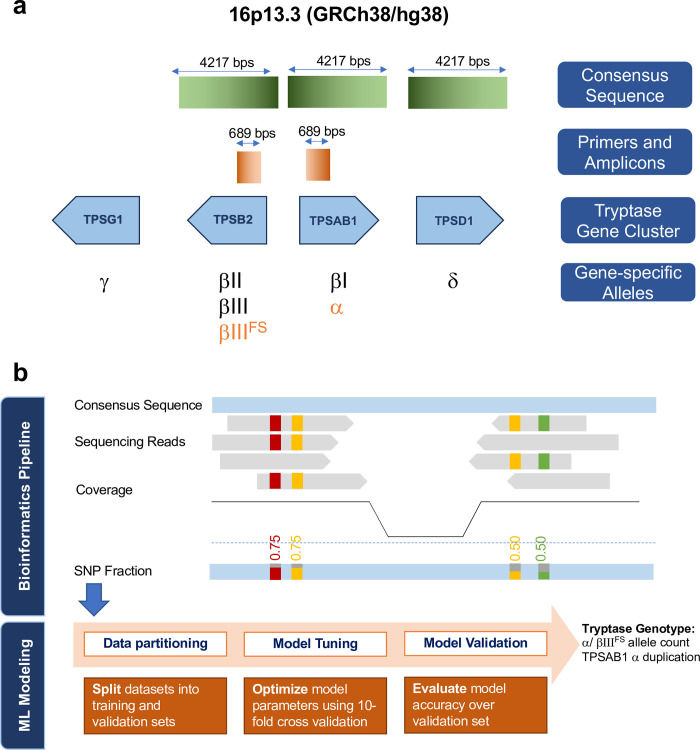 Fig. 1 Genomic map of 16p13.3 tryptase gene cluster and sequencing-based machine learning workflow for TPSAB1 genotyping.1
The biological functions of TPSAB1 tetrameric tryptase are fully focused on extracellular PAR2/EMR2 receptor cleavage and downstream allergic signal amplification:
Creative Biolabs offers high-quality TPSAB1 proteins through optimized mammalian secretion systems, including heparin-stabilized tetramer and isolated monomer protease domain variants. These products retain native PAR2/EMR2 substrate cleavage activity, suitable for allergic inflammation and mastocytosis inhibitor screening assays. All TPSAB1 proteins undergo strict quality control to ensure consistent performance and reliable application across immunology research platforms.
Not finding the protein product you need? Contact us to start your one-stop custom service!
Creative Biolabs provides custom-engineered TPSAB1 stable cell lines, including mast cell-like overexpression and blank empty vector control models. These cell lines are optimized for granule protease profiling and allergic signal functional analysis. Each cell line undergoes stringent validation to ensure stable expression profiles during long-term hematopoietic cell culture, and can be widely deployed for anti-asthma compound screening workflows.
Not finding the stable cell line product you need? Contact us to start your one-stop custom service!
High-specificity recombinant antibodies targeting TPSAB1 are developed via advanced antibody engineering technologies, with no cross-reactivity with other granulocyte serine proteases. These antibodies are validated for mast cell granule localization detection and skin/lung tissue expression profiling, and can be combined with PAR2 marker reagents to analyze inflammatory protease signaling complexes in immune cell models.
Not finding the recombinant antibody product you need? Contact us to start your one-stop custom service!
Beyond catalog products, Creative Biolabs offers specialized custom services for TPSAB1 research:
A1: TPSAB1 is mast cell tetrameric serine protease that cleaves PAR2/EMR2 to drive allergic inflammatory responses.
A2: TPSAB1 is the central effector of mast cell allergy, gene copy variants cause hereditary tryptasemia.
A3: No, all TPSAB1 products and services are strictly for research use only, not intended for clinical allergy testing.
A4: Offerings include tetrameric TPSAB1 proteases, isoform-specific detection antibodies and custom stable cell lines for mast cell research.
A5: TPSAB1 proteins are validated via PAR2 receptor cleavage proteolytic functional testing.








