Creative Biolabs is offering the most comprehensive services for antibody development projects. With strict regulation and effective execution, we are dedicated to providing the most valuable solutions to complete your projects.
HighlightsCreative Biolabs is offering the most comprehensive services for antibody development projects. With strict regulation and effective execution, we are dedicated to providing the most valuable solutions to complete your projects.
HighlightsCreative Biolabs has established a broad range of platforms for developing novel antibodies or equivalents. These cutting-edge technologies enable our scientists to meet your demands from different aspects and tailor the most appropriate solution that contributes to the success of your projects.
HighlightsWith deep understanding in antibody-related realms and extensive project experience, Creative Biolabs offers a variety of references to help you learn more about our capacities and achievements, including infographic, flyer, case study, peer-reviewed publications, and all kinds of knowledge that can assist your projects. You are also welcome to contact us directly for more specific solutions.
HighlightsGet a real taste of Creative Biolabs, one of the most professional custom service providers in the world. We are committed to providing highly customized comprehensive solutions with the best quality to advance your projects.
Highlights Loading...
All listed services and products are For Research Use Only. Do Not use in any diagnostic or therapeutic applications.
Translocation-associated membrane protein 1 (TRAM1), encoded by the TRAM1 gene located at human chromosome 8q13.3 and also known as TRAMP or PNAS-8, is an approximately 43 kDa multi-pass transmembrane protein of the endoplasmic reticulum (ER) membrane. It is predicted to contain eight transmembrane segments and a single TLC (TRAM/LAG1/CLN8) domain, and it is widely expressed in line with its role in the general protein translocation machinery. Rather than acting as a channel itself, TRAM1 functions as an auxiliary component of the Sec61 translocon, where it supports the co-translational translocation of nascent secretory and membrane proteins into and through the ER membrane. Together with the Sec61 complex, the TRAP complex, and the oligosaccharyltransferase, TRAM1 forms part of the protein-conducting machinery at the ER membrane. As an integral membrane component of the translocon, TRAM1 has been reported to contact nascent polypeptide chains during translocation and to support the membrane integration of certain precursors, making it an important research target for understanding ER protein biogenesis and membrane protein integration.
TRAM1 is a widely expressed ER membrane protein that participates in SRP-dependent co-translational protein targeting and the subsequent translocation of nascent chains through the Sec61 channel. The protein has been proposed to modulate the phospholipid bilayer near the lateral gate of the Sec61 channel, facilitating the partitioning of transmembrane segments into the lipid phase during membrane protein biogenesis. Alongside the TRAP complex and the signal peptidase complex, TRAM1 is one of several auxiliary components that cooperate with the Sec61 channel, and its close homologs TRAM1L1 and TRAM2 are likewise associated with ER protein translocation. The integral membrane topology and translocon-associated function of TRAM1 make it a useful target for research on co-translational translocation, signal-sequence recognition, and the molecular mechanisms by which membrane proteins integrate into the ER.
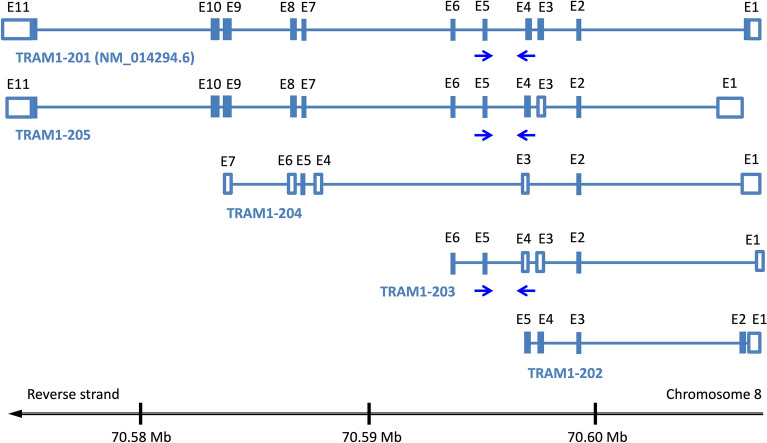 Fig. 1 Linear transcripts of the TRAM1 gene locus.1
TRAM1, encoded by the TRAM1 gene, functions as an integral endoplasmic reticulum membrane protein that supports the co-translational translocation of nascent polypeptide chains through the Sec61 translocon:
Creative Biolabs offers high-quality TRAM1 membrane proteins produced using optimized expression systems, including full-length TRAM1 and constructs representing its transmembrane and TLC domain regions. As an integral endoplasmic reticulum membrane component of the Sec61 translocon, TRAM1 is suitable for studies of co-translational protein translocation, signal-sequence recognition, and membrane protein integration. These membrane protein products can support investigation of translocon function, interactions among Sec61-associated components, and the role of the phospholipid bilayer in protein biogenesis. All TRAM1 membrane proteins undergo strict quality control to support consistent performance across applicable research platforms.
Not finding the protein product you need? Contact us to start your one-stop custom service!
Creative Biolabs provides custom-engineered TRAM1 stable cell lines, including overexpression and blank control models. These cell lines are optimized for studies of endoplasmic reticulum protein translocation and membrane protein biogenesis. Each cell line undergoes stringent validation to ensure stable expression profiles and consistent functional performance in diverse experimental contexts.
Not finding the stable cell line product you need? Contact us to start your one-stop custom service!
High-specificity recombinant antibodies targeting TRAM1 are developed using antibody engineering technologies for research applications involving TRAM1 expression and localization. These antibodies can be used in studies of TRAM1 distribution in the endoplasmic reticulum and may also support characterization of TRAM1-containing translocon complexes in combination with appropriate Sec61, TRAP, or related translocon-component detection reagents.
Not finding the recombinant antibody product you need? Contact us to start your one-stop custom service!
Beyond catalog products, Creative Biolabs offers specialized custom services for TRAM1 research:
TRAM1 is an integral endoplasmic reticulum membrane protein that functions as an auxiliary component of the Sec61 translocon, facilitating the co-translational translocation of nascent secretory and membrane proteins into and through the ER membrane. It has been proposed to modulate the phospholipid bilayer near the lateral gate of the Sec61 channel to support membrane protein integration.
TRAM1 is a core component of the endoplasmic reticulum protein translocation machinery, and studying it informs the molecular mechanisms of co-translational translocation, signal-sequence recognition, and membrane protein biogenesis. As a multi-pass membrane protein with a TLC domain, TRAM1 also provides a model for investigating how integral membrane proteins contribute to translocon function.
No, all TRAM1 products and services are strictly for research use only, not intended for clinical diagnosis or treatment.
Offerings include full-length TRAM1 membrane proteins, custom TRAM1 stable cell lines, and TRAM1-specific recombinant antibodies for ER protein translocation and membrane protein biogenesis research.
TRAM1 products are suitable for studies of co-translational protein translocation, membrane protein integration, and Sec61 translocon complex assembly.