Creative Biolabs is offering the most comprehensive services for antibody development projects. With strict regulation and effective execution, we are dedicated to providing the most valuable solutions to complete your projects.
HighlightsCreative Biolabs is offering the most comprehensive services for antibody development projects. With strict regulation and effective execution, we are dedicated to providing the most valuable solutions to complete your projects.
HighlightsCreative Biolabs has established a broad range of platforms for developing novel antibodies or equivalents. These cutting-edge technologies enable our scientists to meet your demands from different aspects and tailor the most appropriate solution that contributes to the success of your projects.
HighlightsWith deep understanding in antibody-related realms and extensive project experience, Creative Biolabs offers a variety of references to help you learn more about our capacities and achievements, including infographic, flyer, case study, peer-reviewed publications, and all kinds of knowledge that can assist your projects. You are also welcome to contact us directly for more specific solutions.
HighlightsGet a real taste of Creative Biolabs, one of the most professional custom service providers in the world. We are committed to providing highly customized comprehensive solutions with the best quality to advance your projects.
Highlights Loading...
All listed services and products are For Research Use Only. Do Not use in any diagnostic or therapeutic applications.
T cell receptor beta constant 1 (TRBC1) is the conserved constant domain subunit of TCR β chain encoded by TRBC1 gene, exclusively expressed in mature αβ T lymphocytes, anchored to T cell plasma membrane and forming core scaffold of TCR-CD3 complex. It owns conserved extracellular Ig-like domain, transmembrane segment and short cytoplasmic tail, responsible for stabilizing variable region heterodimer and linking CD3 signal transduction subunits. During thymic T cell maturation, TRBC1 mediates correct folding and membrane trafficking of rearranged TCR β chains to complete positive and negative selection. In peripheral immunity, TRBC1 maintains intact TCR complex structure upon antigen peptide-MHC ligation, transducing downstream T cell proliferation and effector differentiation signals. Distinct from TRBC2 paralog, TRBC1 shows biased expression in specific T cell subsets and malignant T cell clones, with unique structural features irreplaceable for stable TCR assembly. Defective TRBC1 impairs TCR membrane expression and abolishes antigen responsiveness; clonal TRBC1 overexpression is a biomarker for T cell leukemia/lymphoma, making it a core target for adaptive immunity and hematology research.
TRBC1 executes scaffold and signal coupling function on T cell lipid bilayers, utilizing conserved constant Ig domain to form disulfide bond linkage with TCR α chain and recruit CD3 subunits. Its conserved transmembrane motif mediates stable complex anchoring, separating structural characteristics from TRBC2 subtype. TRBC1 bridges extracellular antigen recognition and intracellular T cell activation cascades, balancing thymic selection and peripheral immune response magnitude. TRBC1 participates in thymocyte development, peripheral antigen-specific immunity and clonal T cell malignancy formation. Loss of functional TRBC1 severely reduces surface TCR expression and eliminates antigen-triggered T cell activation. Therefore, TRBC1 represents a pivotal research target for TCR structural biology and T cell tumor screening.
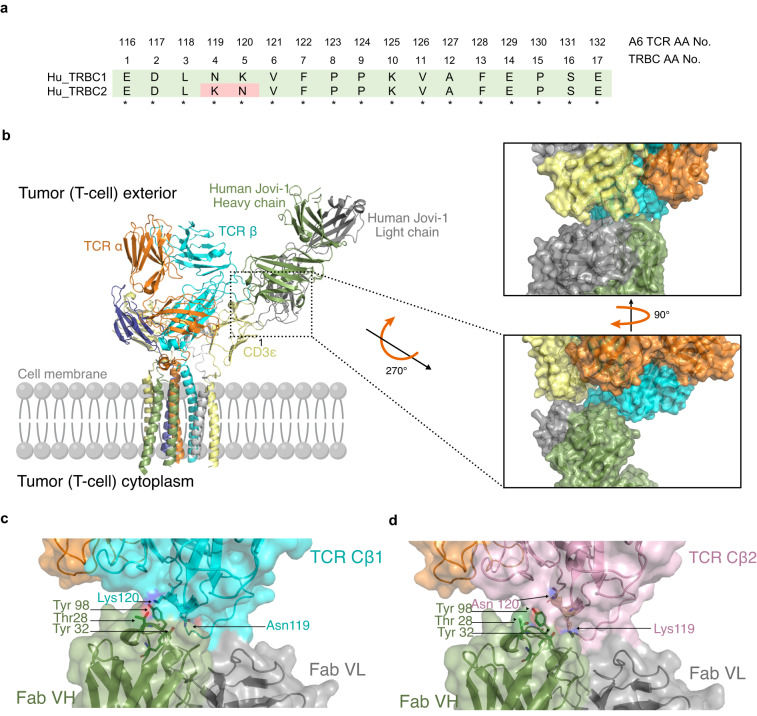 Fig. 1 Structural comparison of TRBC1/TRBC2 epitopes and binding mode of TRBC1-specific therapeutic antibody Jovi-1 with TCR-CD3 complex.1
The biological functions of TRBC are focused on TCR complex stabilization and CD3 signal coupling:
Creative Biolabs offers high-quality TRBC1 proteins through optimized expression systems, including full-length extracellular-membrane domain and isolated Ig constant domain variants. These products retain native TCR heterodimer assembly and CD3 binding biological activity, suitable for TCR structural interaction and T cell tumor biomarker screening. All TRBC1 proteins undergo strict quality control to ensure consistent performance and reliable application across diverse research platforms.
Not finding the membrane protein product you need? Contact us to start your one-stop custom service!
Creative Biolabs provides custom-engineered TRBC1 stable cell lines, including overexpression and blank control models. These cell lines are optimized for TCR complex profiling and T cell activation signal functional analysis. Each cell line undergoes stringent validation to ensure stable expression profiles and consistent functional performance in diverse experimental contexts.
Not finding the stable cell line product you need? Contact us to start your one-stop custom service!
High-specificity recombinant antibodies targeting TRBC1 are developed via advanced antibody engineering technologies, with no cross-reactivity with TRBC2 and other Ig superfamily subunits. These antibodies are validated for T cell membrane localization detection and lymphoid/tumor tissue expression profiling, and can be combined with CD3 detection reagents to analyze intact TCR-CD3 complexes in primary T cell models.
Not finding the recombinant antibody product you need? Contact us to start your one-stop custom service!
Beyond catalog products, Creative Biolabs offers specialized custom services for TRBC1 research:
TRBC1 is the TCR β constant domain that acts as scaffold to stabilize TCR heterodimer and recruit CD3 subunits for antigen-triggered T cell activation.
TRBC1 distinguishes T cell clonal populations and serves as specific biomarker for T cell hematological malignancies, critical for adaptive immunity research.
No, all TRBC1 products and services are strictly for research use only, not intended for clinical diagnosis or treatment.
Offerings include full-length TRBC1 membrane proteins, isoform-specific detection antibodies and custom stable cell lines for TCR research.
TRBC1 proteins are validated via TCR α chain heterodimer assembly and CD3 co-binding functional testing.