Creative Biolabs is offering the most comprehensive services for antibody development projects. With strict regulation and effective execution, we are dedicated to providing the most valuable solutions to complete your projects.
HighlightsCreative Biolabs is offering the most comprehensive services for antibody development projects. With strict regulation and effective execution, we are dedicated to providing the most valuable solutions to complete your projects.
HighlightsCreative Biolabs has established a broad range of platforms for developing novel antibodies or equivalents. These cutting-edge technologies enable our scientists to meet your demands from different aspects and tailor the most appropriate solution that contributes to the success of your projects.
HighlightsWith deep understanding in antibody-related realms and extensive project experience, Creative Biolabs offers a variety of references to help you learn more about our capacities and achievements, including infographic, flyer, case study, peer-reviewed publications, and all kinds of knowledge that can assist your projects. You are also welcome to contact us directly for more specific solutions.
HighlightsGet a real taste of Creative Biolabs, one of the most professional custom service providers in the world. We are committed to providing highly customized comprehensive solutions with the best quality to advance your projects.
Highlights Loading...
All listed services and products are For Research Use Only. Do Not use in any diagnostic or therapeutic applications.
T cell receptor delta constant (TRDC or TCRD) encodes the constant region of the T cell receptor delta chain, approximately 150–170 amino acids in length with an estimated molecular mass approaching 19 kDa, which may increase slightly due to N-linked glycosylation. TRDC serves as a structural component of the γδ T cell receptor, in which the delta chain pairs with the TCR gamma chain through a disulfide linkage to form the antigen-recognition heterodimer. The receptor complex then interacts with the CD3 signaling apparatus to transmit activation signals following ligand recognition. Antigen specificity is primarily determined by the variable regions and CDRs of the complete γδ TCR and varies among γδ T-cell subsets, which can recognize phosphoantigens, stress-induced ligands, and other molecular targets through distinct mechanisms. In contrast to conventional αβ T cells, which commonly depend on peptide recognition in the context of MHC molecules, γδ T cells bearing TRDC-containing receptors have a role at the junction of innate and adaptive immunity and can mount rapid responses without conventional peptide-MHC recognition. TRDC-expressing γδ T cells are especially prevalent at barriers of mucosal and epithelial tissues, such as the intestinal mucosa, skin, and reproductive system, where they contribute to first-line immune surveillance against infection and cellular stress. In oncological research, γδ T cells have demonstrated cytotoxic activity against hematologic malignancies, including acute myeloid leukemia and multiple myeloma, as well as solid tumor models such as neuroblastoma and renal cell carcinoma.
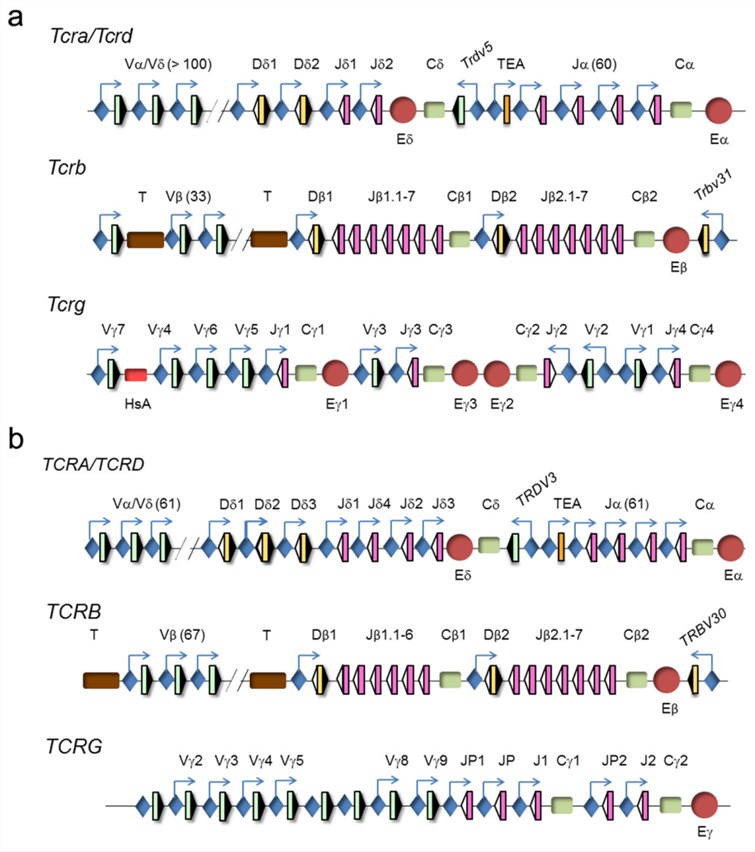 Fig.1 Genomic representation of mouse and human T-cell receptor (TCR) loci.1
TRDC regulates the various immunological pathways that extend beyond being a simple constant domain structure:
Our catalog features a validated collection of recombinant TRDC proteins designed to support T cell receptor structural biology, receptor-assembly studies, and related immunology research. Because appropriate immunoglobulin-fold topology, cysteine pairing, and structural integrity are important considerations for studies of γδ TCR assembly, our production strategies are selected according to the requirements of individual protein formats and downstream applications. The portfolio may include wild-type TRDC, engineered variants, and selected species orthologs for structural and comparative research. Specific expression systems, sequence modifications, formulation conditions, and quality-control specifications are provided according to the corresponding product datasheet or project requirements. These recombinant TRDC proteins provide research tools for structural characterization, protein interaction studies, and investigations of γδ TCR assembly.
Not finding the membrane protein product you need? Contact us to start your one-stop custom service!
Identifying cellular platforms that accurately recapitulate TRDC surface presentation and γδ TCR assembly is critical to unraveling innate-like immune recognition and advancing immunotherapeutics. Combining these two methods, we established a collection of TRDC stable cell lines that maintain true plasma membrane localization and correct pairing with TCR gamma at the heterodimeric level as well as functional cooperation among CD3 signaling components. In addition to constitutive wild-type TRDC, our collection includes cysteine-to-serine mutants that prevent interchain disulfide bonding interaction, naturally occurring polymorphisms impacting receptor stability and co-expression systems for reconstructing complete γδ TCR-CD3 complexes in one cell. In order to enable mechanistic interrogations of TRDC-driven signaling, we engineered reporter-coupled lines containing elements from the NFAT, NF-κB or IL-2 promoters driving luciferase, which allow for real-time quantification of TCR pathway activation in response to phosphoantigen- or antibody-mediated stimulation. For these purposes, complementary loss-of-function models (e.g., using shRNA-mediated knockdown or dominant-negative TRDC expression) are readily available for rescue experiments and synthetic lethality screening.
Not finding the stable cell line product you need? Contact us to start your one-stop custom service!
We offer a complete panel of TRDC recombinant antibodies with high-affinity that have been specifically developed to keep up with the need for robust research. Developed using modern recombinant technology platforms, they provide improved specificity, increased sensitivity and compared to standard polyclonal antibodies have enhanced batch-to-batch consistency. Our TRDC recombinant antibodies are validated in multiple applications including Western Blotting (WB), ELISA, Flow Cytometry (FCM), Immunofluorescence(IF),Immunocytochemistry; ICC and enough more which can help users to accurately detect the expression level of their target protein not only within peripheral blood mononuclear cells but also tumor-infiltrating lymphocytes, lymph node homogenates as well as cell lysate. We perform antibody labeling that can specifically identify the Cδ domain and full-length δ chain to profile γδ T cell subsets as well as distinct states of paired assembly by their associated TCR. Reagents against the DE loop, the connecting peptide domain and Cδ/CD3δ interface also provide high-quality tools for detailed studies of γδ TCR structure-function relations as well as pharmacological modulation.
Not finding the recombinant antibody product you need? Contact us to start your one-stop custom service!
In addition to our customized catalog offerings, Creative Biolabs provides contract protein engineering and antibody discovery services for TRDC-focused research programs:
Using the entire CD3 signaling machinery from separate loci have allowed us to create multi-stable lines contitutively expressing TRDC along with specific segments of T cell receptor, e.g.,TRDV. Through the batch-wise release of surface TCR density, phosphoantigen-stimulated calcium mobilization and consequent downstream ERK phosphorylation, we offer a standardized cellular platform that allows for continuous mechanistic investigation or pharmacological studies without requiring repeated transient transfection.
Yes, we provide recombinant proteins and stable cell lines containing characterized alternative splice variants as well as pathogenic substitutions that disrupt the TRDC-CD3 interaction interface or changing charge distribution across transmembrane.
Yes, the immunogen is within a highly conserved region of mammalian species and can easily be detected in human, mouse and rat lymphoid preparations or cell lysates without needing multiple reagents to detect different species.
No. All Creative Biolabs TRDC products and services for research use only.