Creative Biolabs is offering the most comprehensive services for antibody development projects. With strict regulation and effective execution, we are dedicated to providing the most valuable solutions to complete your projects.
HighlightsCreative Biolabs is offering the most comprehensive services for antibody development projects. With strict regulation and effective execution, we are dedicated to providing the most valuable solutions to complete your projects.
HighlightsCreative Biolabs has established a broad range of platforms for developing novel antibodies or equivalents. These cutting-edge technologies enable our scientists to meet your demands from different aspects and tailor the most appropriate solution that contributes to the success of your projects.
HighlightsWith deep understanding in antibody-related realms and extensive project experience, Creative Biolabs offers a variety of references to help you learn more about our capacities and achievements, including infographic, flyer, case study, peer-reviewed publications, and all kinds of knowledge that can assist your projects. You are also welcome to contact us directly for more specific solutions.
HighlightsGet a real taste of Creative Biolabs, one of the most professional custom service providers in the world. We are committed to providing highly customized comprehensive solutions with the best quality to advance your projects.
Highlights Loading...
All listed services and products are For Research Use Only. Do Not use in any diagnostic or therapeutic applications.
Thyrotropin-releasing hormone receptor (TRHR) is the cellular "on/off" switch that links the hypothalamus to the thyroid gland by the shortest endocrine chain of communication. It has a single ligand, a tripeptide—a very small molecule consisting of only three amino acids—which although extremely small, is the key component of a regulatory system that controls basal metabolic rates, growth, body temperature, and energy expenditure in almost all tissues. TRHR is expressed by thyrotroph cells located in the anterior pituitary. When the ligand binds to the receptor, G protein-coupled receptor (GPCR) activation occurs, leading to calcium release from internal stores and subsequent secretion of thyroid stimulating hormone (TSH) into the bloodstream. TSH travels via the blood to the thyroid gland; once there, TSH activates thyroid hormone production. Thyroid hormones travel back to the hypothalamus and pituitary to complete the negative feedback loop. Therefore, the entire axis depends upon the moment that three amino acids bind to TRHR. Due to its rapid desensitization properties, and its ability to resensitize through endocytic trafficking mechanisms, TRHR serves as an excellent experimental model for studying how GPCRs respond to repeated exposure to agonist. Furthermore, because of its small size, TRHR provides researchers with a useful template for developing analog compounds to study receptor function. There are few receptors that offer as many opportunities for exploring aspects of endocrinology, neurobiology, and pharmacology as TRHR does.
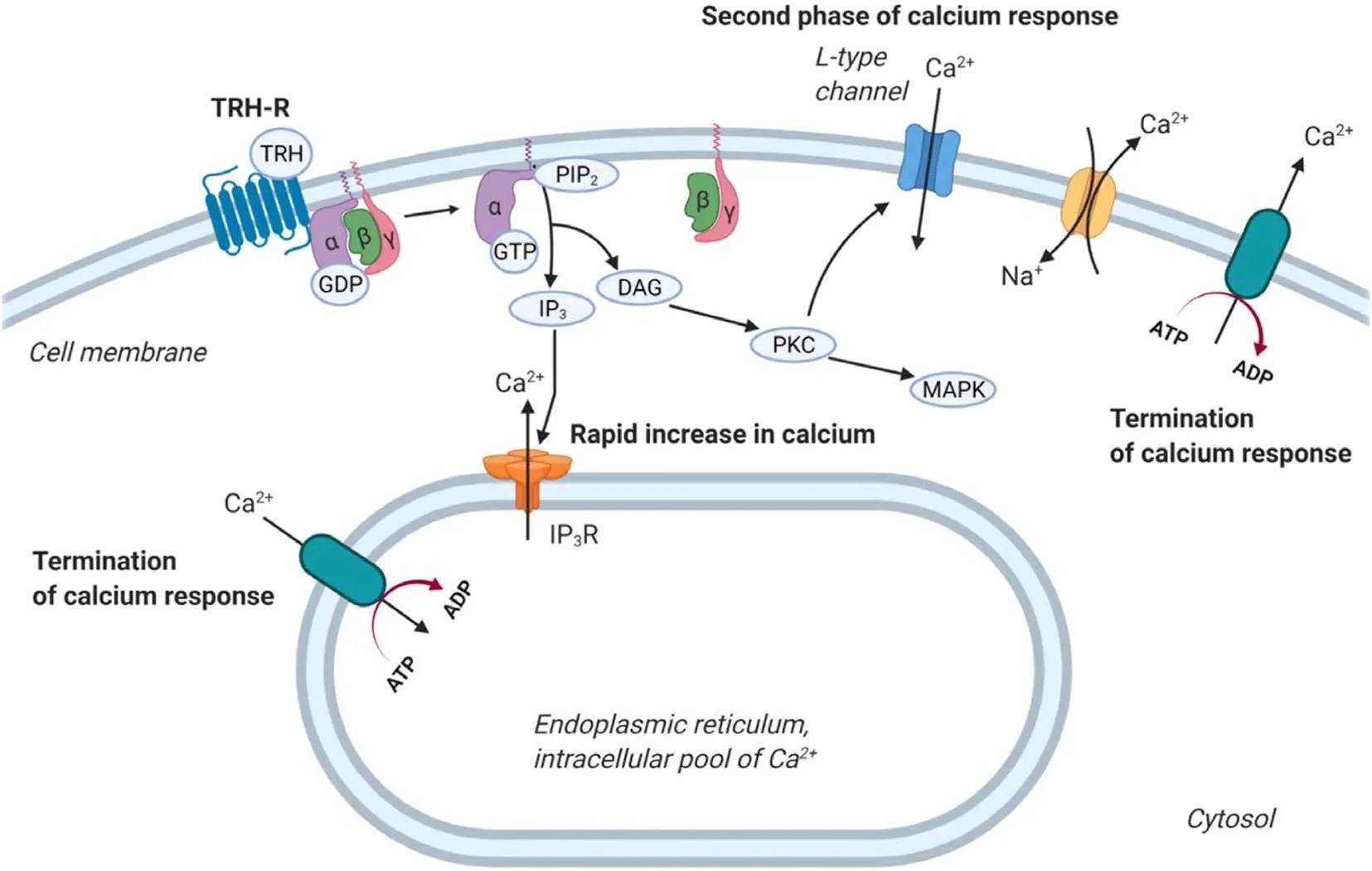 Fig.1 Regulation of calcium release by TRH receptor.1
Several research currents keep converging on this receptor:
In order for the production of credible TRHR to occur, you must preserve the tripeptide-responsive properties of the TRHR throughout the entire process of handling. If the preparation of the TRHR does not reach the assay with the original pocket geometry intact, then it will not respond to tripeptide binding as expected; this is the key characteristic of TRHR. We use optimized eukaryotic expression systems to produce full length TRHR, along with supporting the proper folding of the TRHR based on its transmembrane architecture. We also choose the most appropriate membrane format for the preservation of the pharmacological environment of the TRHR. To verify the purity of each preparation, we perform Release Testing using SDS-PAGE. If your study requires a specific desensitization state, a specific ligand condition, or a presentation that matches a specific binding or trafficking assay, we can alter the format of the preparation to match your protocol – i.e., the preparation follows the experimental design.
Not finding the membrane protein product you need? Contact us to start your one-stop custom service!
Cellular models for studying TRHR function have been developed based on two factors: the density of receptors expressed by cells and how effectively these receptors are able to traffic. A receptor that does not recover from desensitization after being stimulated multiple times is not representative of what happens when a cell is repeatedly stimulated. Researchers can use wild type overexpression cell lines as well as different receptor variants to study internalization and recycling kinetics. Each cell line used is characterized prior to use, so the behavior of each cell line is known before experiments are conducted. If you require a specific variant background, a certain level of density, or an expression timeline designed around the requirements of your experimental challenge protocol, then the platform can be customized to meet those needs; each cell line is created specifically for the experiment it will be used in.
Not finding the stable cell line product you need? Contact us to start your one-stop custom service!
The antibody work for TRHR has to deal with the issue of receptor density; thyrotrophs produce limited amounts of TRHR, therefore, clone performance must be sensitive enough to detect TRHR in low-expression systems as well as high-expression ones. This recombinant panel is being evaluated based upon its ability to perform with increased sensitivity. Additionally, because the clones are produced using a defined sequence, performance will remain consistent across lots. In addition to providing a flexible solution for projects that require different conjugates, validation with specific samples types, or adjustments to clone formats to accommodate a particular workflow, we can make those modifications available upon request.
Not finding the recombinant antibody product you need? Contact us to start your one-stop custom service!
Extending well beyond our standard catalog, we deliver fully customizable discovery and manufacturing solutions meticulously tailored to the sophisticated demands of TRHR-targeted research and precompound development:
The natural ligand is a tripeptide, which makes recognition chemistry unusually compact and assay conditions unusually consequential. Pocket integrity is the quality attribute on which everything else rests.
Its internalization and recycling kinetics are well characterized and experimentally accessible, making it a practical model for studying how GPCRs handle repeated stimulation.
All TRHR products and services are provided strictly for preclinical research. They are not designed, validated, or authorized for any use involving human subjects.
Central distribution ties the receptor to arousal, feeding, and mood-related programs, making it a bridge target between endocrine and neuroscience research territories.