
Creative Biolabs is offering the most comprehensive services for antibody development projects. With strict regulation and effective execution, we are dedicated to providing the most valuable solutions to complete your projects.
HighlightsCreative Biolabs is offering the most comprehensive services for antibody development projects. With strict regulation and effective execution, we are dedicated to providing the most valuable solutions to complete your projects.
HighlightsCreative Biolabs has established a broad range of platforms for developing novel antibodies or equivalents. These cutting-edge technologies enable our scientists to meet your demands from different aspects and tailor the most appropriate solution that contributes to the success of your projects.
HighlightsWith deep understanding in antibody-related realms and extensive project experience, Creative Biolabs offers a variety of references to help you learn more about our capacities and achievements, including infographic, flyer, case study, peer-reviewed publications, and all kinds of knowledge that can assist your projects. You are also welcome to contact us directly for more specific solutions.
HighlightsGet a real taste of Creative Biolabs, one of the most professional custom service providers in the world. We are committed to providing highly customized comprehensive solutions with the best quality to advance your projects.
Highlights Loading...
All listed services and products are For Research Use Only. Do Not use in any diagnostic or therapeutic applications.
Transient receptor potential melastatin 3 (TRPM3) is a calcium-permeable, non-selective cation channel in the large family of TRP channels and more specifically belongs to the melastatin-related subfamily. The channel has a homotetrameric assembly, and each subunit is estimated to be about 1555 amino acids long with the classical TRP architecture, including six transmembrane segments (S1–S6), a pore loop between S5 and S6, intracellular N- and C-terminal regions, as well as a coiled-coil domain at the distal C terminus that facilitates tetrameric assembly. The N-terminal region is intracellular and contains conserved melastatin homology regions, while the C-terminal tail contains the TRP domain and additional regulatory regions involved in channel function and assembly. This modular architecture allows the integration of several activating stimuli, such as heat, chemical ligands, and intracellular signaling molecules. TRPM3 expression is highly enriched in small-diameter nociceptive neurons of the dorsal root ganglia (DRG) and trigeminal ganglia, where it mediates noxious heat sensing and promotes inflammatory thermal hyperalgesia. In addition to expression in the central nervous system, including the hippocampus, cerebellum, and choroid plexus, TRPM3 is also present in pancreatic β-cells, kidney, and the palpebral conjunctiva of the eye. Knockout studies emphasize the physiological importance of TRPM3 in pain signaling: mice lacking this channel show reduced responses to noxious heat and impaired inflammatory heat hyperalgesia, while core body temperature remains largely unaffected.
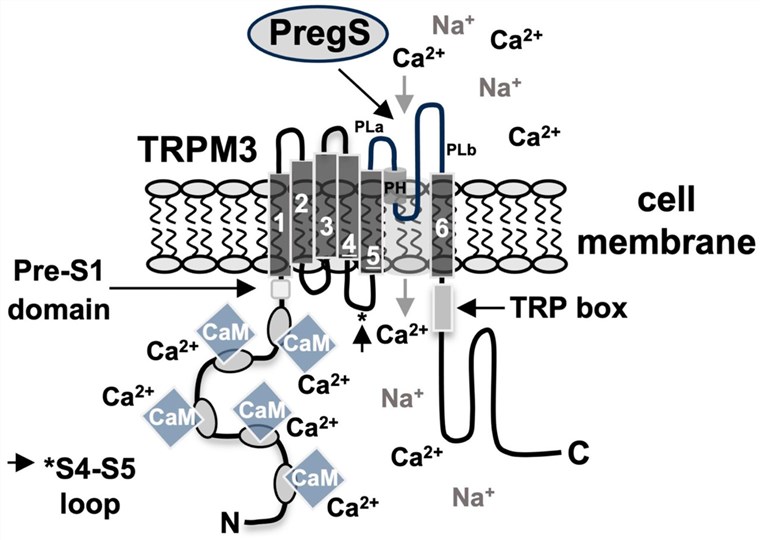 Fig.1 Domain structure of TRPM3 channels.1
The TRPM3 functional repertoire covers a wide range of physiological and pathological areas:
The large size of the TRPM3 channel, its tetrameric assembly, polymodal gating, and dependence on an appropriate membrane environment for correct folding complicate structural and pharmacological studies of this pathway. Creative Biolabs has developed a custom TRPM3 protein design platform that provides membrane protein constructs for structural biology, ligand-binding studies, channel research, and antibody-related research. Structural insights and codon-optimized gene synthesis are used by our engineering team to develop constructs tailored to specific experimental requirements while considering key structural and functional features of TRPM3. Each engagement starts with a technical consultation to align the protein design with your specific research needs. Specific conformational strategies, preparation formats, and structural or functional assays are determined according to individual project requirements.
Not finding the membrane protein product you need? Contact us to start your one-stop custom service!
Functional TRPM3 that expresses well in cellular models, and predominantly at the plasma membrane are vital for calcium influx assays, electrophysiology, inhibitor screening and heat–sensing studies. Creative Biolabs engineered custom TRPM3 stable cell lines using optimized transduction and selection protocols that generate a homogenous, long-term expression of the channel. Our cell engineering platform relies on lentiviral delivery, transposon-mediated integration and gene knock-in methods for control with precision. Monoclonal selection is performed on each line and they are phenotypically validated for clonal purity as well as surface channel density and responsiveness to heat, PregS, or CIM0216 stimulation.
Not finding the stable cell line product you need? Contact us to start your one-stop custom service!
Antibodies to the extracellular epitopes of TRPM3 locked at high efficacy are pivotal for the detection, surface mapping and modulation of channel gating. Creative Biolabs enables end-to-end recombinant antibody discovery programs against membrane protein targets with confirmed extracellular loops and conformational TRPM3 epitopes. Our antibody development pipeline delivers binders with the specificity, affinity and developability profiles needed for research diagnostic or therapeutic applications through integrated immunogen design targeting at a range of multi-platform selection methodologies to assigned downstream engineering. Utilizing recombinant expression and clonal sequencing, we generate a renewable fully characterized reagent free of batch-to-batch variability normally present in polyclonal sera.
Not finding the recombinant antibody product you need? Contact us to start your one-stop custom service!
Stretching beyond typical catalog products, Creative Biolabs provides comprehensive discovery resources spanning the entire TRPM3 research landscape:
No, no reagents or services offered are intended for use in diagnostic applications or therapeutic use, as all data is provided only for research purposes.
Yes. Relative to other TRP channels, solvation properties are less known so here we engineered dual-stable lines from independent loci constitutively expressing full-length TRPM3 along with a bright high-affinity fluorescent calcium reporter.
Yes. When tested on lightly fixed neural and endocrine preparations, the selected clones gave specific plasma membrane staining patterns corresponding to known distributions of nociceptive neuron, β-cell, and epithelial. Validation comprises peptide competition and recombinant antigen absorption to verify that the epitope recognized by a mAb is preserved on various tissue matrices.
Yes. The protein is provided in a mild, non-ionic detergent buffer that maintains the native transmembrane fold and allows for direct exchange into synthetic lipid environments suitable for any biophysical or functional assay.








