
Creative Biolabs is offering the most comprehensive services for antibody development projects. With strict regulation and effective execution, we are dedicated to providing the most valuable solutions to complete your projects.
HighlightsCreative Biolabs is offering the most comprehensive services for antibody development projects. With strict regulation and effective execution, we are dedicated to providing the most valuable solutions to complete your projects.
HighlightsCreative Biolabs has established a broad range of platforms for developing novel antibodies or equivalents. These cutting-edge technologies enable our scientists to meet your demands from different aspects and tailor the most appropriate solution that contributes to the success of your projects.
HighlightsWith deep understanding in antibody-related realms and extensive project experience, Creative Biolabs offers a variety of references to help you learn more about our capacities and achievements, including infographic, flyer, case study, peer-reviewed publications, and all kinds of knowledge that can assist your projects. You are also welcome to contact us directly for more specific solutions.
HighlightsGet a real taste of Creative Biolabs, one of the most professional custom service providers in the world. We are committed to providing highly customized comprehensive solutions with the best quality to advance your projects.
Highlights Loading...
All listed services and products are For Research Use Only. Do Not use in any diagnostic or therapeutic applications.
MCOLN1/TRPML1 is a six-transmembrane endolysosomal cation channel encoded by MCOLN1. Tetrameric assembly within lysosomal compartments is required for channel activity; channel gating is directly modulated by lysosomal PI(3,5)P₂, while luminal pH and membrane lipids act as auxiliary regulatory factors under distinct cellular states. This channel protein can be detected across multiple epithelial and secretory cell groups with abundant lysosomal structures.
The protein mediates cation efflux from lysosomal compartments to cytoplasmic regions, regulating a series of downstream signaling events associated with intracellular membrane transport and autophagic progression. Cation release via assembled TRPML1 complexes may activate the calcineurin-TFEB signaling cascade, which can modulate transcriptional programs linked to lysosomal biogenesis and intracellular substance clearance. Complete tetramer assembly is necessary to maintain steady cation transfer across lysosomal boundary structures.
Perturbation of MCOLN1 expression or channel functionality may disrupt lysosomal cation balance and substance degradation, which has been associated with abnormal intracellular substrate accumulation in relevant pathological models. In existing research, this channel serves as a common research target for exploring lysosomal ion transport and autophagy-related biological processes.
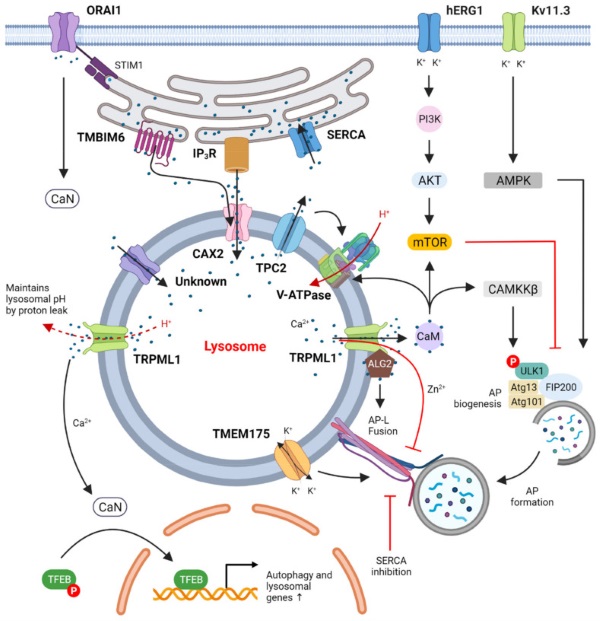 Fig. 1 Schematic of lysosomal ion‑dependent signaling networks. The TRPML1‑driven cation efflux‑calcineurin‑TFEB cascade facilitates lysosomal biogenesis and autophagic turnover.1
The documented biological activities of TRPML1 center on lysosomal channel complex formation, intracellular cation signal transmission and cellular metabolic equilibrium:
Creative Biolabs offers purified TRPML1 membrane samples via standardized expression workflows, including full-length MCOLN1/TRPML1 constructs and isolated luminal structural variants with modified glycosylation profiles. Isolated luminal structural fragments cannot form complete transmembrane assemblies and do not sustain cation permeability or autophagy-/TFEB related regulatory behaviors. Full-length constructs can be applied to lysosomal ion transport research, while truncated fragments fit structural and binding-related research projects. All samples undergo standardized internal quality screening; assessments targeting channel-associated behaviors are conducted exclusively with full-length constructs in simulated lysosomal membrane environments.
Not finding the membrane protein product you need? Contact us to start your one-stop custom service!
Creative Biolabs provides customizable cell models with modified TRPML1 expression levels, applicable to research exploring channel assembly, lysosomal signal cascades and lysosomal regulatory molecule screening. Sample characterization covers steady expression identification and general channel function assessment.
Not finding the stable cell line product you need? Contact us to start your one-stop custom service!
Not finding the recombinant antibody product you need? Contact us to start your one-stop custom service!
Beyond standard catalog reagents, Creative Biolabs offers tailored analytical support centered on TRPML1 related laboratory exploration:
TRPML1 is an endolysosomal mucolipin TRP cation channel subunit that forms tetrameric channels in endolysosomal and lysosomal limiting membranes to regulate ion flux, maintain lysosomal homeostasis, and support autophagic cargo processing and clearance following PI(3,5)P₂-dependent channel activation.
TRPML1 serves as a major regulatory mediator of lysosomal metal homeostasis and autophagic degradative signaling; its dysfunction drives intracellular substrate buildup and lysosomal storage lesions, rendering it a vital research object for lysosomal TRP channel and metabolic disorder investigations.
No, all TRPML1 products and services are strictly for research use only, not intended for clinical diagnosis or treatment.
Offerings include TRPML1 proteins (full-length, luminal pore domain variants), specific recombinant antibodies, and custom stable cell research models, supporting lysosomal metal transport and storage disorder research.
Laboratory analytical workflows cover TRPML channel oligomer binding assays and tests measuring lysosomal clearance signal regulation, to assess native channel performance in lysosomal transport research.








