Creative Biolabs is offering the most comprehensive services for antibody development projects. With strict regulation and effective execution, we are dedicated to providing the most valuable solutions to complete your projects.
HighlightsCreative Biolabs is offering the most comprehensive services for antibody development projects. With strict regulation and effective execution, we are dedicated to providing the most valuable solutions to complete your projects.
HighlightsCreative Biolabs has established a broad range of platforms for developing novel antibodies or equivalents. These cutting-edge technologies enable our scientists to meet your demands from different aspects and tailor the most appropriate solution that contributes to the success of your projects.
HighlightsWith deep understanding in antibody-related realms and extensive project experience, Creative Biolabs offers a variety of references to help you learn more about our capacities and achievements, including infographic, flyer, case study, peer-reviewed publications, and all kinds of knowledge that can assist your projects. You are also welcome to contact us directly for more specific solutions.
HighlightsGet a real taste of Creative Biolabs, one of the most professional custom service providers in the world. We are committed to providing highly customized comprehensive solutions with the best quality to advance your projects.
Highlights Loading...
All listed services and products are For Research Use Only. Do Not use in any diagnostic or therapeutic applications.
Upstream binding transcription factor (UBTF, also known as UBF) is a high-abundance nucleolar HMG box chromatin scaffold protein encoded by UBTF gene, which is continuously constitutively expressed in all mammalian proliferative cells and mainly enriched in tandem ribosomal DNA repeat sites in nucleolar tissue regions. Different from the conventional transcription factors targeting RNA polymerase II, UBTF specifically mediates the assembly of RNA polymerase I pre-initiation complex, leads the efficient transcription and synthesis of ribosomal precursor RNA, regulates some histone Pol II transcription genes that are key to cell division, and participates in cell proliferation regulation in multiple dimensions. Under the physiological state of resting and low proliferation of cells, low level of UBTF can limit the rate of ribosome biogenesis, reduce the level of cell metabolic turnover and maintain cell homeostasis; However, in the environment stimulated by mitogen or activated by carcinogenic signal, the expression of UBTF is significantly up-regulated, which greatly enhances the transcription efficiency of rDNA and the ribosome synthesis reserve, providing sufficient material basis for the rapid and infinite proliferation of tumor cells. In addition, the new functional acquired mutation of UBTF will destroy the normal structure of nucleolar chromatin and induce progressive neurodegeneration in children. Other HMG family proteins can't compensate the exclusive function of rDNA chromatin remodeling and transcription regulation of UBTF. Knocking down UBTF can effectively block the proliferation of tumor cells, while pathogenic UBTF mutation will break the ribosome homeostasis of neurons, which is an irreplaceable core target for the study of nucleolar transcription mechanism and targeted screening of anti-proliferative diseases.
UBTF is anchored at the repeated chromatin site of rDNA, and at the same time, it plays the dual functions of nucleolar chromatin scaffold and Pol I transcription co-activator. By bending the DNA configuration of ribosome promoter with multiple HMG box domains in series, SL1 initiation complex is recruited to complete the transcription initiation assembly. It targets the specific binding characteristics of rDNA repeats and forms a clear functional differentiation with broad-spectrum nuclear localization HMG protein, which is the core molecular switch for regulating cell ribosome biogenesis. UBTF-mediated precursor rRNA transcription process can accurately couple extracellular proliferation signal with cell ribosome supply level, and dynamically balance cell proliferation ability and neuronal translation steady state according to cell cycle state. This molecule is widely involved in many physiological and pathological processes, such as the establishment of nucleolar structure, the proliferation and growth of tumor cells and the maintenance of the steady state of children's neural development. Abnormal expression of UBTF function will dismantle the rDNA transcription core complex, directly block the cell cycle process and inhibit cell proliferation and metabolism. To sum up, UBTF is the key core target for the mechanism research of nucleolar transcription factor and the targeted therapy of proliferative disorders.
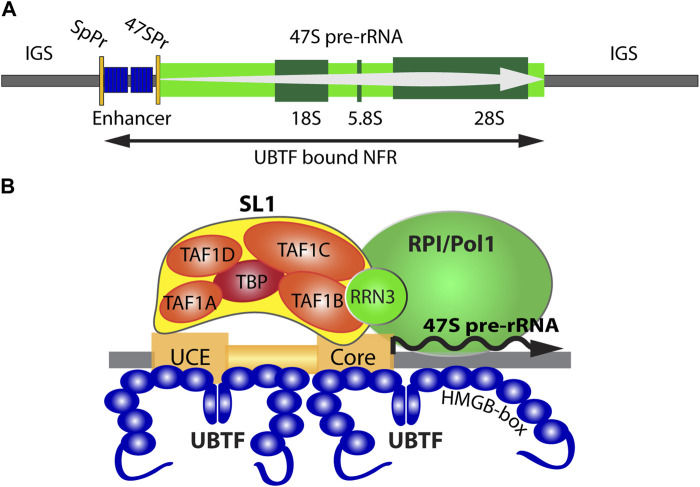 Fig. 1 Schematic of UBTF-mediated rDNA transcription and RNA polymerase I pre-initiation complex assembly.1
The biological functions of UBTF are fully focused on rDNA promoter scaffolding and RNA Pol I activation:
Creative Biolabs offers high-quality UBTF proteins through optimized eukaryotic expression systems, including full-length nucleolar isoform and isolated HMG-box tandem domain variants. These products retain native rDNA chromatin binding and Pol I co-activation activity, suitable for ribosome biogenesis and anti-tumor proliferative screening assays. All UBTF proteins undergo strict quality control to ensure consistent performance and reliable application across nucleolar research platforms.
Not finding the protein product you need? Contact us to start your one-stop custom service!
Creative Biolabs provides custom-engineered UBTF stable cell lines, including oncogenic overexpression and blank empty vector control models. These cell lines are optimized for nucleolar transcription factor profiling and cell cycle functional analysis. Each cell line undergoes stringent validation to ensure stable expression profiles during long-term proliferative cell culture, and can be widely deployed for anti-proliferative drug screening workflows.
Not finding the stable cell line product you need? Contact us to start your one-stop custom service!
High-specificity recombinant antibodies targeting UBTF are developed via advanced antibody engineering technologies, with no cross-reactivity with other nuclear HMG-box transcription factors. These antibodies are validated for nucleolar localization detection and tumor/neuronal tissue expression profiling, and can be combined with Pol I marker reagents to analyze intact rDNA transcription complexes in cell models.
Not finding the recombinant antibody product you need? Contact us to start your one-stop custom service!
Beyond catalog products, Creative Biolabs offers specialized custom services for UBTF research:
UBTF is a nucleolar HMG factor that remodels rDNA chromatin and activates RNA Pol I ribosomal RNA transcription.
UBTF drives tumor proliferation and its pathogenic variants trigger childhood neurodegenerative disease.
No, all UBTF products and services are strictly for research use only, not intended for clinical diagnosis or treatment.
Offerings include full-length nucleolar UBTF transcription factors, isoform-specific detection antibodies and custom stable cell lines for ribosome research.
UBTF proteins are validated via rDNA chromatin binding and pre-rRNA transcriptional testing.